

Wire EDM
Sparks from a thin moving wire cut through-profiles
Wire EDM (electrical discharge machining) cuts metal with a thin brass wire that never touches it: thousands of tiny electric sparks per second jump from the wire and erode the metal away. It makes the precise openings in punching and stamping dies, gear and spline profiles, and fine slots in hardened steel. Because the wire does no pushing, hardness does not matter, and accuracy reaches a few thousandths of a millimeter.
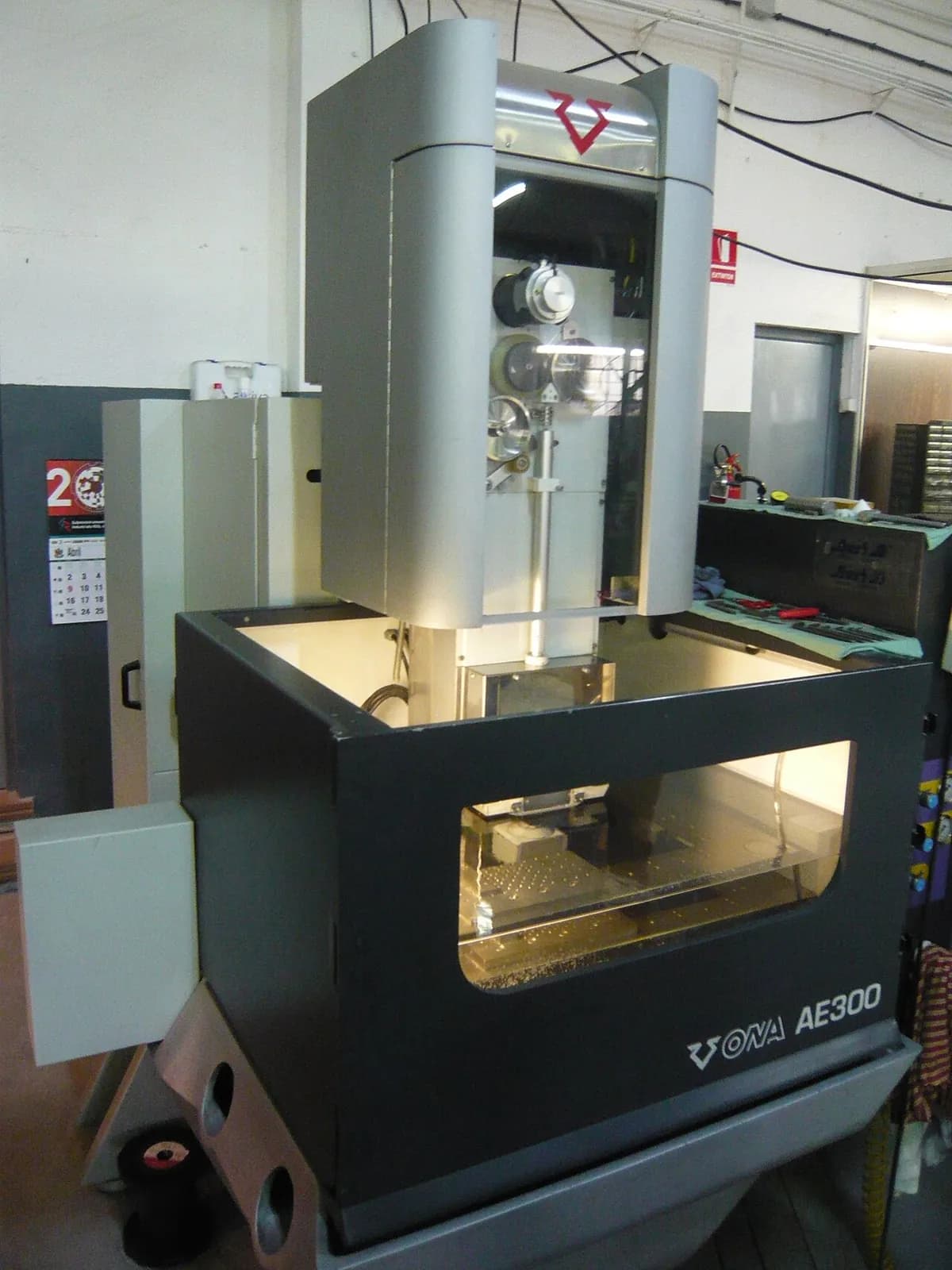
How it works
Feed the wire. A brass wire, typically about 0.25 mm thick, unwinds from a spool and runs through the part at a steady speed, so fresh wire always does the cutting.
Guide it. Precision guides (often diamond) above and below the part hold the wire straight and taut. Tilting the guides relative to each other cuts tapered walls.
Spark. A pulse generator applies short voltage pulses between the wire (negative) and the part (positive). Sparks jump the tiny gap, each melting and vaporizing a microscopic crater.
Flush. The part sits in deionized water (water with its minerals removed so it barely conducts). It insulates the gap until each spark, cools the cut and flushes away debris.
Follow the outline. The CNC table moves the part so the wire traces the contour, starting from the edge or from a drilled start hole; used wire goes to a bin. When the loop closes, the inner piece drops free.
For the best accuracy, the machine usually follows the first cut with one to several lighter skim cuts that smooth the wall and correct its size.
Key facts
- Materials
- Any electrically conductive material, especially hard ones: hardened tool steel, carbide, titanium, nickel alloys, copper, graphite
- Typical parts
- Punches and die openings, gears and splines, extrusion dies, medical and aerospace parts, fine slots
- Part size
- Through-cuts in plates up to about 300 mm thick; wire from about 0.02 to 0.3 mm
- Precision
- Very high: down to a few micrometers (thousandths of a millimeter) with skim cuts
- Surface finish
- Fine, matte, slightly frosted surface; very smooth after skim cuts
- Batch size it suits
- One-offs and small series: tooling, prototypes, high-value parts
- Tooling and machine cost
- No part-specific tooling; wire is used up; machines cost from tens to hundreds of thousands of dollars
- Speed
- Slow: often minutes to hours per part; machines run unattended overnight
Strengths and limits
Strengths
- Very high accuracy and sharp inside corners
- Hardness does not matter, so parts can be cut after hardening
- No cutting force: thin, delicate walls do not bend
- Thick plates and tapered walls in one setup
Limits
- Slow compared with milling or laser
- Only electrically conductive materials
- Only through-cuts: the wire must pass all the way through
- Wire is consumed; the surface layer is slightly altered by heat
Where it's used
- Tool and die makingPunch and die sets, stamping and extrusion dies
- AerospaceTurbine disc slots, fir-tree roots, nickel-alloy parts
- MedicalSurgical tools and implant parts in titanium
- MachineryGears, splines, keyways in hardened shafts and hubs
- ElectronicsLead-frame dies and fine connector tooling
How to recognize it
- A uniform matte, frosted gray surface with no tool marks or directional lines.
- Very sharp inside corners with only a tiny radius, about half the wire thickness.
- Perfectly parallel or precisely tapered walls in thick, hard parts such as die blocks.
- Sometimes a tiny witness mark where the cut started and ended.
Compare with
Watch it
RAPID DIRECT · An animated look at the spark gap and the process
wireedmguy · An operator explains the wire, guides and water
ReliableEDM · Typical parts and why shops choose wire EDM
TITANS of CNC MACHINING · A real shop machine at work, and a slug falling out
See real photos
- Wikipedia: Electrical discharge machining — overview with a wire EDM section (wire, deionized water, guides) and history
- Wikimedia Commons photo search
Remember
- The wire never touches the part: sparks across a tiny gap erode the metal.
- Hardness does not matter, and accuracy reaches a few micrometers.
- Slow and limited to conductive through-cuts, so it is kept for precise, hard or high-value parts.
More in Cutting and non-traditional machining
All 100 processes
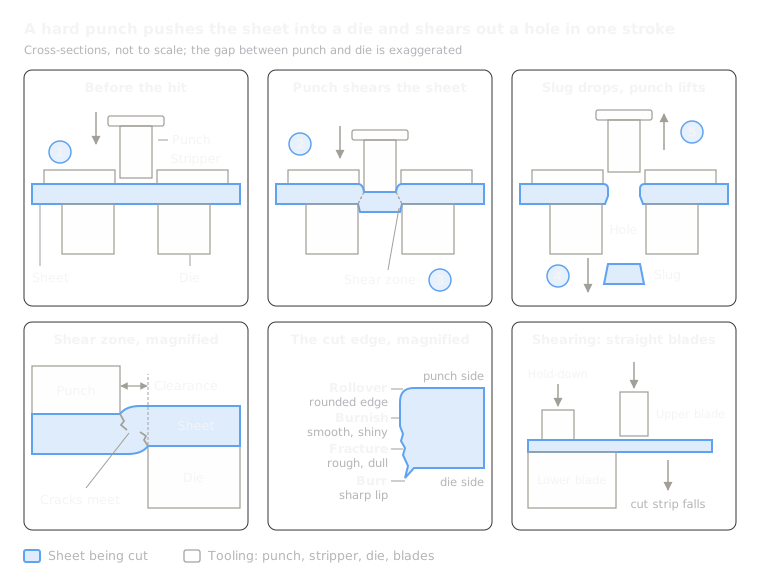 6.1Punching and shearingA punch shears shapes out of sheet against a dieOpen the lesson
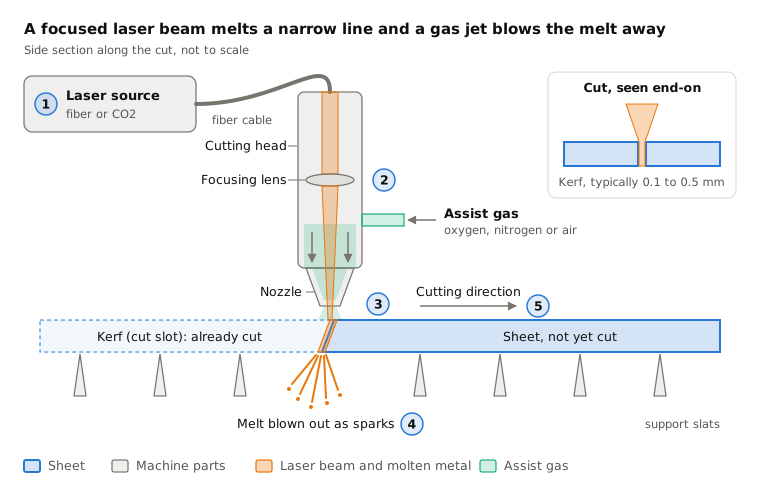
 6.2Laser cuttingFocused light melts or vaporizes a narrow cutOpen the lesson
 6.3Plasma cuttingA superheated gas jet melts through conductive plateOpen the lesson
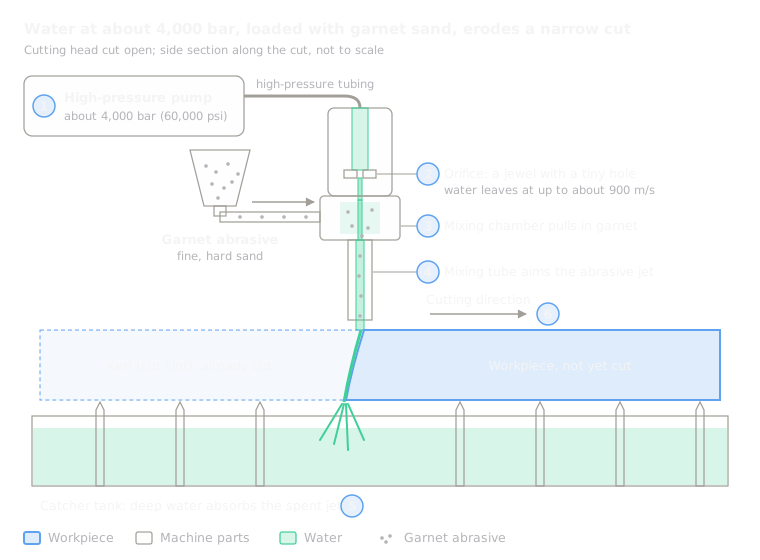 6.4Waterjet cuttingVery high-pressure water, usually with abrasive, erodes a cutOpen the lesson
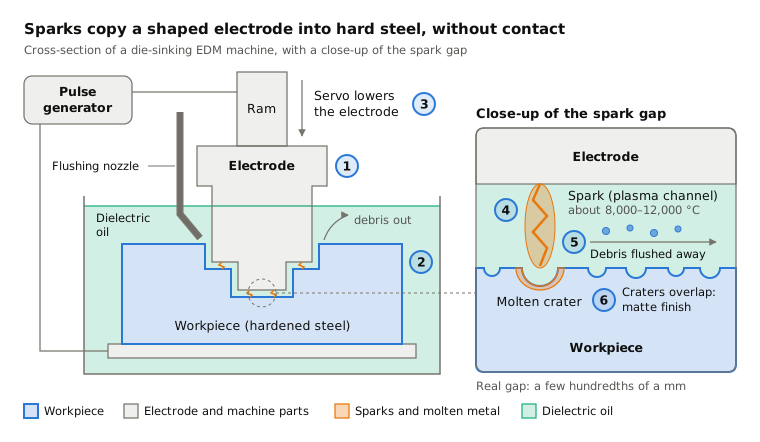
 6.6Sinker EDMSparks copy a shaped electrode into a blind cavityOpen the lesson
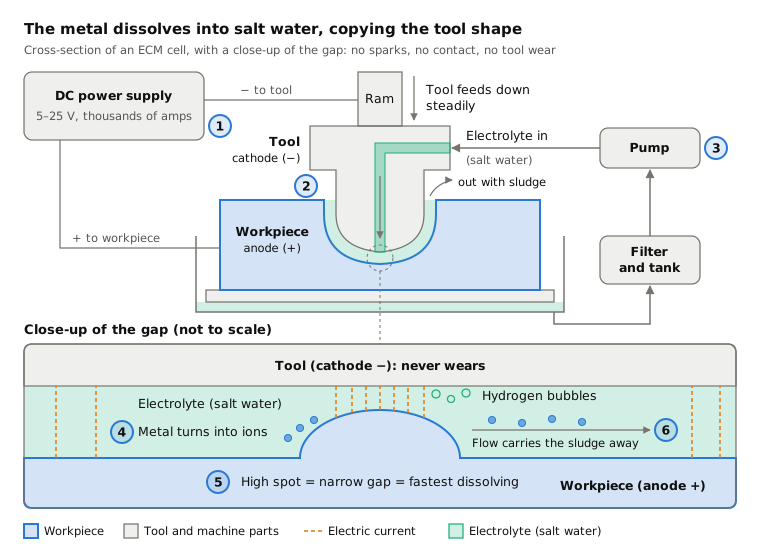
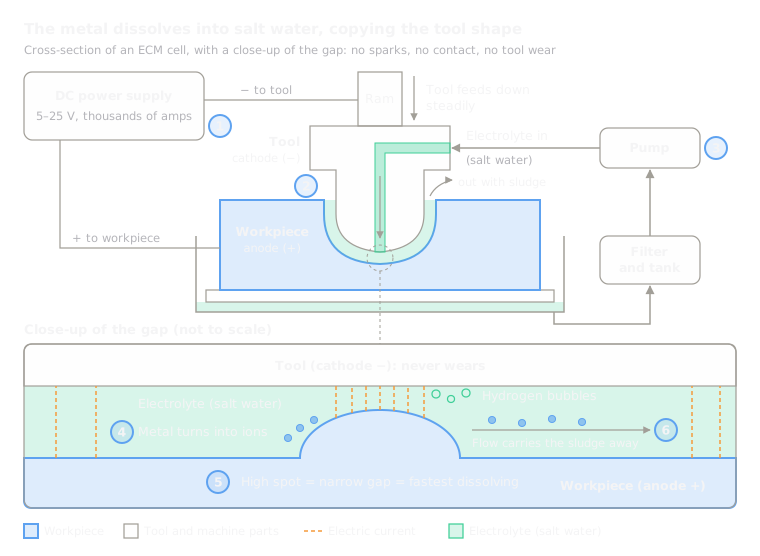 6.7Electrochemical machining (ECM)Electrolysis dissolves metal in the shape of the toolOpen the lesson
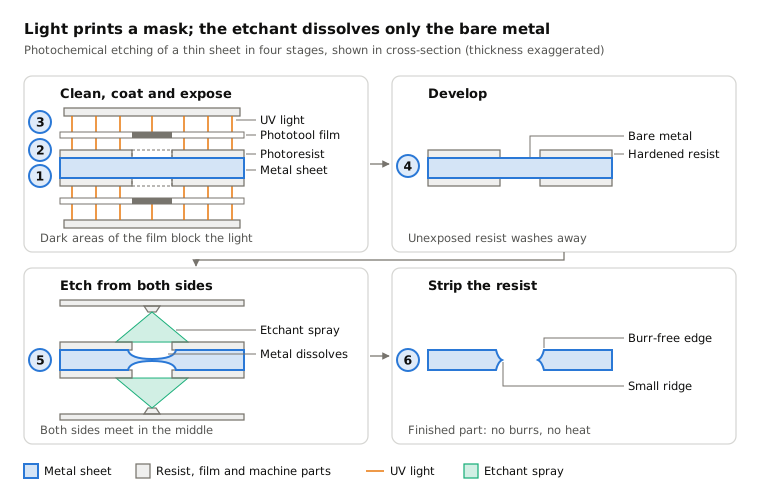
 6.8Chemical machining and photochemical etchingA light-printed mask lets an etchant dissolve only bare metalOpen the lesson
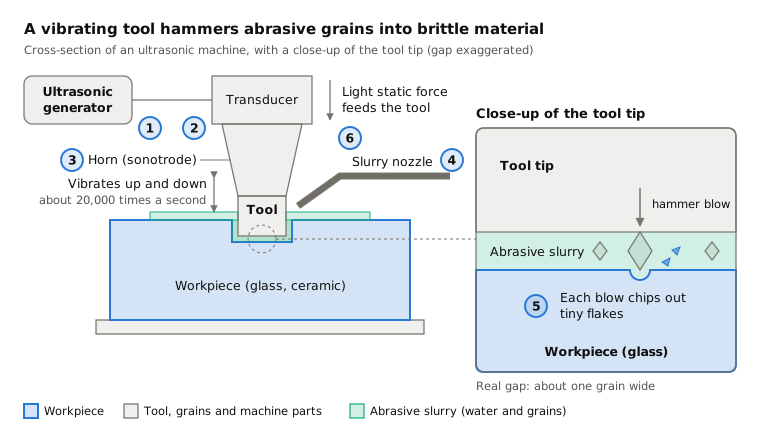
 6.9Ultrasonic machiningA vibrating tool hammers abrasive grains into the surfaceOpen the lesson
Try it
Put AI to work in your CAD.
Model parts, generate drawings and automate the repetitive work inside your CAD software.