

Punching and shearing
A punch shears shapes out of sheet against a die
Punching cuts holes and shapes in sheet metal by forcing a hard punch through the sheet into a matching die. The slots in a steel shelving upright and the holes in a perforated grille were made this way, one stroke per hole. Shearing is the same cut made along a straight line by two long blades, and it is how most sheet is cut to size.
How it works
Clamp. The sheet lies on the die (the lower tool: a hardened block with an opening shaped like the hole). The stripper, a plate around the punch, presses the sheet flat.
Press. The punch (the upper tool: a hardened steel rod with the shape of the hole) comes down and pushes the metal into the die opening. The edge first bends and rounds over.
Shear and crack. The sharp edges cut a smooth band into the metal. Then cracks start at the punch edge and the die edge and run toward each other across the clearance (the small gap between punch and die).
Break through. When the cracks meet, the cut-out disc, called the slug, breaks free and is pushed down through the die as scrap.
Strip and move. The punch lifts while the stripper holds the sheet down. On a CNC turret punch press (a computer-controlled machine with a rotating magazine of punches), the table then slides the sheet to the next hole.
Shearing
Shearing (bottom right) applies the same action along a straight line. A hold-down clamps the sheet, and a long upper blade comes down just past a fixed lower blade. The upper blade is usually tilted slightly, so it cuts progressively along the line, like scissors. An adjustable stop behind the blades, the back gauge, sets the width of the strip.
Key facts
- Materials
- Sheet steel, stainless steel, aluminum, copper and brass; also plastics, leather and gasket sheet with simpler tools
- Typical parts
- Electrical cabinets, brackets, chassis panels, perforated screens, washers, shelving uprights
- Part size
- Sheet usually up to about 6 mm thick; CNC turret presses take sheets up to roughly 1.5 × 3 m
- Precision
- About ±0.1 mm on a CNC turret press
- Surface finish
- Faces untouched; the cut edge has a shiny band, a rough band and a small burr (a sharp raised lip)
- Batch size it suits
- Prototypes to large series with standard tools; dedicated dies pay off in mass production
- Tooling and machine cost
- Standard punch-and-die sets cost tens to hundreds of dollars each; a CNC turret press costs hundreds of thousands
- Speed
- One stroke per hole, often several hundred strokes per minute
Strengths and limits
Strengths
- Very fast: one stroke per hole
- Low cost per hole; standard tools cover common shapes
- No heat, so the metal around the hole is unchanged
- The same machine can also form louvers (raised vent slots) and stiffening ribs
Limits
- Each hole shape needs its own punch and die
- Sheet only, usually up to about 6 mm thick
- The edge is partly rough and carries a burr
- Holes narrower than about the sheet thickness can break the punch
Where it's used
- ElectricalControl cabinets, junction boxes, knock-outs for cable entries
- Building and furnitureShelving uprights, perforated facade panels, ceiling grid parts
- Appliances and air handlingOven and washer housings, vent grilles, duct parts
- Electronics and ITServer racks, computer chassis, shielding plates
- AutomotiveBrackets and reinforcements; sheared blanks for stamped body panels
How to recognize it
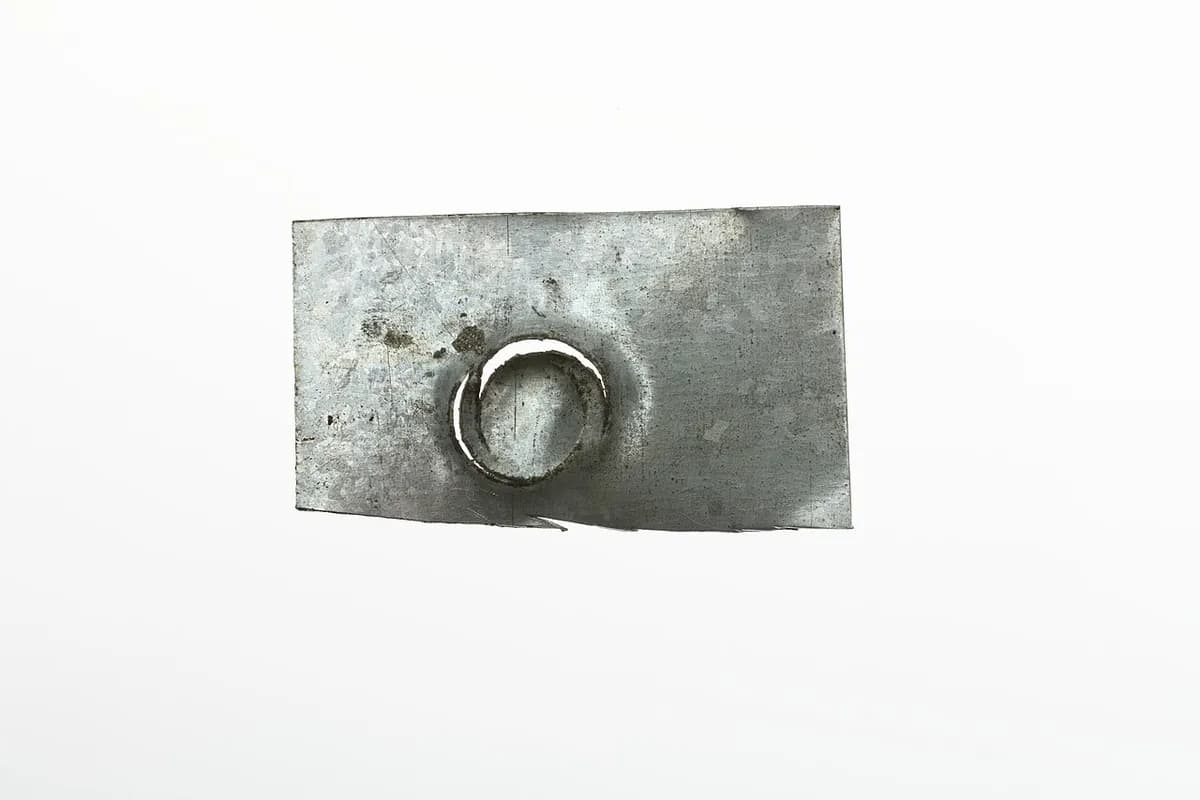
- The hole wall has a shiny band near one face and a duller, rougher band near the other.
- One face shows a slightly rounded hole edge; the other face has a small, sharp burr.
- Large outlines with a faint scalloped edge come from nibbling: many small, overlapping hits.
- Rows of identical holes, slots or louvers, and knock-outs (part-cut discs you break out for cables).
Compare with
Watch it
Roy Manufacturing · A beginner's tour of a CNC turret punch and its tools
Headland Technology · The machine's parts, taken apart in an animation
TRUMPF Inc. · Close-ups of the punching head and its tools at work
NCTOOLS CADCAM · A sheet perforated with long rows of holes
See real photos
- Wikipedia: Punching — the principle, with photos of hand punches and an industrial punch press
- Wikipedia: Shearing (manufacturing) — overview of straight-blade shearing
- Wikimedia Commons photo search
Remember
- A punch and die cut by shearing: the metal bends, is cut partway, then cracks through.
- The clearance between punch and die sets the edge quality and the size of the burr.
- Punching is the fastest way to make many holes in sheet; shearing does the same along a straight line.
More in Cutting and non-traditional machining
All 100 processes
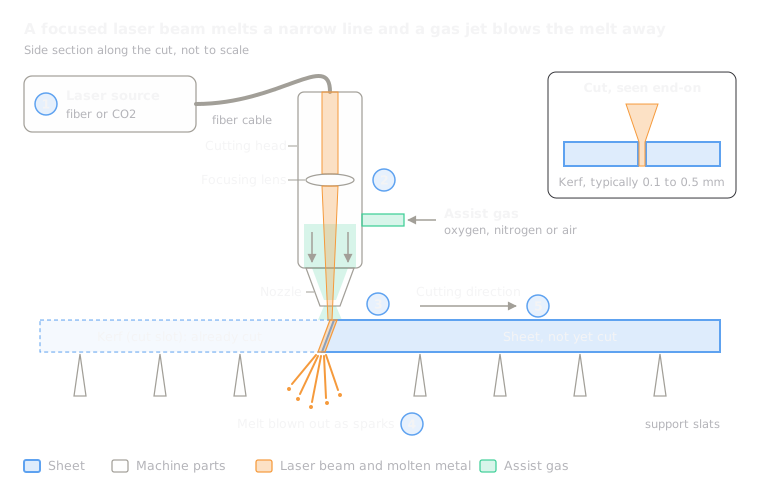 6.2Laser cuttingFocused light melts or vaporizes a narrow cutOpen the lesson
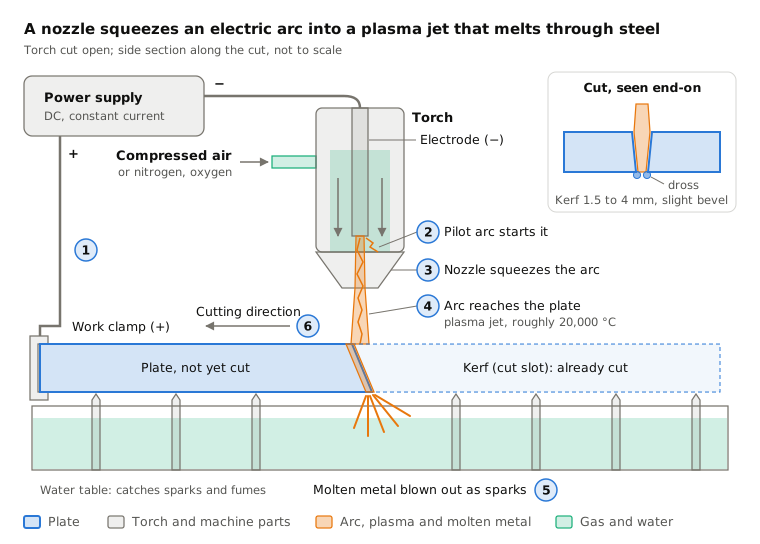
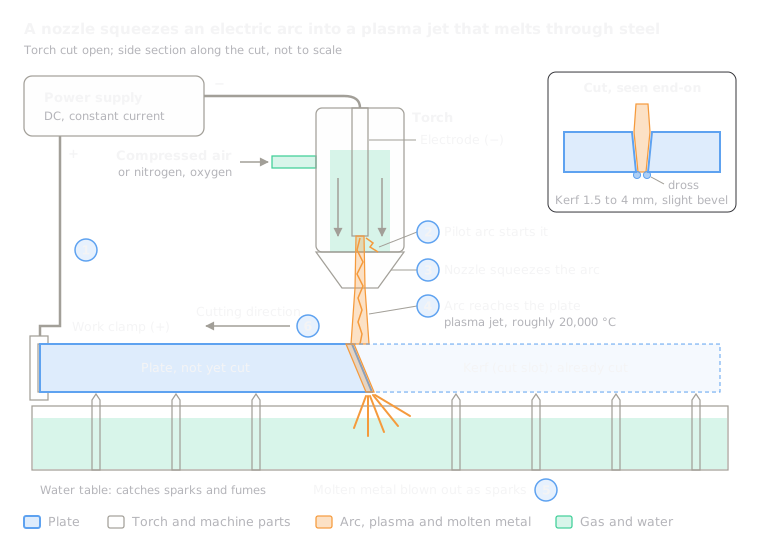 6.3Plasma cuttingA superheated gas jet melts through conductive plateOpen the lesson
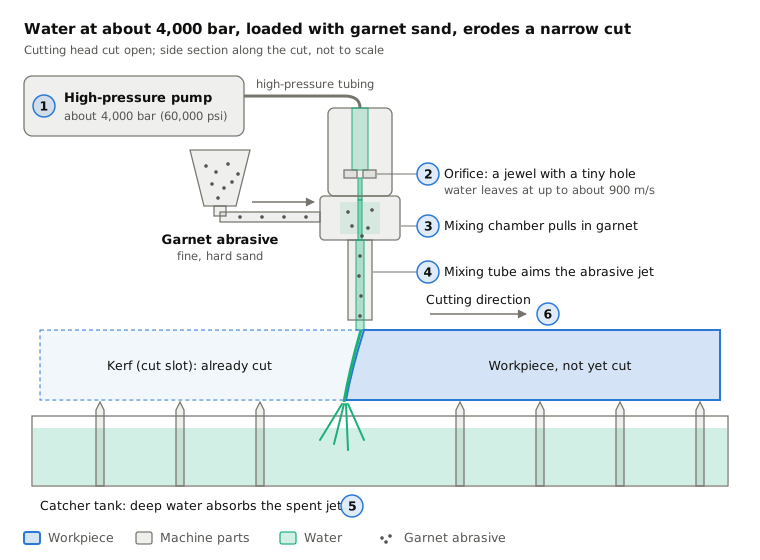
 6.4Waterjet cuttingVery high-pressure water, usually with abrasive, erodes a cutOpen the lesson
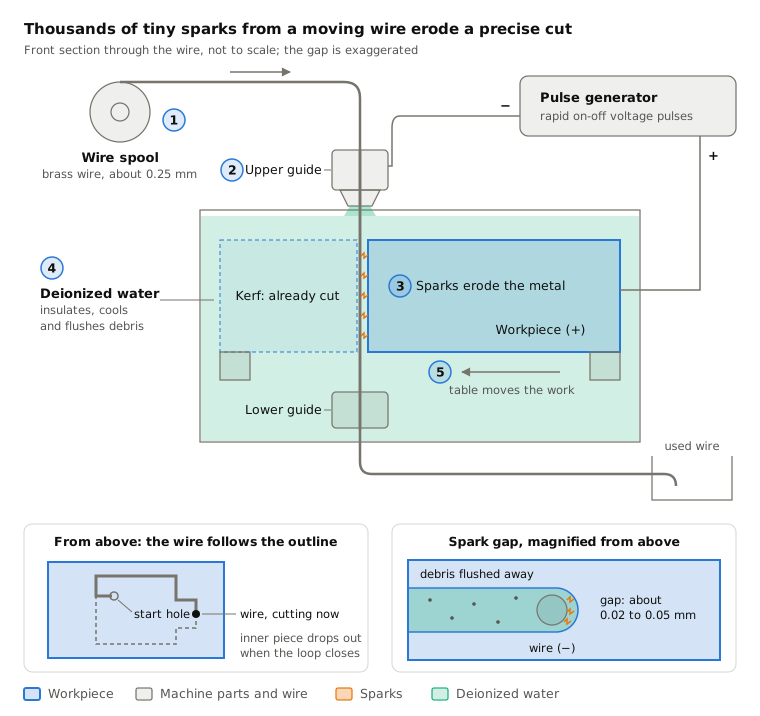
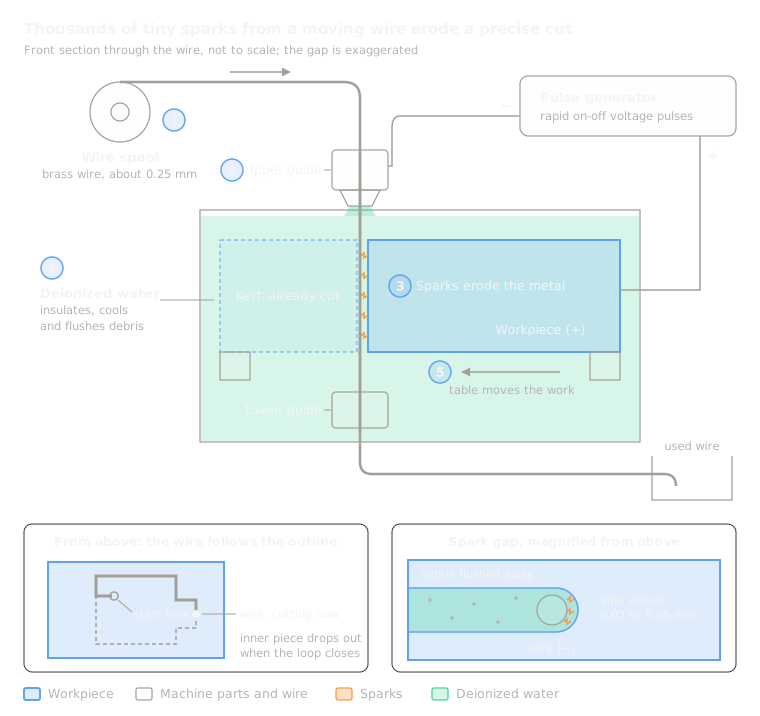 6.5Wire EDMSparks from a thin moving wire cut through-profilesOpen the lesson
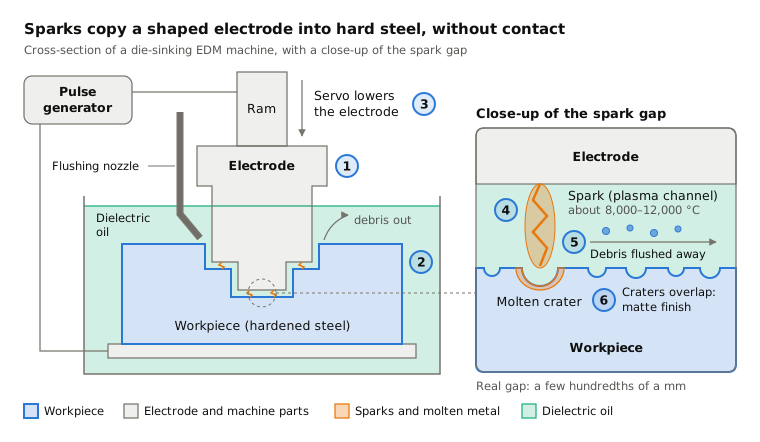
 6.6Sinker EDMSparks copy a shaped electrode into a blind cavityOpen the lesson
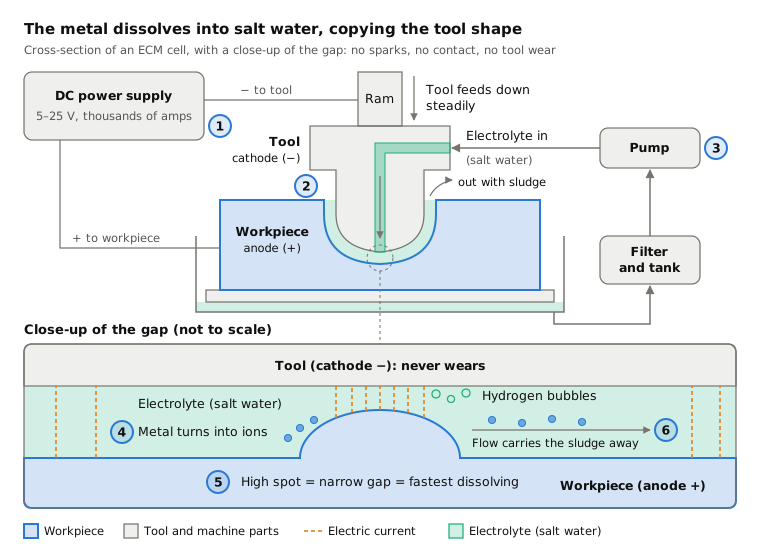
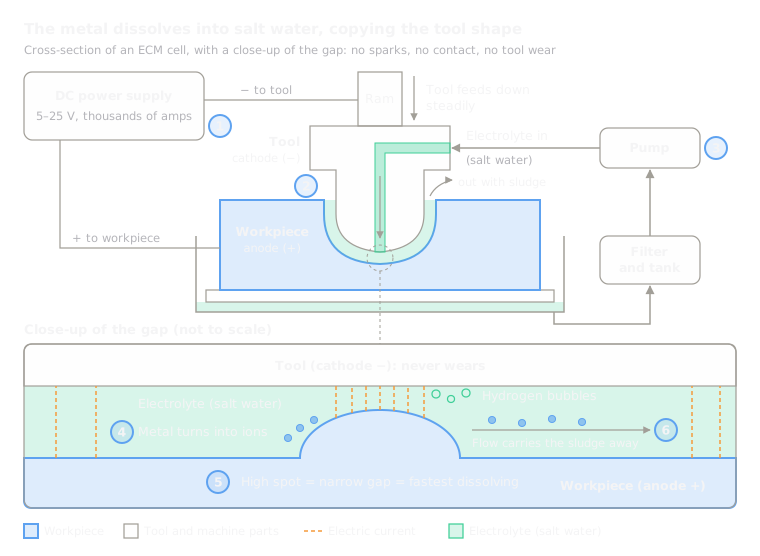 6.7Electrochemical machining (ECM)Electrolysis dissolves metal in the shape of the toolOpen the lesson
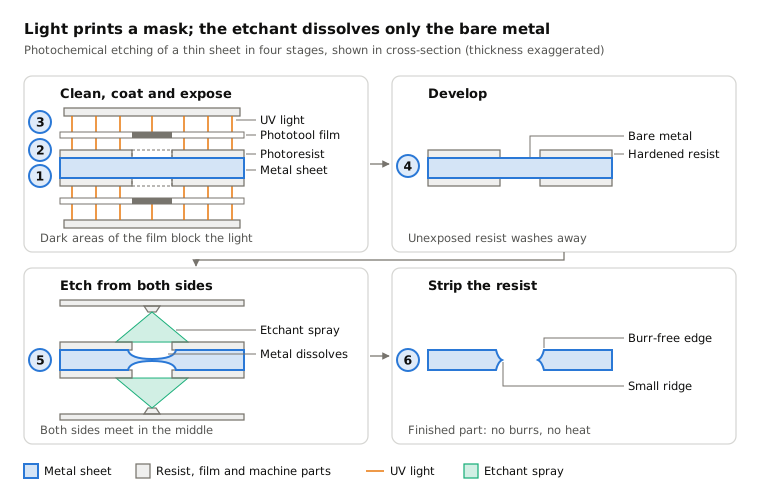
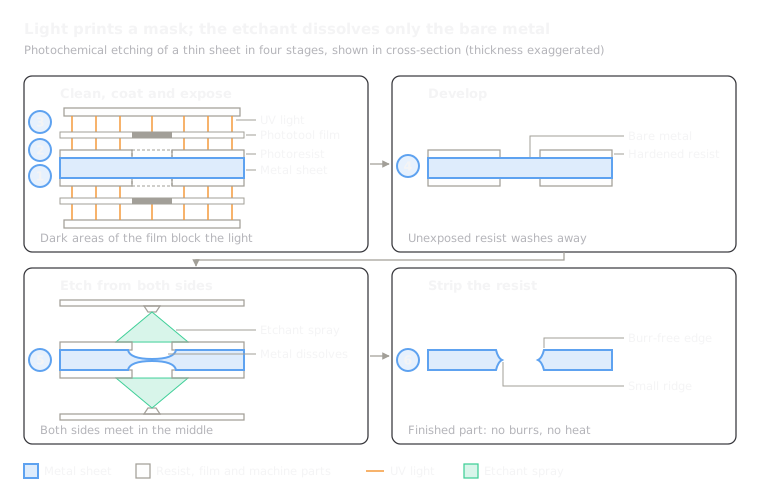 6.8Chemical machining and photochemical etchingA light-printed mask lets an etchant dissolve only bare metalOpen the lesson
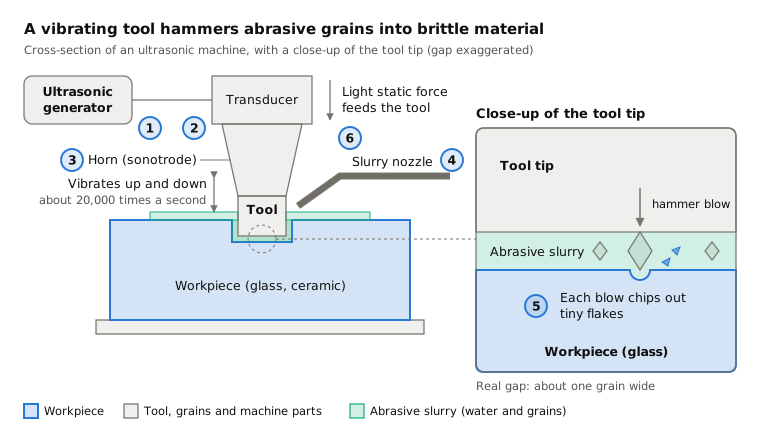
 6.9Ultrasonic machiningA vibrating tool hammers abrasive grains into the surfaceOpen the lesson
Try it
Put AI to work in your CAD.
Model parts, generate drawings and automate the repetitive work inside your CAD software.