

Machining
Machining makes a part by removing material from a solid block, bar or casting until only the wanted shape is left. Every process in this chapter does it the same way: something harder than the workpiece is pushed against it while one of them moves, and small pieces called chips are carried away. Machining gives the most accurate sizes and smoothest surfaces of any family in this course.
The big idea
Think of carving: a knife peels wood, sandpaper rubs it smooth. Machining has the same two branches. In cutting with a sharp tool (lessons 5.1 to 5.6), a few hard, shaped edges peel off visible chips, fast; knurling is the odd one in this group, since it mostly presses a pattern instead of peeling chips. In abrading with grit (lessons 5.7 to 5.9), thousands of tiny hard grains each scratch off a microscopic chip, slowly but very precisely, and they can cut steel that has already been hardened. A typical precision part meets both: it is turned or milled close to shape, heat-treated, then ground, honed or superfinished to its final size and finish.
The 9 processes in this chapter
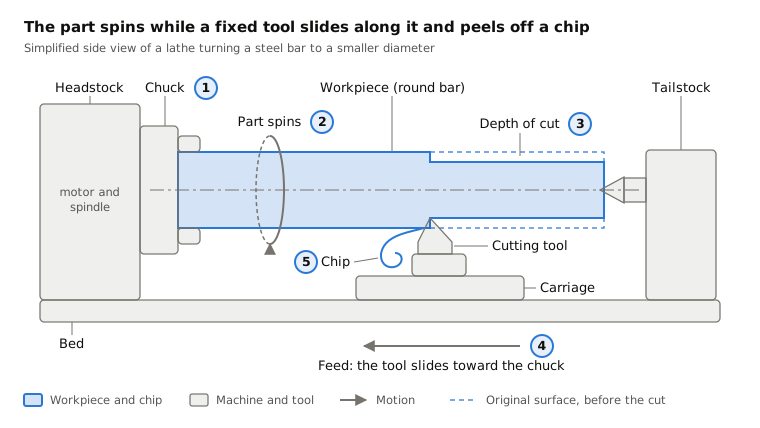
 5.1ShortTurning (lathe)The part spins; a single-point tool cuts itOpen the lesson
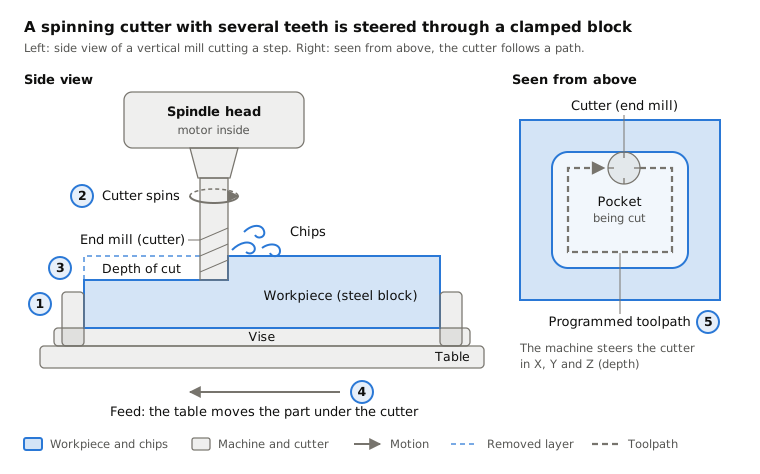
 5.2ShortMillingA spinning multi-edge cutter moves over a fixed partOpen the lesson
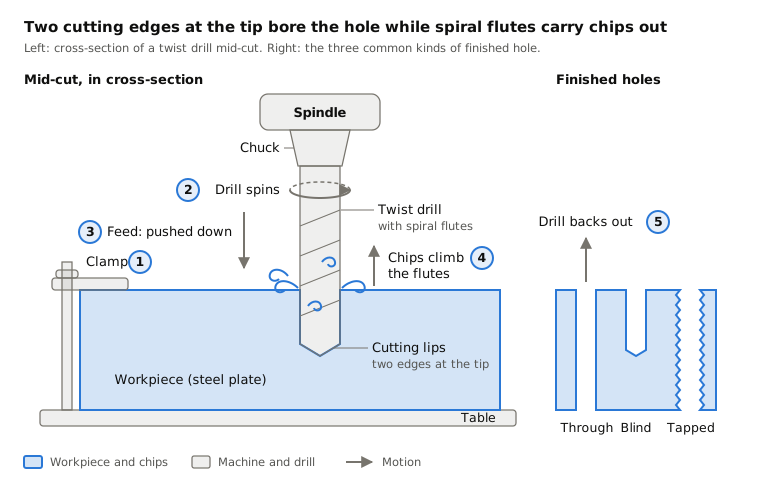
 5.3ShortDrillingA spinning twist drill plunges into the partOpen the lesson
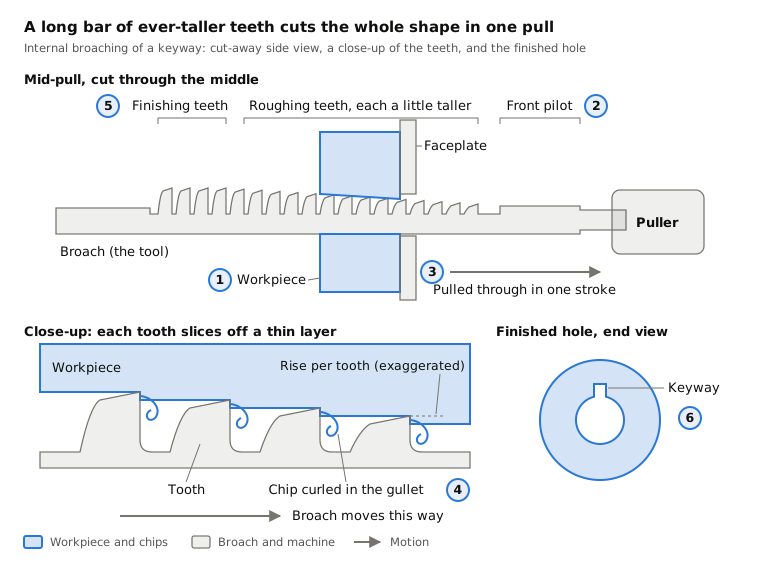
 5.4BroachingA long toothed bar is pulled through or across in one strokeOpen the lesson
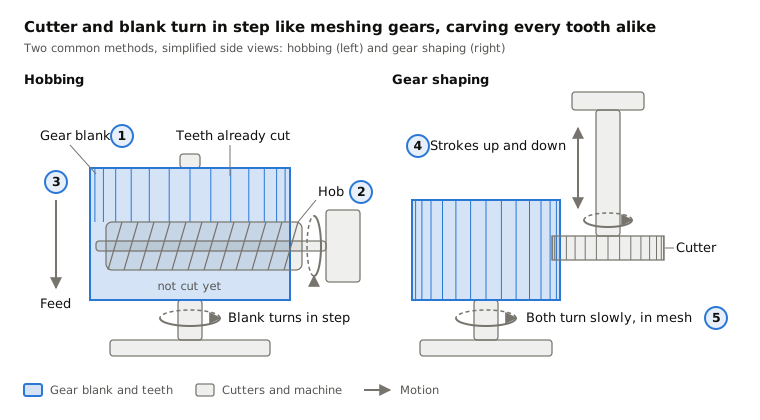
 5.5Gear cutting (hobbing, shaping)Hobs or shaper cutters generate gear teethOpen the lesson
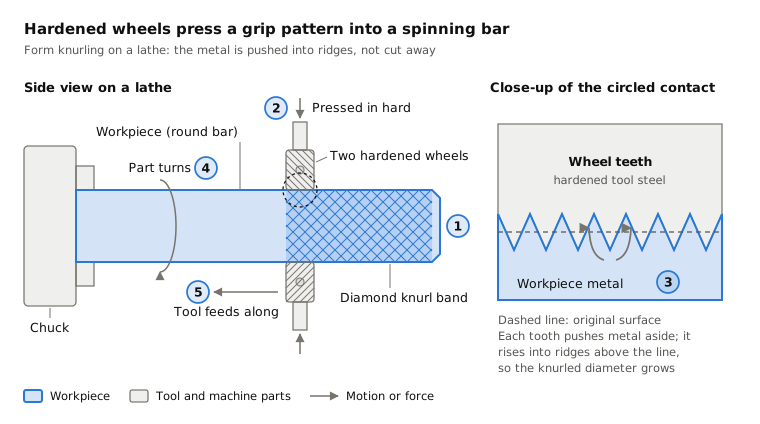
 5.6KnurlingHardened wheels press a grip pattern into a turning partOpen the lesson
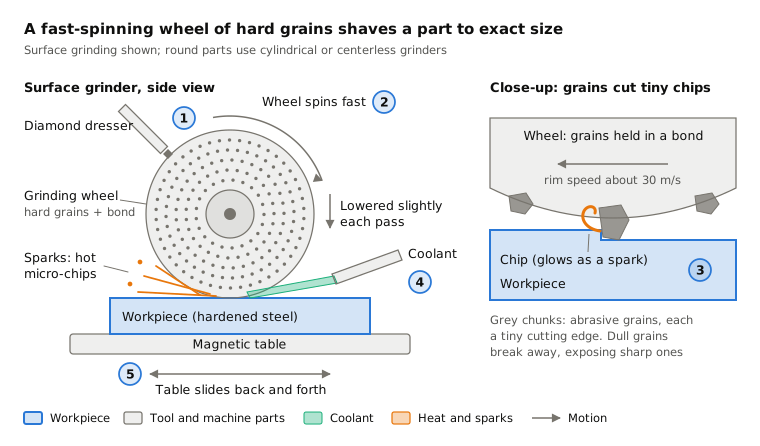
 5.7GrindingA fast wheel of hard grains shaves the surfaceOpen the lesson
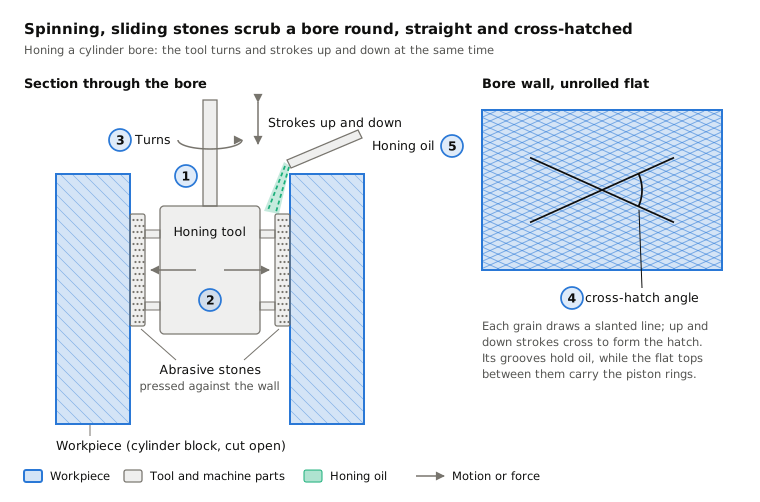
 5.8HoningStones turn and stroke inside a boreOpen the lesson
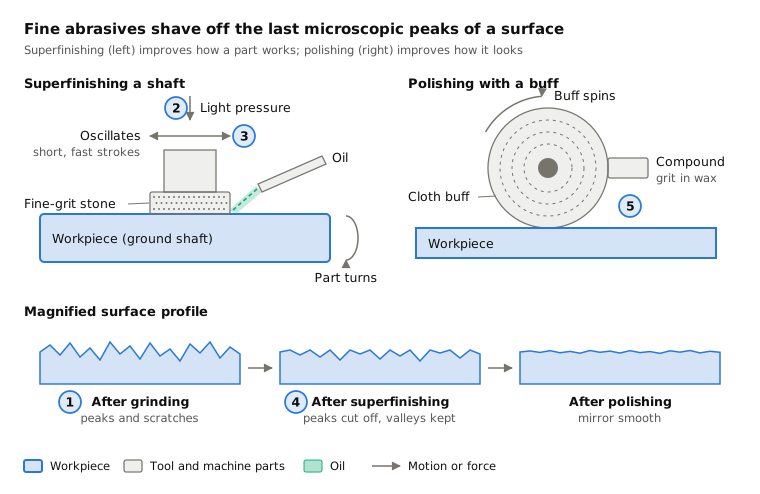
 5.9Superfinishing and polishingFine stones or buffs remove the last microscopic peaksOpen the lesson
Side by side
| Process | In one line | Best for | Batch size | Precision |
|---|---|---|---|---|
| 5.1Turning (lathe) | The part spins; a single-point tool cuts it | Round parts: shafts, pins, bushings | One-offs to millions | About ±0.01–0.05 mm |
| 5.2Milling | A spinning multi-edge cutter moves over a fixed part | Flat faces, pockets, slots, 3D shapes | One-offs to large series | About ±0.01–0.05 mm |
| 5.3Drilling | A spinning twist drill plunges into the part | Round holes | Any | About ±0.05–0.1 mm |
| 5.4Broaching | A long toothed bar is pulled through or across in one stroke | Keyways, splines, odd-shaped holes | Large series | About ±0.01–0.02 mm |
| 5.5Gear cutting (hobbing, shaping) | Hobs or shaper cutters generate gear teeth | Gears and splines | Medium to mass production | Fine, set by gear quality grades |
| 5.6Knurling | Hardened wheels press a grip pattern into a turning part | Knobs, handles, press-fit pins | Any | About ±0.1 mm |
| 5.7Grinding | A fast wheel of hard grains shaves the surface | Hardened shafts, bearing rings, flat plates | Any | A few micrometers |
| 5.8Honing | Stones turn and stroke inside a bore | Engine and hydraulic cylinders | One-offs to mass production | A few micrometers on roundness |
| 5.9Superfinishing and polishing | Fine stones or buffs remove the last microscopic peaks | Bearing parts, journals, decorative parts | Mass production (superfinishing); any (polishing) | Changes size by about 1 µm or less |
How to choose within this family
- Start with the shape: round parts go on a lathe (turning), flat and 3D shapes on a mill, holes on a drill; special shapes like gears, splines and keyways have their own processes.
- Hardened material or micrometer tolerances call for an abrasive step (grinding, then honing or superfinishing if needed) after the cutting steps.
- Bores that must seal or slide (cylinders, hydraulic tubes) are usually honed; outside running surfaces such as bearing tracks are superfinished.
- High volumes of the same feature favor dedicated tools (broaches, hobs, centerless grinders); one-offs and prototypes favor flexible CNC turning and milling.
- For grip or looks , add knurling or polishing at the end; they serve function and appearance more than accuracy.
Key words
- Chip
- the small piece of material a cutting edge or grain removes.
- Feed
- how far the tool advances into or along the part per turn or per minute.
- Depth of cut
- how deep the tool goes into the material on one pass.
- CNC
- computer numerical control; the machine follows a programmed path instead of hand wheels.
- Tolerance
- how far a real size may differ from the drawing, such as ±0.01 mm.
- Surface roughness (Ra)
- the average height of the tiny peaks and valleys on a surface, in micrometers.
- Abrasive
- a very hard grain (aluminum oxide, silicon carbide, CBN, diamond) used to grind, hone or polish.
- Coolant
- a fluid that cools the cut, lubricates it and washes chips away.
Try it
Put AI to work in your CAD.
Model parts, generate drawings and automate the repetitive work inside your CAD software.