

Grinding
A fast wheel of hard grains shaves the surface
Grinding removes metal with a fast-spinning wheel made of countless tiny, very hard grains, each acting as a miniature cutting tool. It gives hardened steel shafts, bearing rings and drill bits their final size and smooth finish. When a part must be accurate to within a few micrometers (thousandths of a millimeter), it is usually ground.
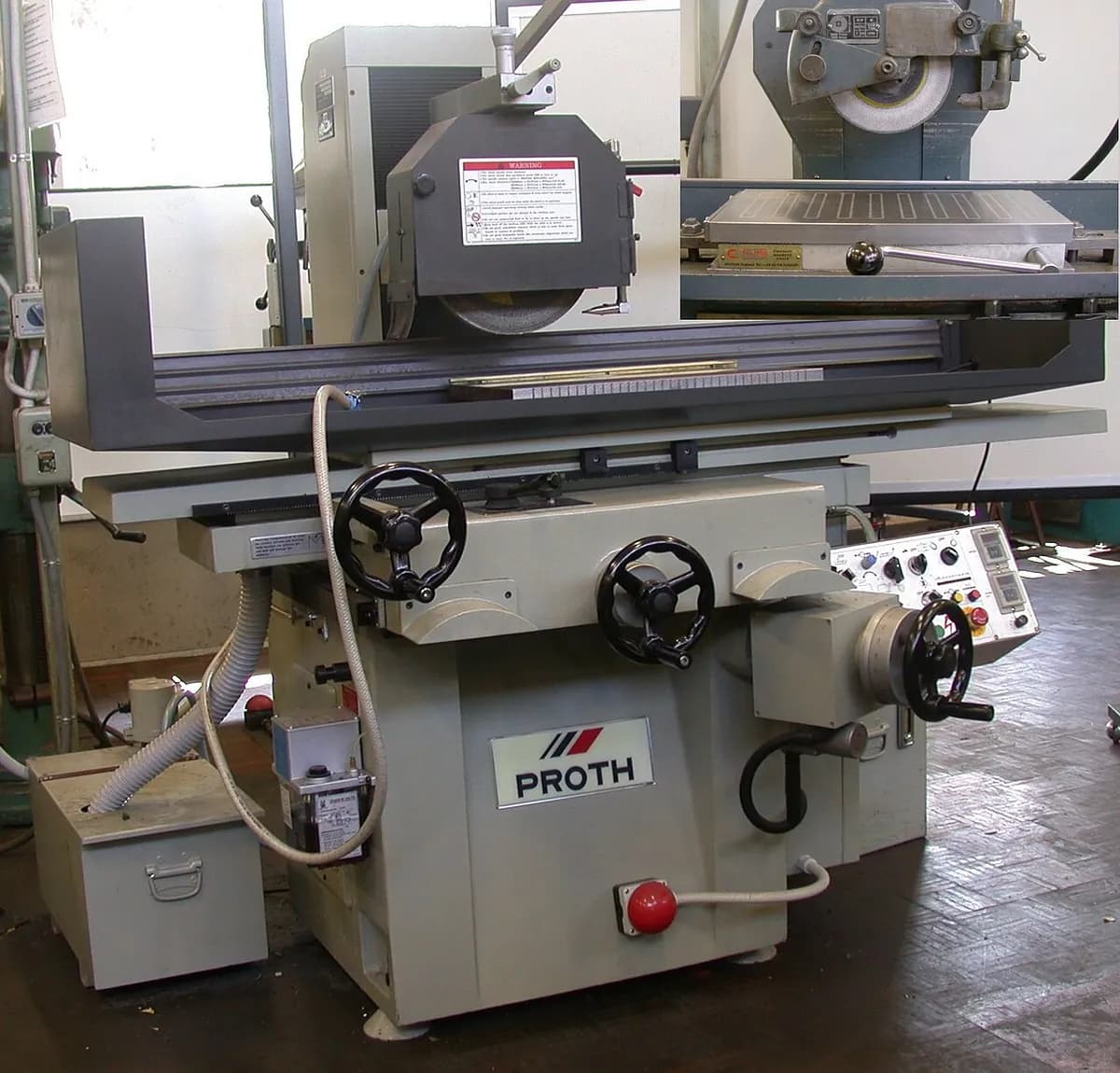
How it works
Dress the wheel. A diamond-tipped tool skims the spinning wheel so it runs perfectly round and its grains are sharp and exposed.
Spin it fast. The wheel turns at thousands of revolutions per minute; its rim moves at about 30 m/s (roughly 100 km/h).
Grains cut tiny chips. Each grain that touches the part shaves off a chip far thinner than a hair. The chips get so hot that they glow: those are the sparks.
Flood with coolant. A jet of water-based coolant or oil cools the part, washes chips away and keeps the wheel from clogging. Without it, the surface can burn (overheat, soften or crack).
Feed in tiny steps. The table slides the part back and forth under the wheel, which is lowered slightly after each pass. Final passes with no extra lowering, called spark-out, end when the sparks die away.
Key facts
- Materials
- Hardened steels, tool steels, cast iron, carbide, ceramics, glass; soft metals such as aluminum tend to clog the wheel
- Typical parts
- Bearing rings and rollers, shafts, gauge blocks, cutting-tool edges, flat machine slideways
- Part size
- From needle rollers a few millimeters across to rolls and machine beds several meters long
- Precision
- Typically a few micrometers (about ±0.005 mm); precision work reaches about 1 µm on diameters
- Surface finish
- Smooth, satin to bright; typically Ra 0.2–0.8 µm (Ra is the average height of the surface roughness)
- Batch size it suits
- Any: one part in a toolroom to millions on centerless lines
- Tooling and machine cost
- Wheels (aluminum oxide, silicon carbide, or costly CBN and diamond) from tens to thousands of dollars; precision grinders from tens of thousands to over a million
- Speed
- Slow per volume of metal removed, often minutes per part; through-feed centerless grinders finish many small pins per minute
Strengths and limits
Strengths
- Cuts hardened steel and other materials too hard for ordinary cutting tools
- Very tight tolerances (a few µm) and smooth surfaces
- Many machine types: flat faces, shafts, bores, profiles
- Suits single parts and fully automated mass production alike
Limits
- Removes metal slowly, so it is kept for the last few tenths of a millimeter
- Too much heat can burn or crack the surface if the coolant or wheel choice is wrong
- The wheel wears and must be dressed regularly
- Precision grinders are expensive, and the swarf (grinding sludge) is messy to handle
Where it's used
- AutomotiveCrankshaft and camshaft journals, valve stems, transmission shafts
- BearingsInner and outer rings, balls and rollers
- ToolingDrills, end mills and punches sharpened on tool grinders
- AerospaceTurbine blade roots, landing-gear parts
- Machine buildingFlat slideways, gauge blocks, precision spindles
How to recognize it
- Very fine, straight, parallel scratch lines all running one way, or around a shaft.
- A smooth satin-to-bright surface that feels glassy under a fingernail.
- Rotary-ground flat parts show overlapping swirl arcs instead of straight lines.
- Blue or brown patches on a ground surface are grinding burn (local overheating).
Compare with
Watch it
THATLAZYMACHINIST · A beginner tour of a cylindrical grinder: the wheel, dressing and how the part is held
Metal Cutting Corp · How centerless grinding works: grinding wheel, regulating wheel and work rest
Okamoto Europe · A CNC surface grinder like the one in the figure, at work
Fritz Studer AG · Precision cylindrical grinding, with sparks and close-ups
See real photos
- Wikipedia: Grinding (abrasive cutting) — types of grinding, wheels and typical tolerances, with photos
- Wikimedia Commons photo search
Remember
- Grinding cuts with countless tiny grains, so it can shape hardened steel and ceramics.
- It removes little material but reaches micrometer accuracy and fine finishes.
- Coolant and regular dressing keep the wheel sharp and the part from burning.
More in Machining
All 100 processes
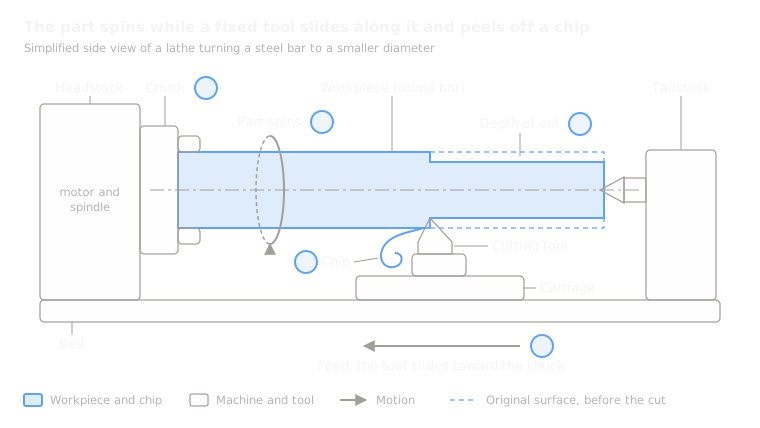 5.1ShortTurning (lathe)The part spins; a single-point tool cuts itOpen the lesson
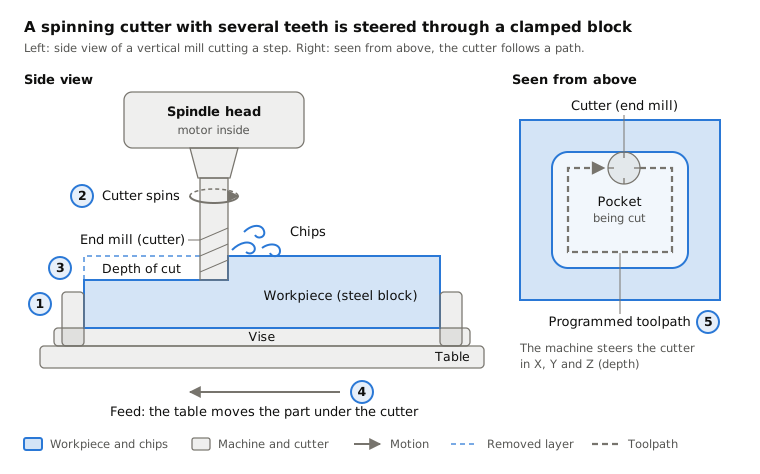
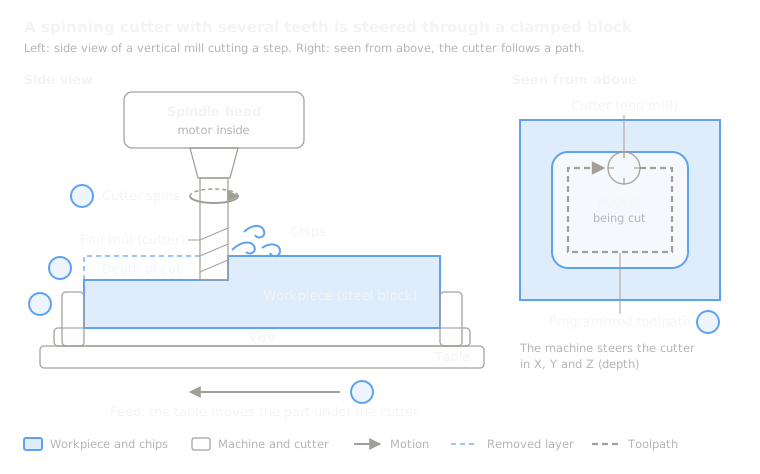 5.2ShortMillingA spinning multi-edge cutter moves over a fixed partOpen the lesson
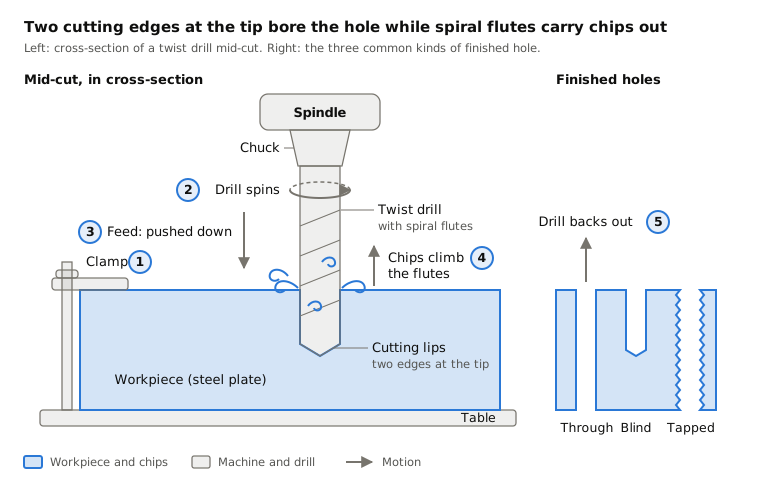
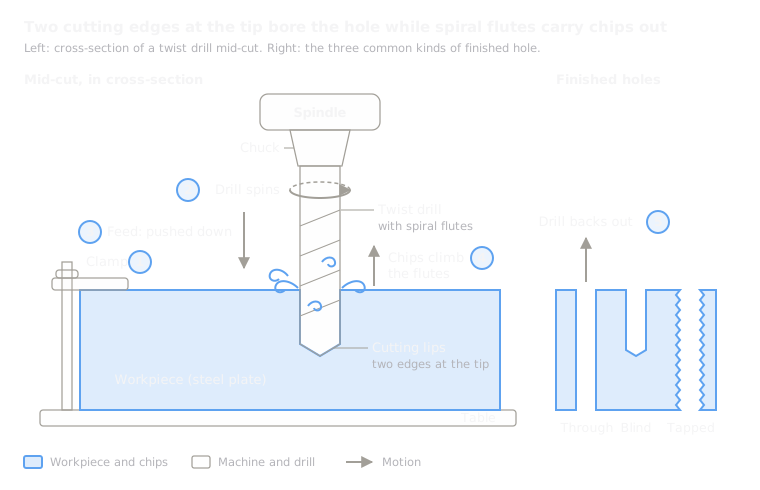 5.3ShortDrillingA spinning twist drill plunges into the partOpen the lesson
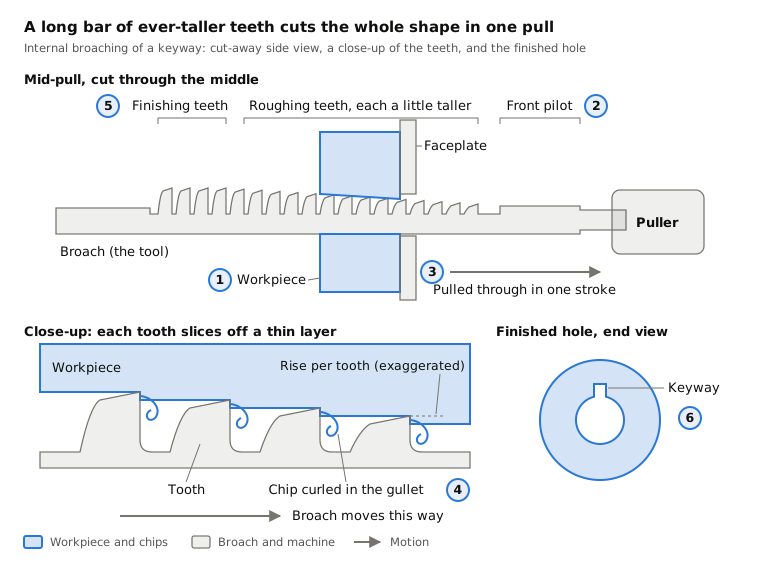
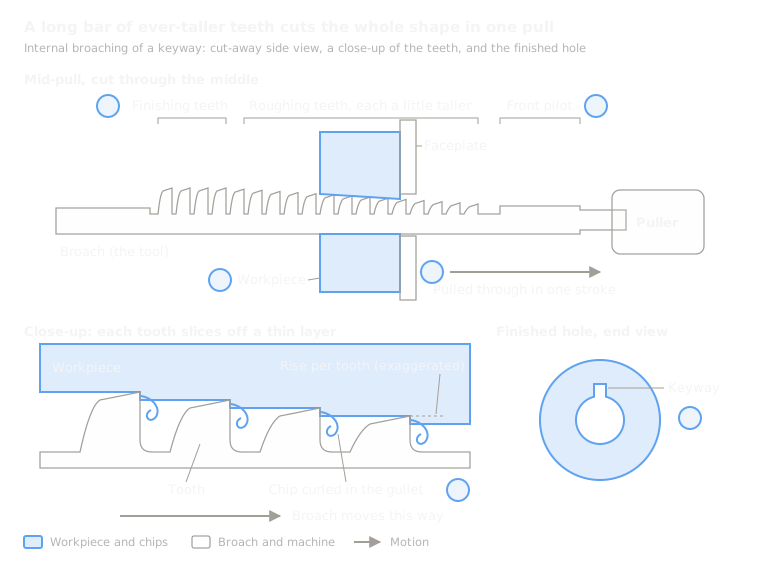 5.4BroachingA long toothed bar is pulled through or across in one strokeOpen the lesson
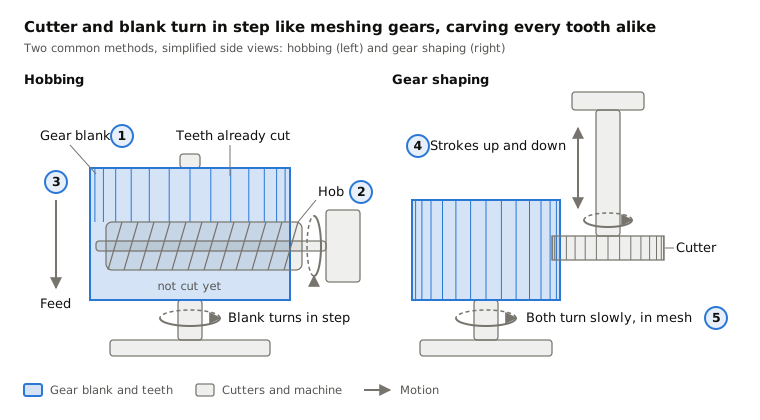
 5.5Gear cutting (hobbing, shaping)Hobs or shaper cutters generate gear teethOpen the lesson
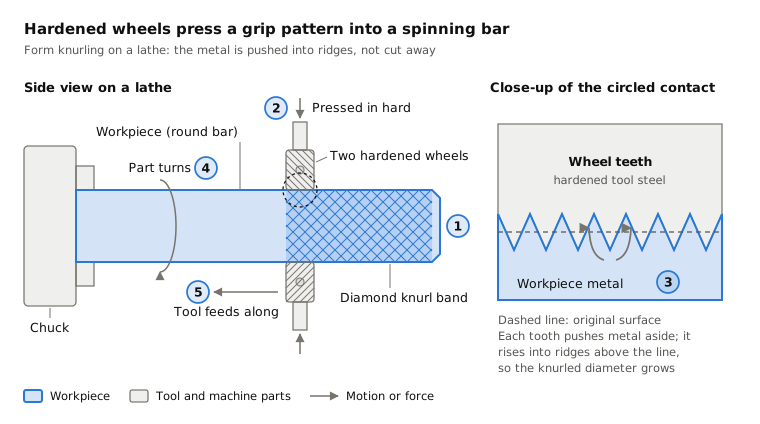
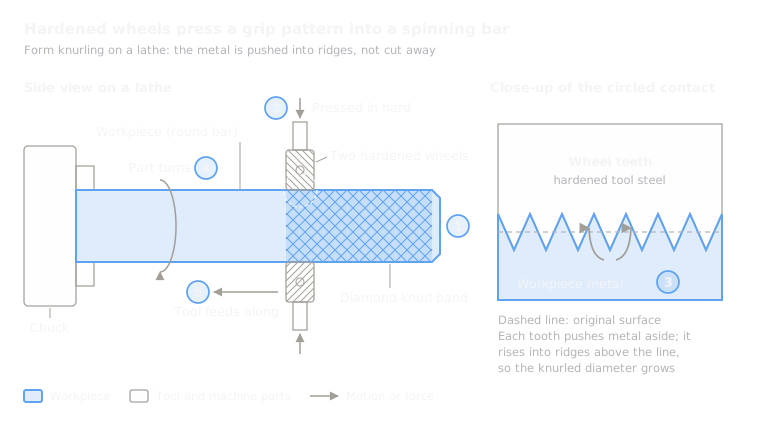 5.6KnurlingHardened wheels press a grip pattern into a turning partOpen the lesson
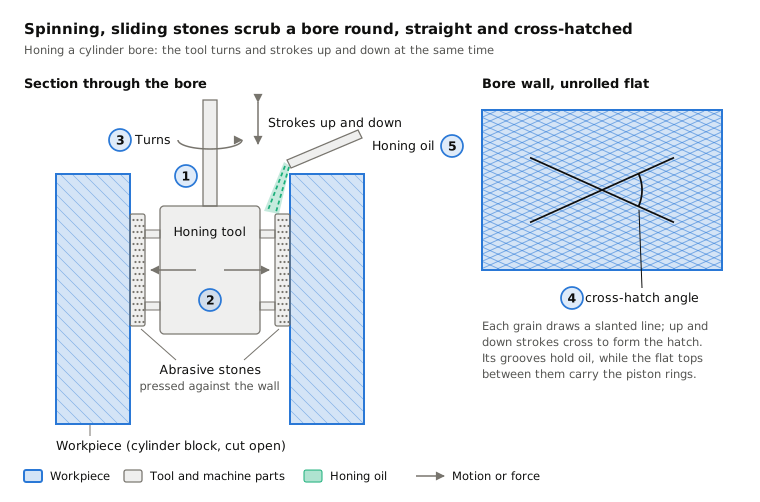
 5.8HoningStones turn and stroke inside a boreOpen the lesson
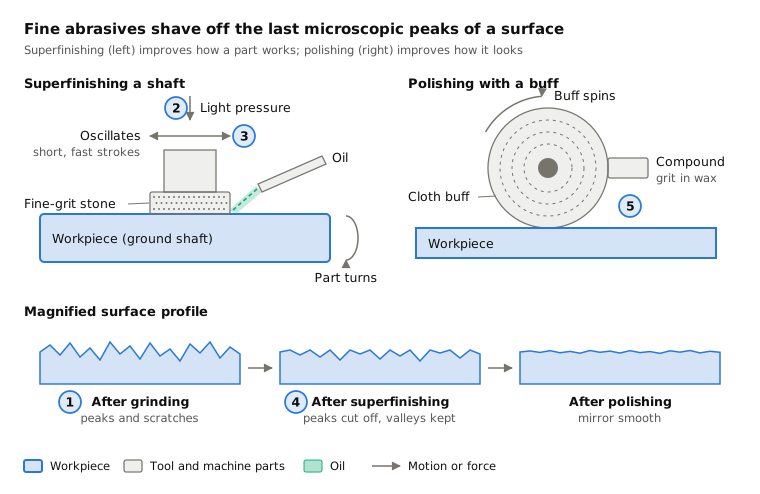
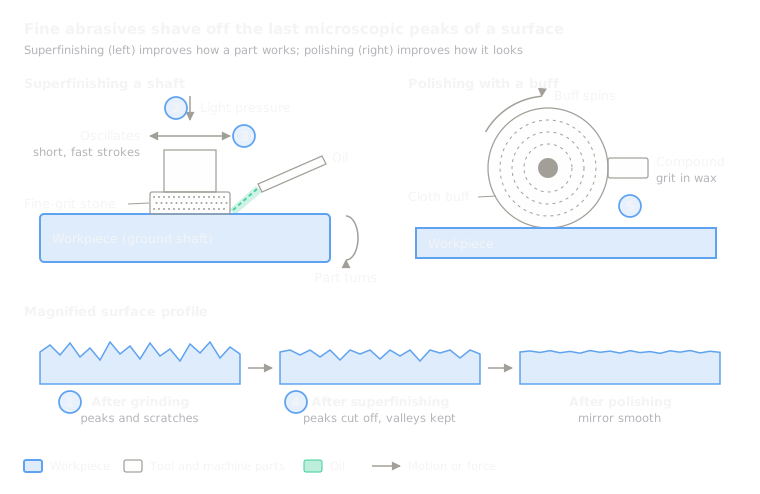 5.9Superfinishing and polishingFine stones or buffs remove the last microscopic peaksOpen the lesson
Try it
Put AI to work in your CAD.
Model parts, generate drawings and automate the repetitive work inside your CAD software.