

Knurling
Hardened wheels press a grip pattern into a turning part
Knurling rolls a pattern of tiny ridges into the surface of a round part so your fingers can grip it. You see it on barbell grips, thumb screws and the handles of precision screwdrivers. It is cheap and quick, and it is usually done on the lathe right after turning.
How it works
Prepare the blank. The bar is first turned to a diameter that suits the knurl's pitch (the spacing between ridges). A small chamfer (a beveled edge) at the end helps the wheels start cleanly.
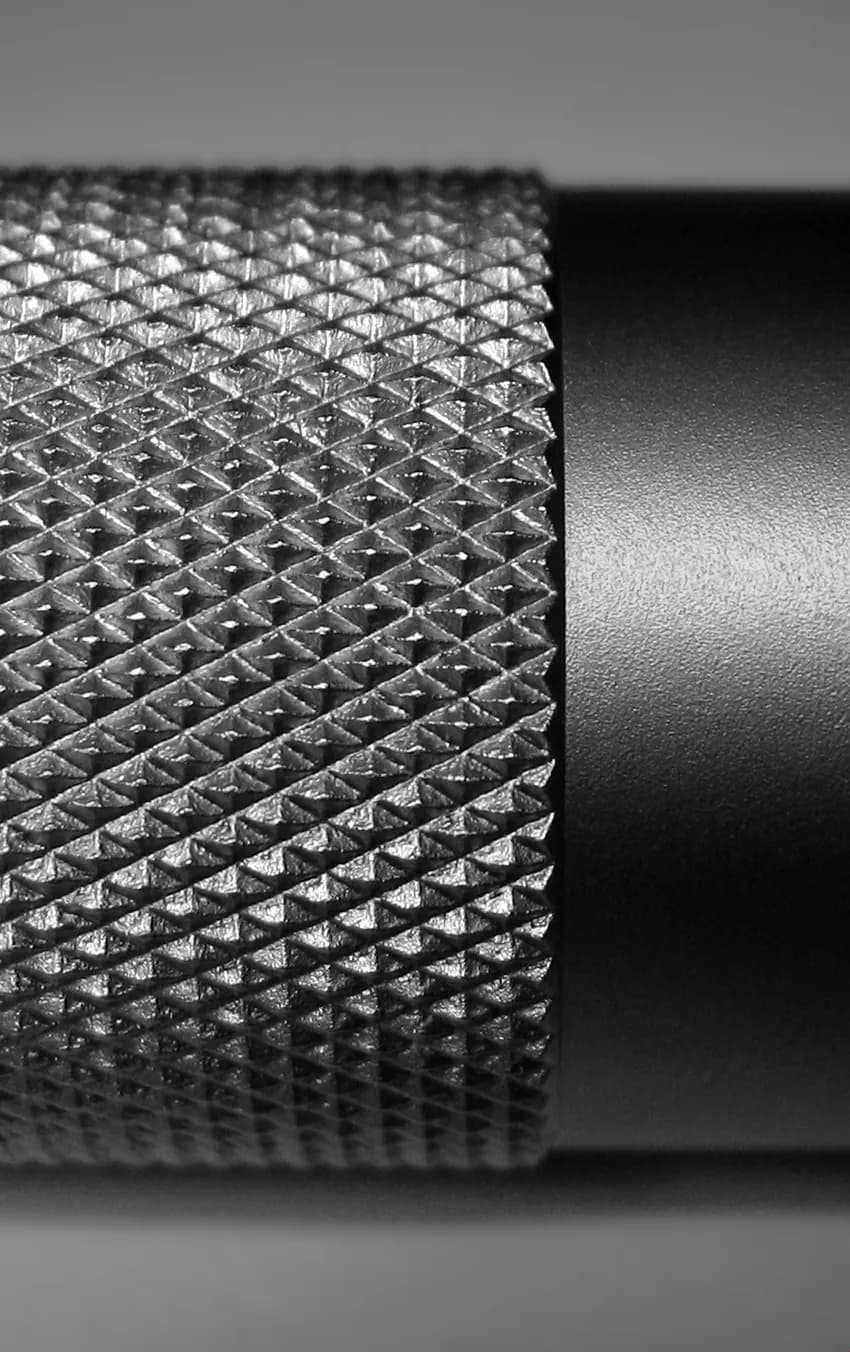
Press the wheels in. With the part turning slowly, hardened steel wheels with fine teeth are forced hard against the surface. Straight teeth make straight ridges; two wheels with teeth slanting opposite ways make a diamond pattern.
Metal flows into ridges. Each tooth pushes metal aside instead of cutting it, and that metal rises between the teeth. This is form knurling: it makes no chips, but the diameter grows slightly.
Let the pattern track. On the first turn, the teeth must drop back into their own grooves so the pattern meets itself evenly. If the circumference does not divide evenly by the pitch, you get double tracking: a messy, doubled pattern.
Feed along the part. The tool travels along the bar with plenty of oil until the whole band is knurled, sometimes in two passes for full depth. Finally the edges are deburred (sharp slivers removed).
Key facts
- Materials
- Most ductile (easily deformed) metals: steel, stainless steel, aluminum, brass; also some plastics. Soft metals knurl most easily
- Typical parts
- Knobs, thumb screws, tool handles, barbell grips, pins and inserts pressed into holes
- Part size
- Typically round parts from a few millimeters to about 100 mm across
- Precision
- About ±0.1 mm on the knurled diameter; the pitch, typically about 0.5–2 mm, matters more than the exact size
- Surface finish
- A textured grip surface; rolled ridges look smooth and slightly shiny
- Batch size it suits
- Any: one-offs on a manual lathe to millions on automatic lathes
- Tooling and machine cost
- Low: a holder and wheels cost tens to a few hundred dollars and fit an existing lathe
- Speed
- A few seconds to a minute per part, in the same setup as turning
Strengths and limits
Strengths
- Cheap tooling that fits any lathe, used in the same setup as turning
- Fast: a band takes seconds
- Form knurling makes no chips and work-hardens (toughens by deforming) the ridges
- A knurled band can also lock a pin or insert into a hole
Limits
- Form knurling pushes hard, so thin tubes can crush or bend; cut knurling (tilted wheels that shave chips) pushes far less
- The diameter grows a little, so the blank must be sized for it
- The pattern double-tracks if the diameter does not suit the pitch
- Hard or brittle materials knurl poorly, and the wheels wear
Where it's used
- Hand toolsScrewdriver and file handles, tap wrenches
- FitnessBarbell and dumbbell grips
- Instruments and machineryThumb screws, adjustment knobs, micrometer thimbles
- AssemblyPress-fit pins and threaded inserts that lock into plastic or aluminum
- Consumer goodsFlashlight bodies, pen barrels, volume knobs on audio gear
How to recognize it
- A regular grid of tiny diamonds, or straight ridges, wrapped around a round part.
- Rolled ridges have slightly rounded, shiny tops; cut knurls look crisper and sharper.
- The knurled band often stands slightly proud of (larger than) the plain diameter beside it, with a small chamfer at its end.
- A smeared, doubled patch in the pattern is a sign of double tracking.
Compare with
Watch it
shop and math · A beginner explanation, then a demo on a lathe
jlinks101 · Close-ups of a diamond pattern forming on a manual lathe
Mike Levy · How cut knurling differs from form knurling
Mazatrol Tips and Tricks · Knurling as one step in a CNC lathe program
See real photos
- Wikipedia: Knurling — straight, diagonal and diamond patterns and their uses, with a few photos
- Wikimedia Commons photo search
Remember
- Knurling rolls a grip pattern into a round surface; form knurling makes no chips.
- The pattern must divide evenly into the circumference, or it double-tracks.
- Form knurling grows the diameter; cut knurling shaves chips and pushes far less.
More in Machining
All 100 processes
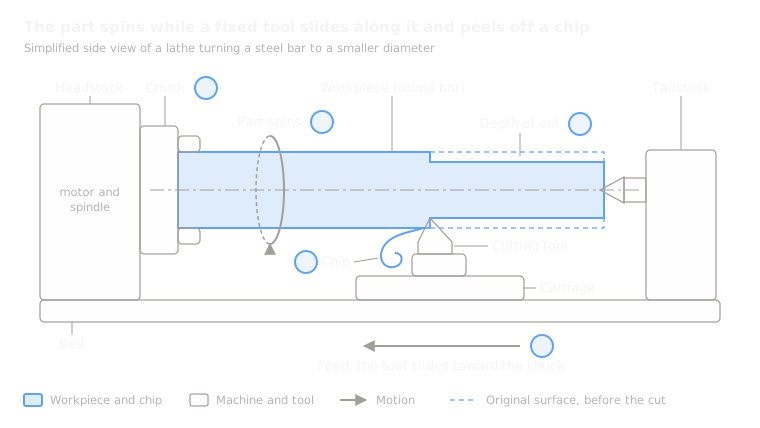 5.1ShortTurning (lathe)The part spins; a single-point tool cuts itOpen the lesson
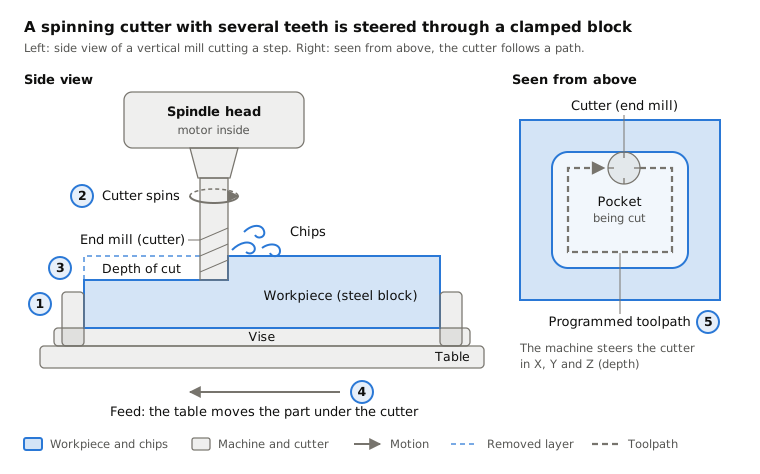
 5.2ShortMillingA spinning multi-edge cutter moves over a fixed partOpen the lesson
 5.3ShortDrillingA spinning twist drill plunges into the partOpen the lesson
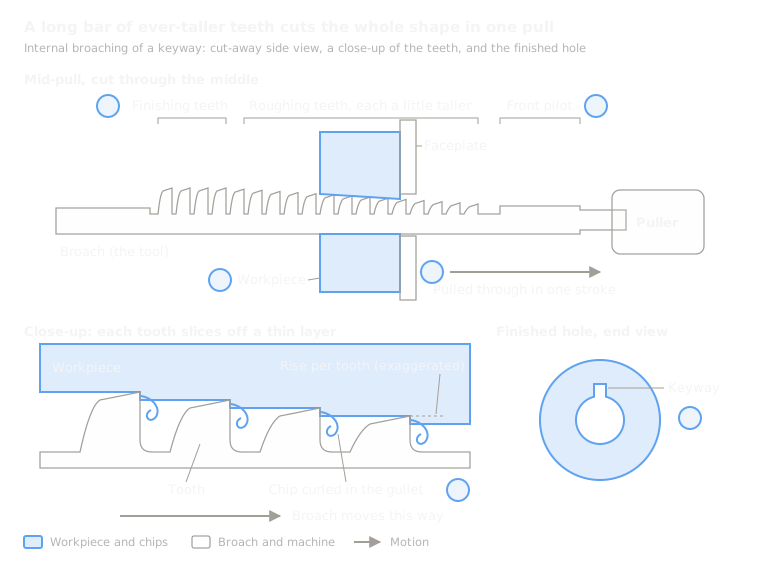 5.4BroachingA long toothed bar is pulled through or across in one strokeOpen the lesson
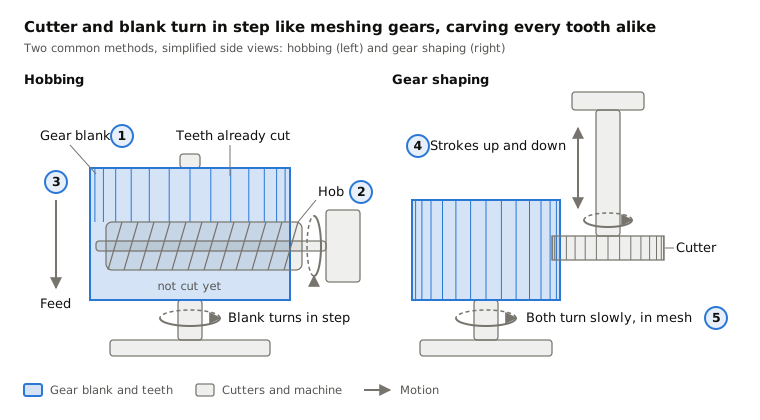
 5.5Gear cutting (hobbing, shaping)Hobs or shaper cutters generate gear teethOpen the lesson
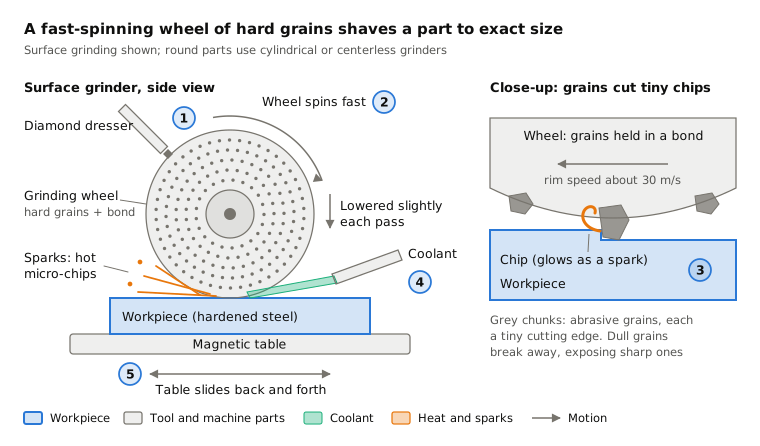
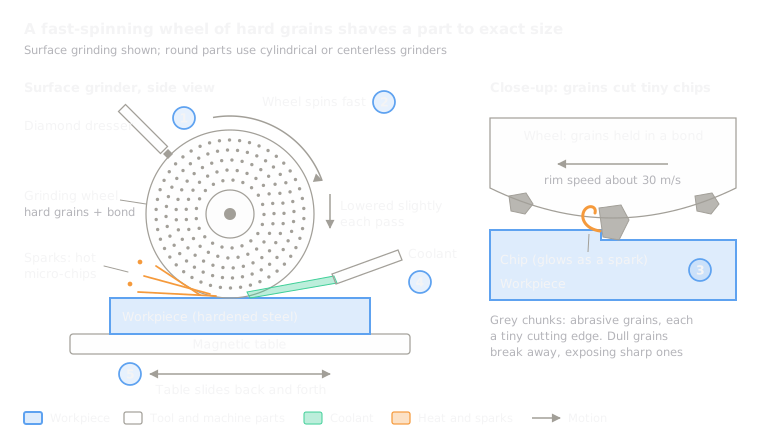 5.7GrindingA fast wheel of hard grains shaves the surfaceOpen the lesson
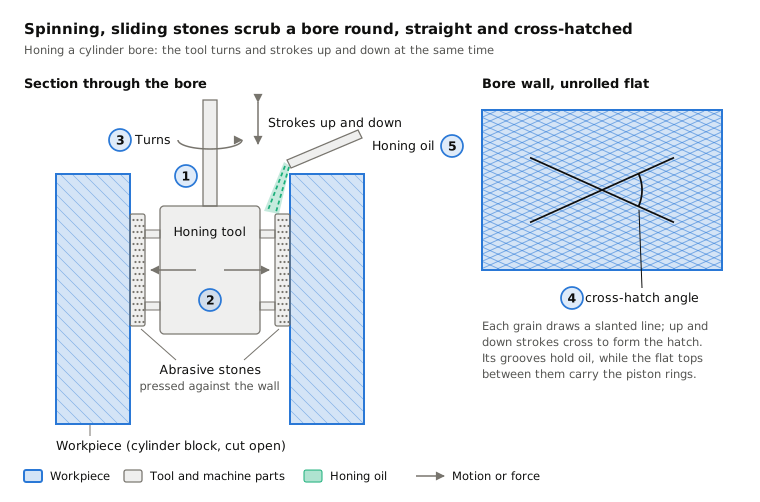
 5.8HoningStones turn and stroke inside a boreOpen the lesson
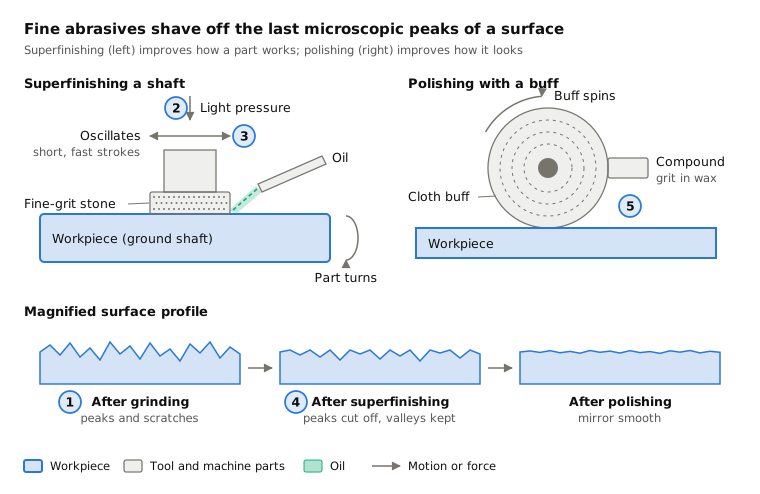
 5.9Superfinishing and polishingFine stones or buffs remove the last microscopic peaksOpen the lesson
Try it
Put AI to work in your CAD.
Model parts, generate drawings and automate the repetitive work inside your CAD software.