

Drilling
A spinning twist drill plunges into the part
Drilling makes round holes: a spinning tool with a pointed tip, the twist drill, is pushed straight into the material. The holes for every bolt in a car, the thousands of tiny holes in a circuit board and the hole you make in a wall at home are all drilled. It is the most common machining operation of all.
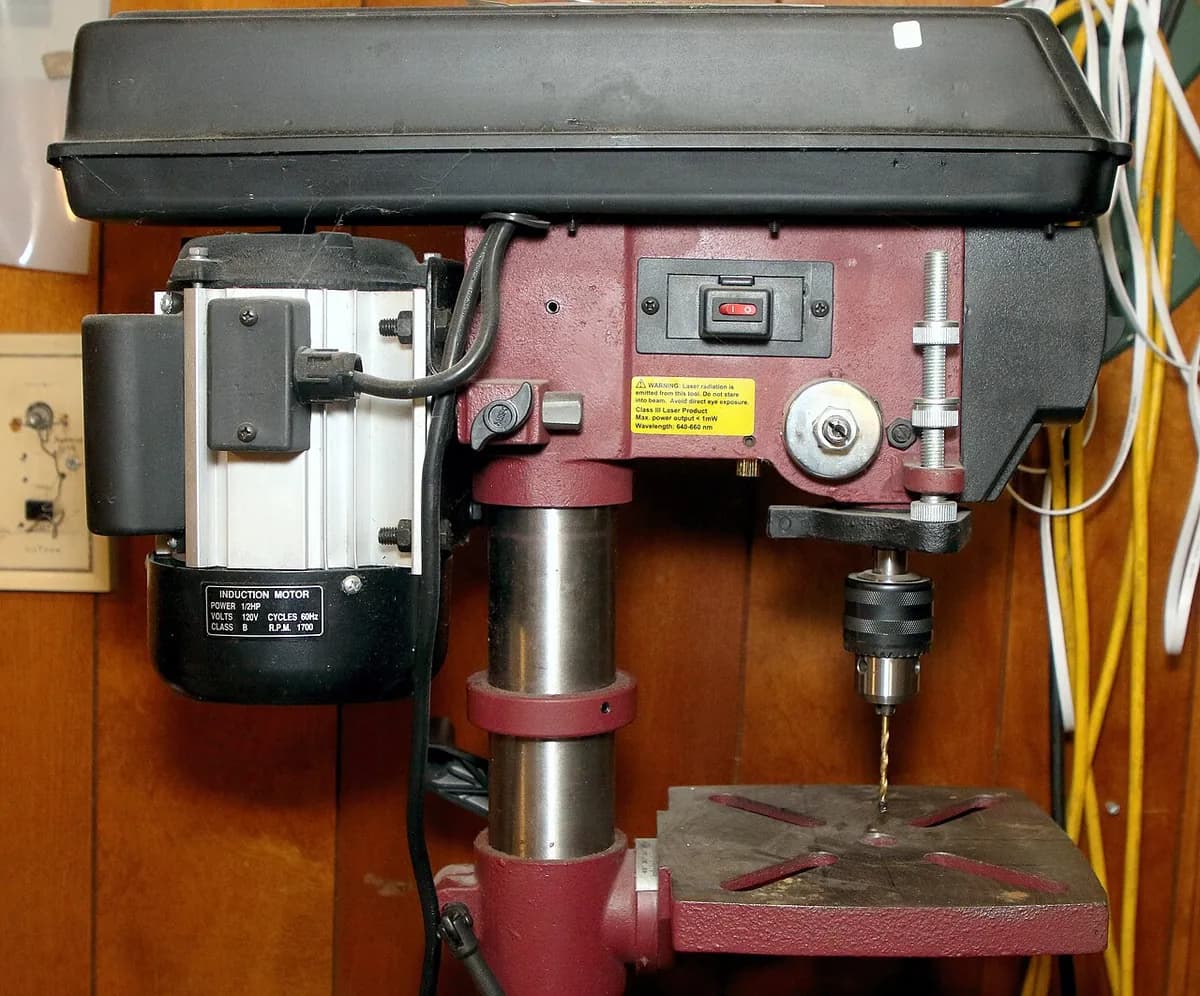
Drilling in a minute, by MecMade
How it works
Mark and clamp. The part is clamped so it cannot spin with the drill. A short, stiff spot drill (or a center punch, by hand) first marks the exact spot so the drill does not wander.
Spin the drill. The spindle turns the drill, typically a few hundred rpm (revolutions per minute) for large drills in steel and several thousand for small ones.
Feed it in. The drill is pushed along its own axis. The two cutting lips (the edges of the cone-shaped tip) shave the bottom of the hole, typically 0.05–0.3 mm per revolution.
Clear the chips. Chips ride up the flutes (the spiral grooves) and spill out at the top. Coolant cools the tip, and deep holes are drilled in short pecks (in-and-out moves) to clear chips.
Break through and back out. A through hole ends when the tip exits the far side, often leaving a burr (a rough lip) to remove. A blind hole stops at depth with a cone-shaped bottom; tapping can then cut threads inside.
Key facts
- Materials
- Almost everything: metals, plastics, wood, composites, circuit boards
- Typical parts
- Holes for bolts, pins, rivets, fluid passages and electrical vias
- Part size
- Holes from about 0.1 mm (circuit boards) to over 50 mm; deep-hole drills reach depths of 100 diameters or more
- Precision
- Typically ±0.05–0.1 mm on diameter; reaming (a light finishing cut) brings it to about ±0.01 mm
- Surface finish
- Typically Ra 1.6–6.3 µm (Ra = average roughness; 1 µm is a thousandth of a millimeter) inside the hole
- Batch size it suits
- Any: one hole by hand to millions on automated lines
- Tooling and machine cost
- Drills cost a few dollars to a few hundred; a drill press costs hundreds of dollars, CNC machines tens of thousands and more
- Speed
- Seconds per hole; a circuit-board drill makes several holes per second
Strengths and limits
Strengths
- Fast, cheap and simple
- Standard drills in every size, no custom tooling
- Works on almost any material
- Easy to automate, with many holes per minute
Limits
- Only round holes, and only straight ones
- Holes tend to be slightly oversize and not perfectly straight
- Deep holes are hard: chips jam and the drill can wander or break
- Leaves burrs, and precise holes need reaming or boring afterward
Where it's used
- AutomotiveBolt holes in engine blocks and wheels, oil passages
- AerospaceHundreds of thousands of rivet holes in an airliner's skin
- ElectronicsHoles and vias in printed circuit boards
- ConstructionHoles for anchors and bolts in steel beams and concrete
- EnergyLong cooling and fluid passages in molds, turbine parts and heat exchangers
How to recognize it
- Round holes with fine circular marks on the inside wall.
- A cone-shaped bottom in holes that do not go all the way through (the drill's point angle, often about 118°).
- Small burrs or a chamfer (a beveled edge) where the drill entered or left.
Compare with
Watch it
Casual DIY · Drill press basics for beginners
Sandvik Coromant · Industrial drilling on a CNC machine, in close-up
MTDCNC · How very deep holes are drilled on a machining center
Newbury Electronics · A circuit board factory tour, including CNC drilling of tiny holes
See real photos
- Wikipedia: Drilling — drill bits, drilling machines and holes
- Open textbook: Introduction to Machining, 8.10 Drilling — photos and video under a CC BY 4.0 license
- Wikimedia Commons photo search
Remember
- A drill spins and plunges straight in; its two tip edges do the cutting.
- The spiral flutes are chip chutes, which is why deep holes need pecking and coolant.
- Drilled holes are fast but rough; reaming, boring or tapping finish them.
More in Machining
All 100 processes
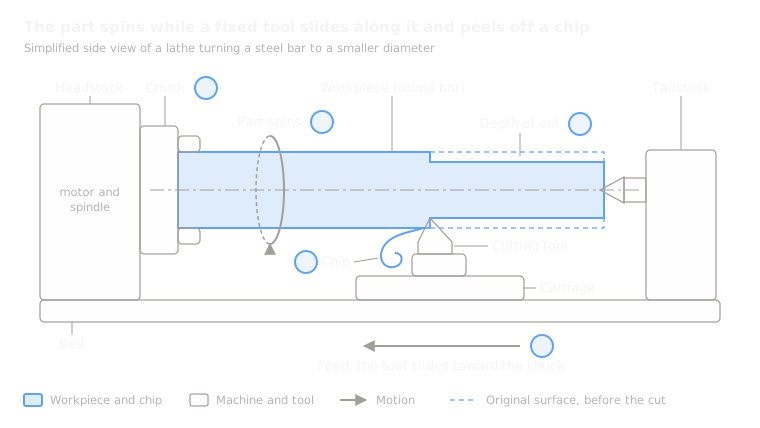 5.1ShortTurning (lathe)The part spins; a single-point tool cuts itOpen the lesson
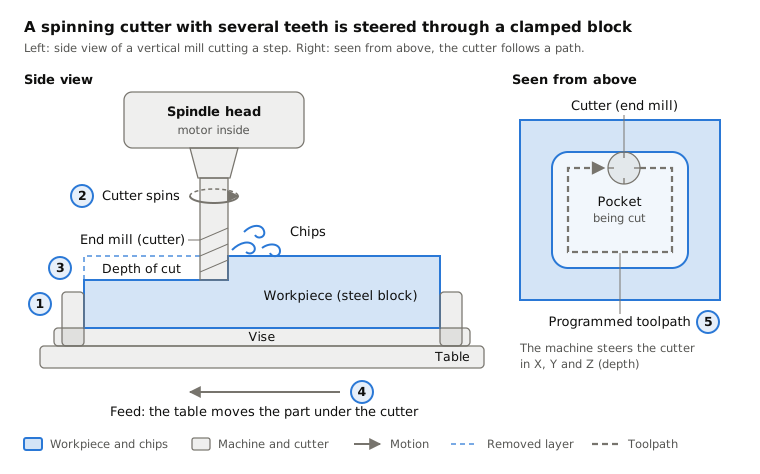
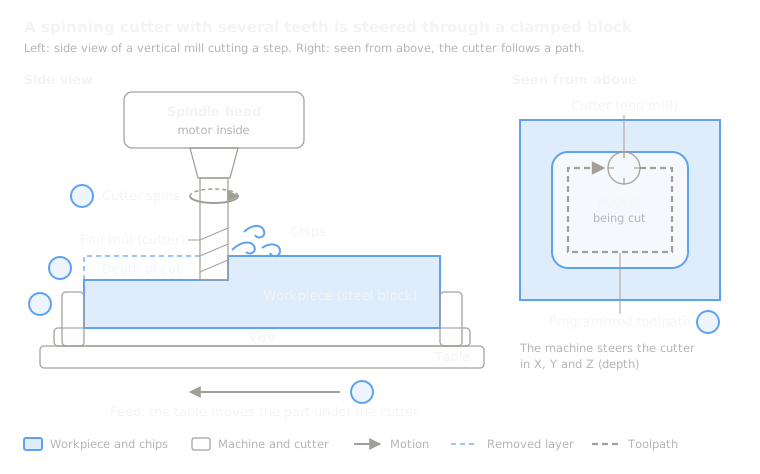 5.2ShortMillingA spinning multi-edge cutter moves over a fixed partOpen the lesson
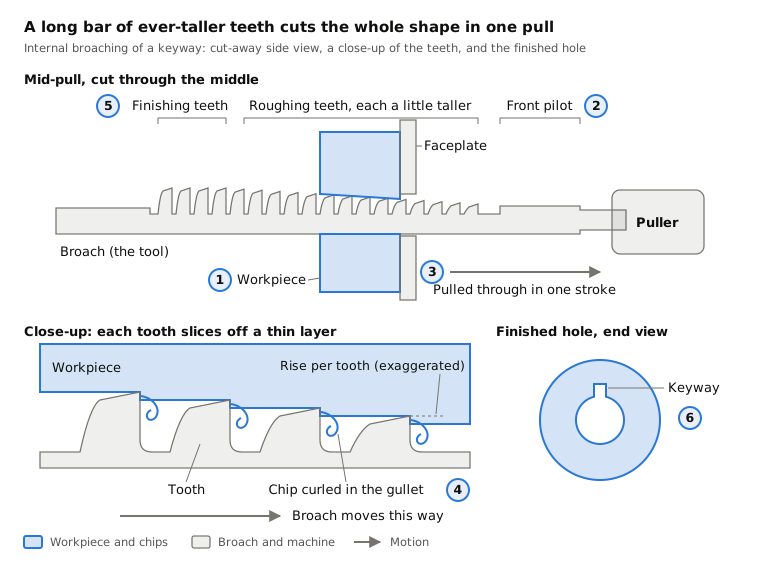
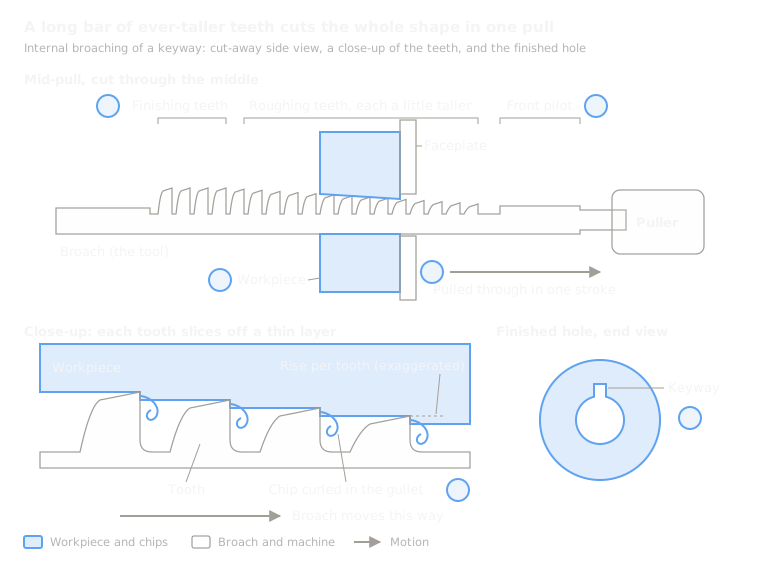 5.4BroachingA long toothed bar is pulled through or across in one strokeOpen the lesson
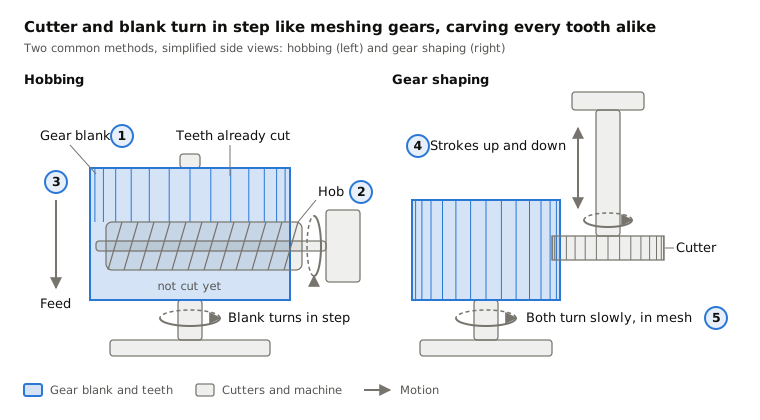
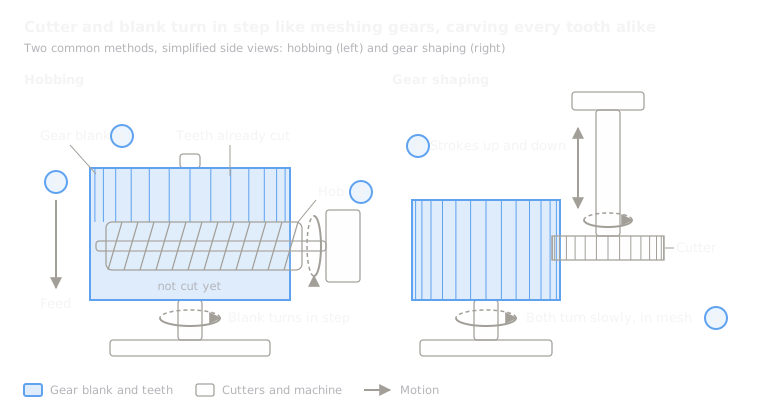 5.5Gear cutting (hobbing, shaping)Hobs or shaper cutters generate gear teethOpen the lesson
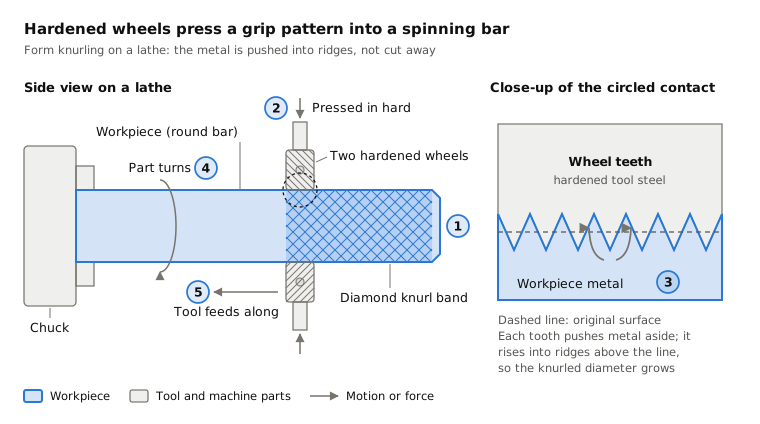
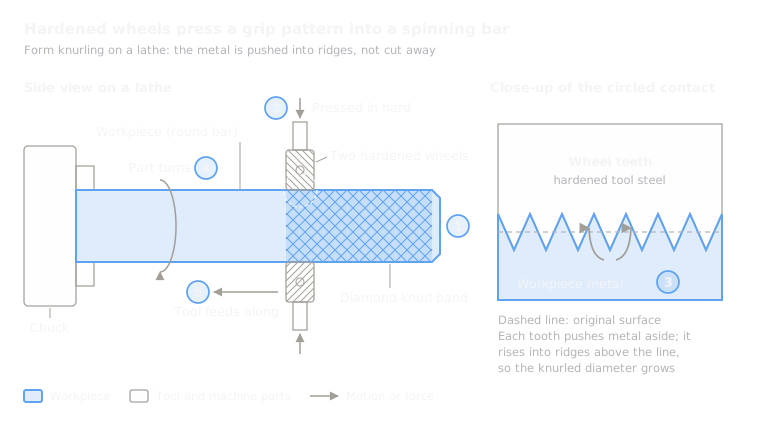 5.6KnurlingHardened wheels press a grip pattern into a turning partOpen the lesson
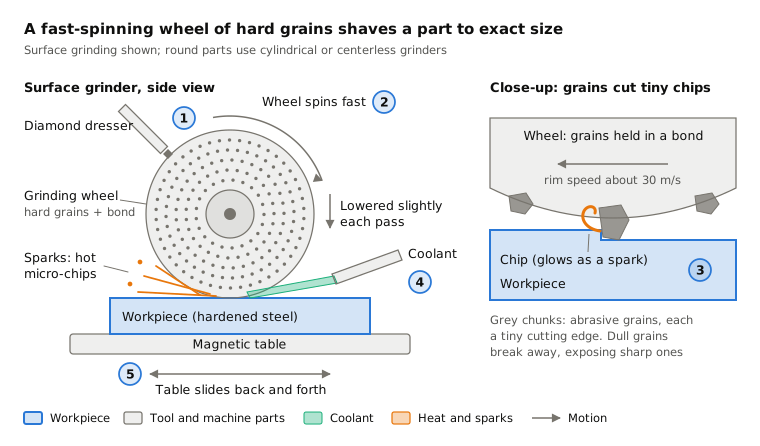
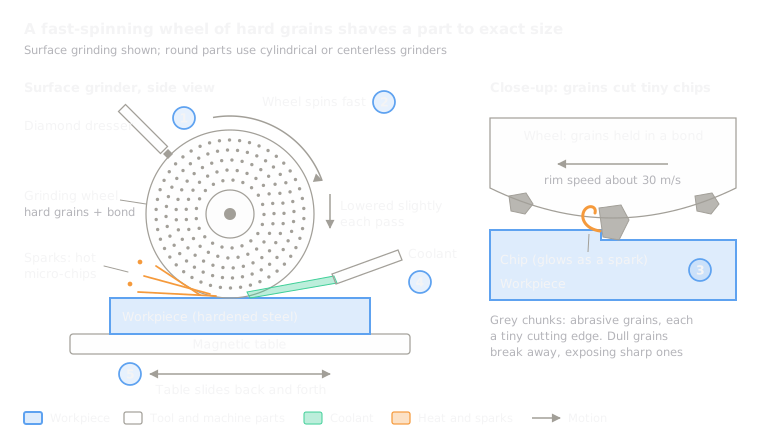 5.7GrindingA fast wheel of hard grains shaves the surfaceOpen the lesson
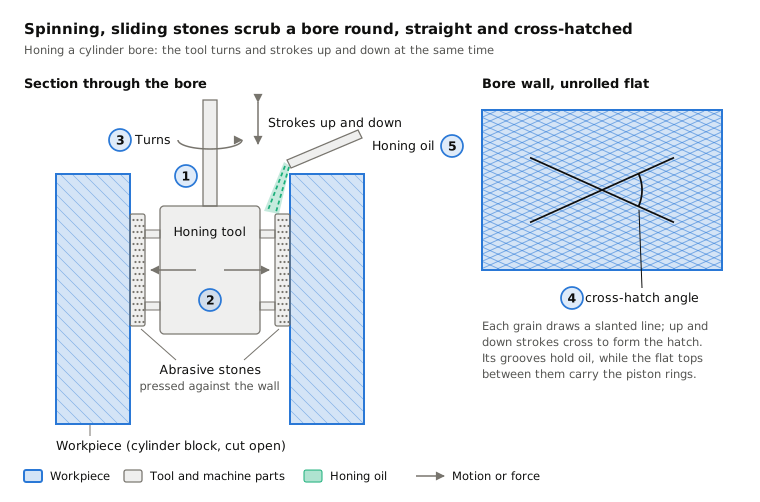
 5.8HoningStones turn and stroke inside a boreOpen the lesson
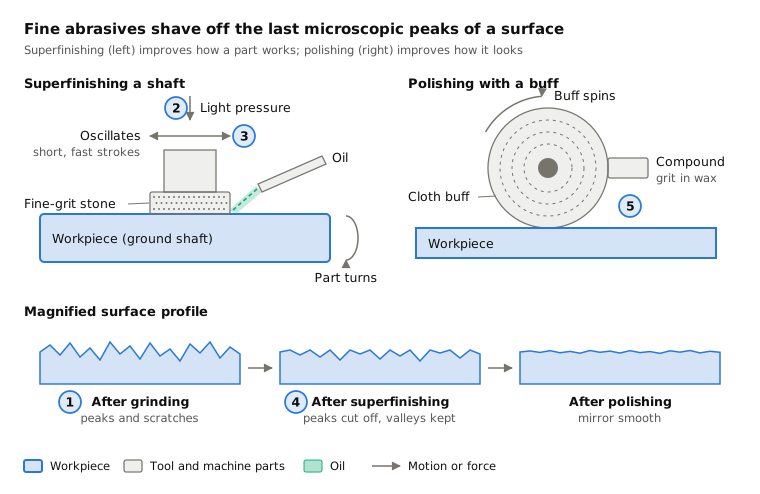
 5.9Superfinishing and polishingFine stones or buffs remove the last microscopic peaksOpen the lesson
Try it
Put AI to work in your CAD.
Model parts, generate drawings and automate the repetitive work inside your CAD software.