

Broaching
A long toothed bar is pulled through or across in one stroke
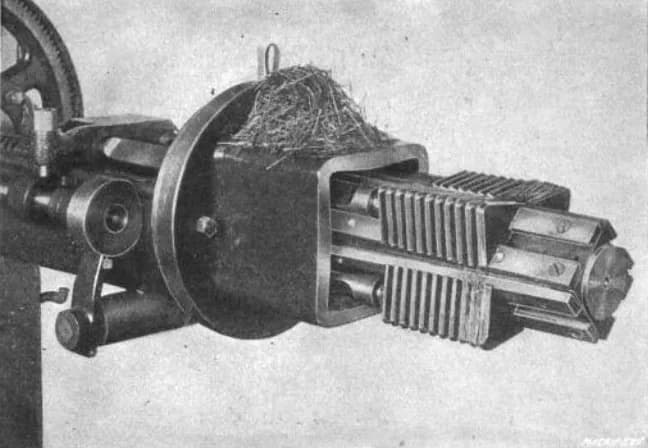
Broaching cuts a whole shape in a single stroke: a long bar covered in teeth, the broach, is pulled or pushed past the workpiece. Each tooth stands a little taller than the one before, so each takes a thin slice. The keyway (a slot that locks a pulley to its shaft) in a bicycle sprocket or a car gear is typically broached.
How it works
Start with a pilot hole. The workpiece already has a plain hole, drilled or bored. It sits against the faceplate (a fixed plate on the machine) that takes the pulling force.
Thread the broach. The front pilot (a smooth guiding section) slides through the hole, and the puller grips the broach's end.
Pull in one stroke. The machine pulls the broach through at a slow, steady speed, typically a few meters per minute.
Each tooth slices a thin layer. The rise per tooth (how much taller each tooth is) is typically a few hundredths of a millimeter. Chips curl into the gullets (the spaces between teeth) and fall out after the stroke.
Finishing teeth size it. The last few teeth all have the same height. They clean up the surface and set the final size.
The shape is done. After one stroke the keyway, spline (a ring of grooves) or hexagon is finished, often in seconds.
Key facts
- Materials
- Steels, cast iron, aluminum, brass, nickel alloys
- Typical parts
- Keyways, splined hubs, square and hexagon holes, gear teeth, slots in turbine disks
- Part size
- Holes from a few millimeters to about 300 mm; surface broaches can be over 1 m long
- Precision
- Typically ±0.01–0.025 mm
- Surface finish
- Typically Ra 0.8–3.2 µm (Ra = average roughness; 1 µm is a thousandth of a millimeter)
- Batch size it suits
- Medium to very high volume; standard keyway broaches suit small shops too
- Tooling and machine cost
- A custom broach costs thousands to tens of thousands of dollars; machines cost tens to hundreds of thousands. A hand keyway set with an arbor press costs a few hundred
- Speed
- Seconds per part for a complete internal shape
Strengths and limits
Strengths
- Very fast: roughing and finishing in one stroke
- Makes shapes that are hard any other way, such as internal splines
- Very consistent from part to part
- Good finish and accuracy without skilled operators
Limits
- Each broach makes only one shape and size
- Custom broaches are expensive and slow to make
- The cut must run straight through, with no obstacle at the end
- The part must be strong enough to take large pulling forces
Where it's used
- AutomotiveSplined hubs in gearboxes, steering rack teeth, keyways in gears
- AerospaceFir-tree slots that hold the blades in turbine disks
- MachineryKeyways in pulleys, sprockets and couplings
- FirearmsRifling grooves inside barrels (traditional method)
- Fasteners and toolsHexagon and star sockets, made by rotary broaching (a small wobbling broach)
How to recognize it
- A slot, spline or polygon inside a hole, with perfectly straight, parallel walls running end to end.
- Fine, straight lines along the direction of the stroke, never circular marks.
- On a polygon socket made by rotary broaching, a slightly rounded bottom where the cut stops.
Compare with
Watch it
ChrisandJimCIM · A classroom explanation of the broaching process
mrpete222 · Pushing a keyway broach through a pulley with an arbor press
Tool Room Engineers Faridabad · An industrial surface broaching machine at work on a flange
Polygon Solutions Inc. · Rotary broaching cutting a spline inside a socket
See real photos
- Wikipedia: Broaching (metalworking) — surface broach photos, a labeled diagram of an internal broach and rotary broach geometry
- Wikimedia Commons photo search
Remember
- A broach is a whole sequence of cuts frozen into one tool.
- Each tooth is slightly taller than the last, so the shape grows tooth by tooth in one stroke.
- Expensive tools, very cheap parts: broaching pays off in volume.
More in Machining
All 100 processes
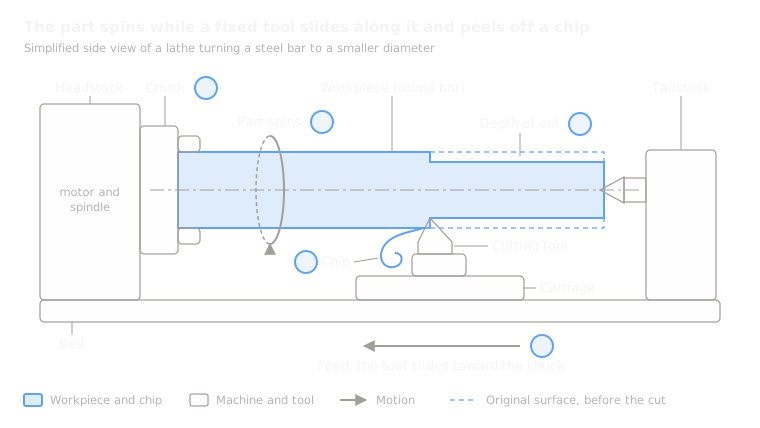 5.1ShortTurning (lathe)The part spins; a single-point tool cuts itOpen the lesson
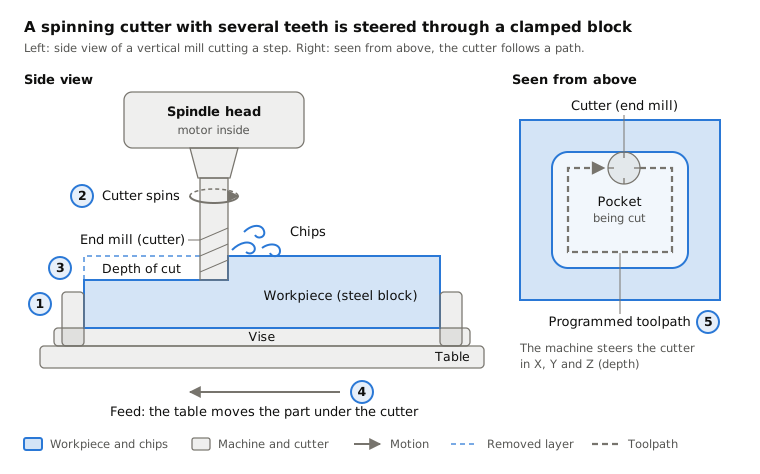
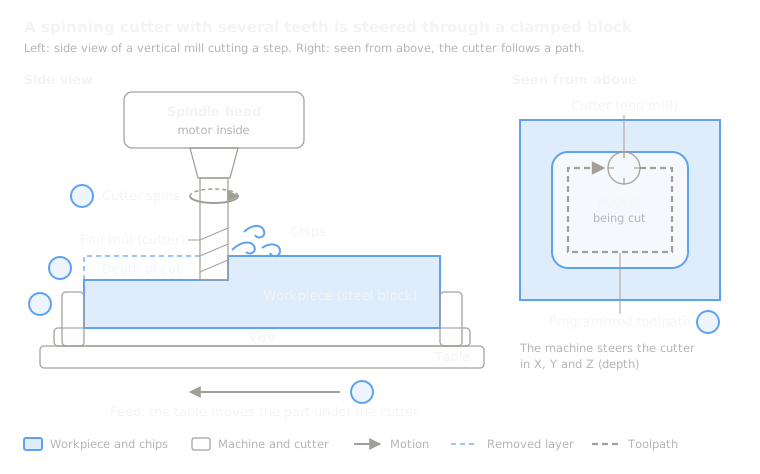 5.2ShortMillingA spinning multi-edge cutter moves over a fixed partOpen the lesson
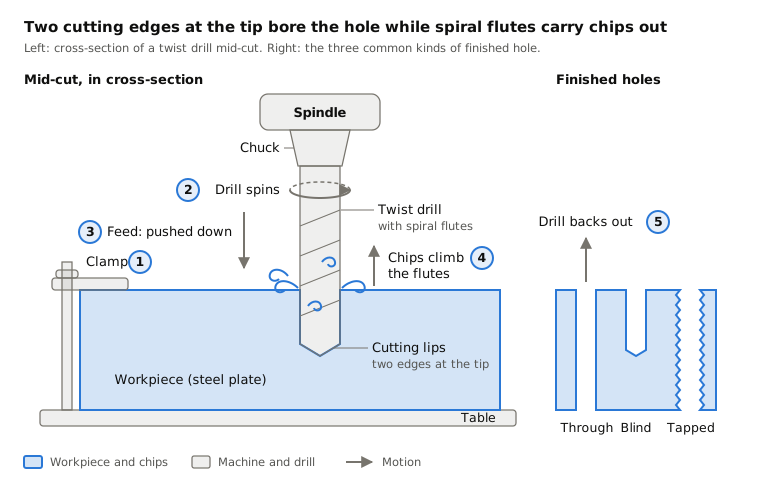
 5.3ShortDrillingA spinning twist drill plunges into the partOpen the lesson
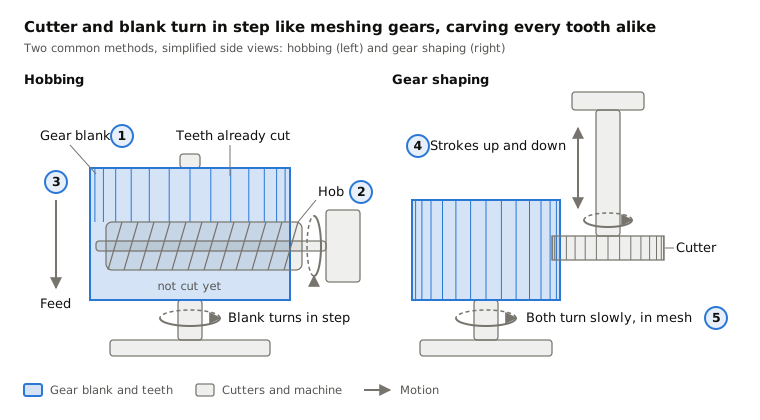
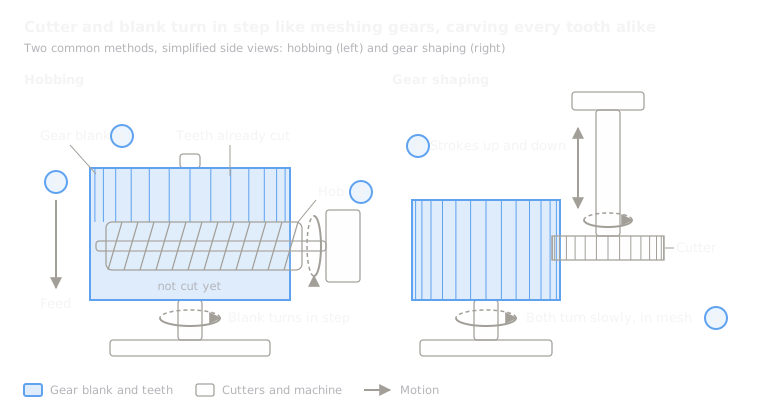 5.5Gear cutting (hobbing, shaping)Hobs or shaper cutters generate gear teethOpen the lesson
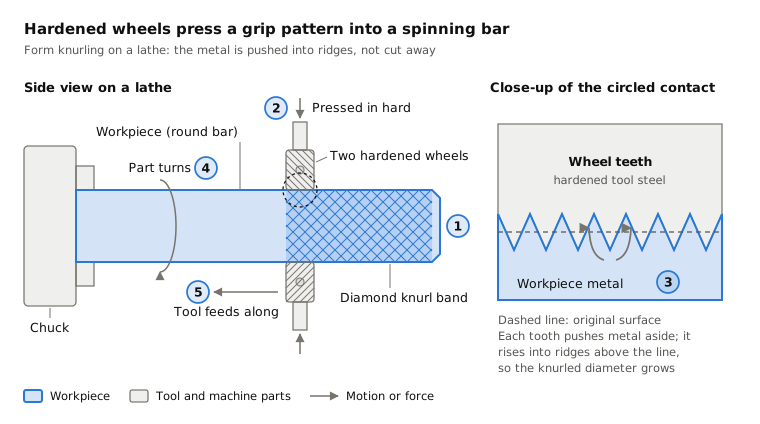
 5.6KnurlingHardened wheels press a grip pattern into a turning partOpen the lesson
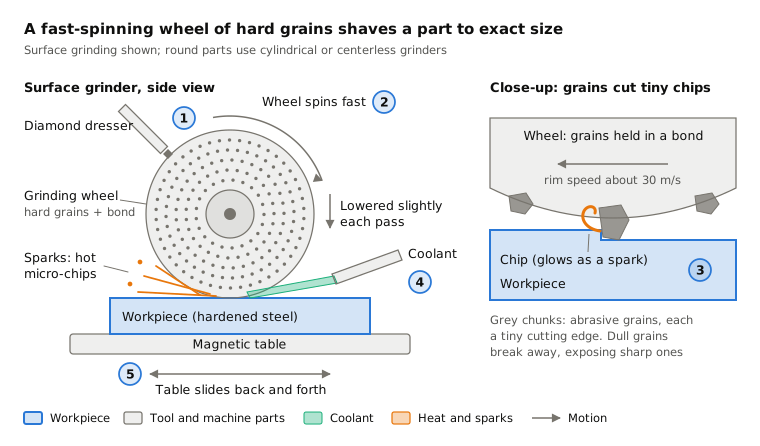
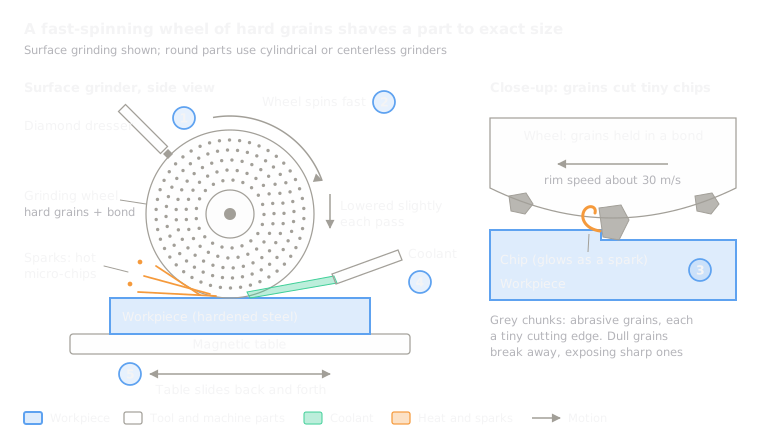 5.7GrindingA fast wheel of hard grains shaves the surfaceOpen the lesson
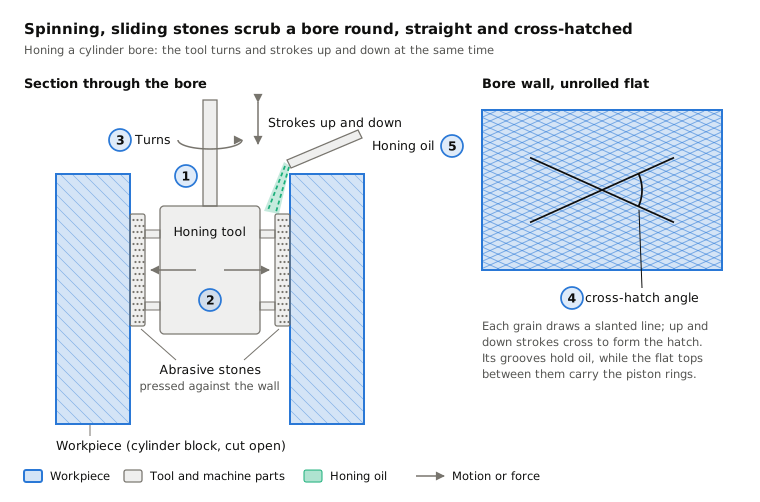
 5.8HoningStones turn and stroke inside a boreOpen the lesson
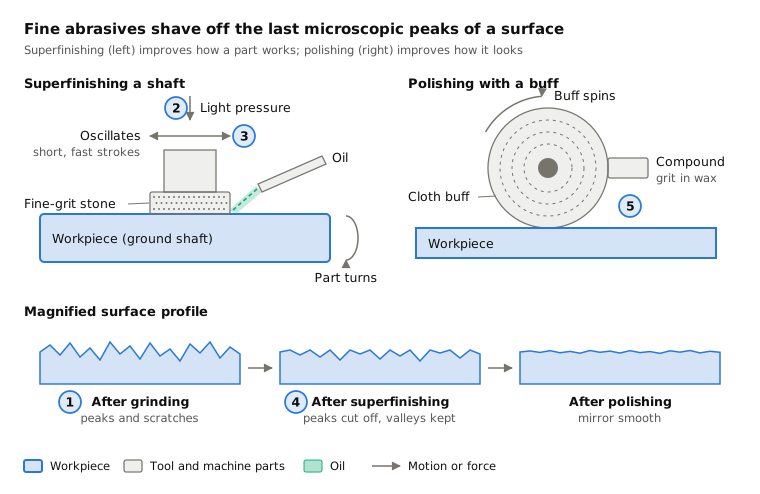
 5.9Superfinishing and polishingFine stones or buffs remove the last microscopic peaksOpen the lesson
Try it
Put AI to work in your CAD.
Model parts, generate drawings and automate the repetitive work inside your CAD software.