

Honing
Stones turn and stroke inside a bore
Honing finishes the inside of a hole by scrubbing it with abrasive stones that turn and slide up and down at the same time. It gives an engine cylinder its round, straight bore and the fine crisscross pattern that holds oil for the piston rings. Hydraulic cylinders, gear bores and fuel-injection parts are honed too.
How it works
Insert the hone. The honing tool slides into a bore that was already drilled, bored or ground close to size. Its shaft often floats slightly, so the tool follows the bore's own axis.
Expand the stones. A cone or wedge inside the tool pushes several long abrasive stones (sticks of bonded grit) outward against the wall with steady, gentle pressure.
Turn and stroke together. The tool rotates while moving up and down along the bore. Because the stones are long, they rub the high spots first and wear them away, so the bore becomes rounder and straighter.
Form the cross-hatch. Every grain draws a slanted scratch, and scratches from up-strokes cross those from down-strokes. The angle, often around 45°, is set by the ratio of stroking speed to turning speed.
Flush and measure. Honing oil washes away chips and worn grit. A gauge checks the diameter, and honing stops at size, typically after removing a few hundredths of a millimeter.
Key facts
- Materials
- Cast iron, steels (hardened too), aluminum bores with liners or coatings, bronze, ceramics
- Typical parts
- Engine cylinders, hydraulic cylinders, connecting-rod and gear bores, valve and injector bodies
- Part size
- Bores from a few millimeters to around 1 m across; hydraulic tubes can be several meters long
- Precision
- Roundness and straightness within a few micrometers; size typically held to about ±0.005 mm
- Surface finish
- A controlled cross-hatch; roughness typically Ra 0.1–0.8 µm, depending on the grit
- Batch size it suits
- From a single engine rebuild to automated lines honing millions of cylinders
- Tooling and machine cost
- Stones and hone heads cost tens to hundreds of dollars; production honing machines are a major investment
- Speed
- Typically under a minute per bore in production; longer for big bores
Strengths and limits
Strengths
- Corrects roundness, straightness and taper left by earlier steps
- Leaves an oil-holding cross-hatch that helps piston rings seal and wear in
- Works on hardened steel and cast iron
- Low forces and temperatures, so no burned or stressed surface layer
Limits
- Removes little material, so the bore must already be close to size
- Cannot move a bore's position: the floating tool follows the existing hole
- Mostly limited to round bores (some machines also do outside diameters or flats)
- Stones wear, and their grit must suit the material and the finish wanted
Where it's used
- AutomotiveEngine cylinder bores, connecting-rod and gear bores
- HydraulicsCylinder tubes, valve bodies, pump housings
- Fuel systemsInjector and fuel-pump bores
- AerospaceLanding-gear cylinders, actuator bores
- Engine rebuildingRe-honing worn cylinders before fitting new piston rings
How to recognize it
- A fine crisscross of straight scratches inside a bore, at a regular angle.
- A satin, even grey finish in a cylinder rather than a mirror shine.
- On a worn engine, the cross-hatch is polished away where the rings rub most.
- Honed hydraulic tubes feel smooth but show faint crossing lines in raking light.
Compare with
Watch it
Car Cure · Why engines need a cross-hatch, explained for beginners
Uncle Tony's Garage · Hands-on honing, choosing stones and checking the cross-hatch
Sunnen Products Company · An automated vertical honing machine in production
Chris Fisher · A flexible ball hone, the simple shop variant
See real photos
- Wikipedia: Honing (metalworking) — honing tools, honed cylinder bores and the cross-hatch, with photos
- Wikimedia Commons photo search
Remember
- Honing scrubs a bore with stones that turn and stroke at the same time.
- It perfects roundness, straightness and size, but it cannot move the hole.
- The cross-hatch it leaves holds oil, so piston rings seal and last.
More in Machining
All 100 processes
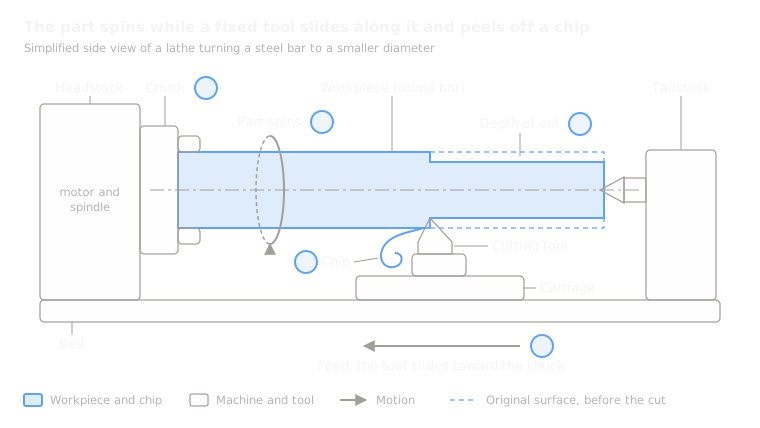 5.1ShortTurning (lathe)The part spins; a single-point tool cuts itOpen the lesson
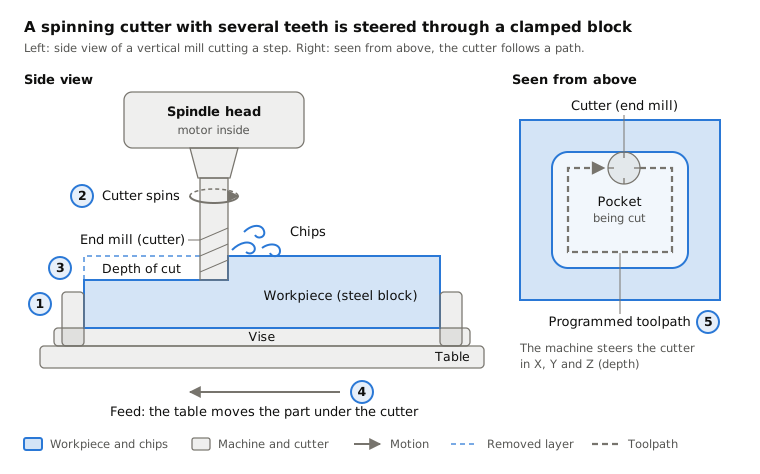
 5.2ShortMillingA spinning multi-edge cutter moves over a fixed partOpen the lesson
 5.3ShortDrillingA spinning twist drill plunges into the partOpen the lesson
 5.4BroachingA long toothed bar is pulled through or across in one strokeOpen the lesson
 5.5Gear cutting (hobbing, shaping)Hobs or shaper cutters generate gear teethOpen the lesson
 5.6KnurlingHardened wheels press a grip pattern into a turning partOpen the lesson
 5.7GrindingA fast wheel of hard grains shaves the surfaceOpen the lesson
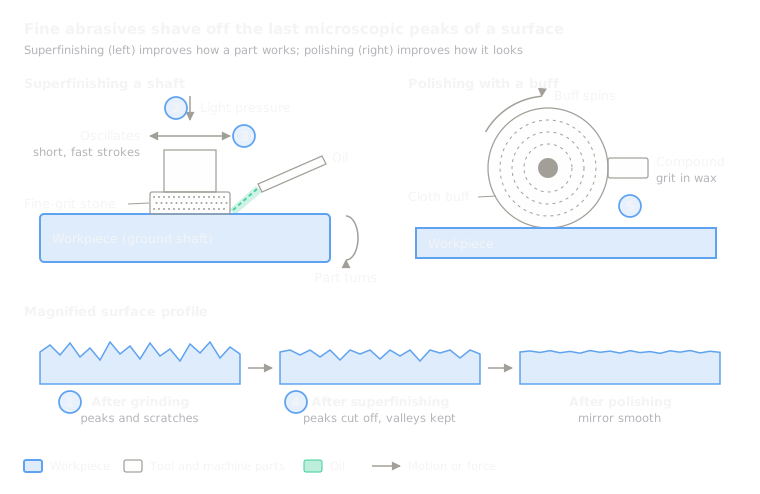 5.9Superfinishing and polishingFine stones or buffs remove the last microscopic peaksOpen the lesson
Try it
Put AI to work in your CAD.
Model parts, generate drawings and automate the repetitive work inside your CAD software.