

Friction stir welding
Solid state: a spinning tool stirs softened edges together
Friction stir welding joins metal plates by pushing a spinning tool along the joint: friction softens the metal and the tool stirs both edges into one, without ever melting them. It is like kneading two lumps of clay together. Invented in 1991 at TWI in the UK, it now builds rocket fuel tanks, train bodies and electric-car battery trays.
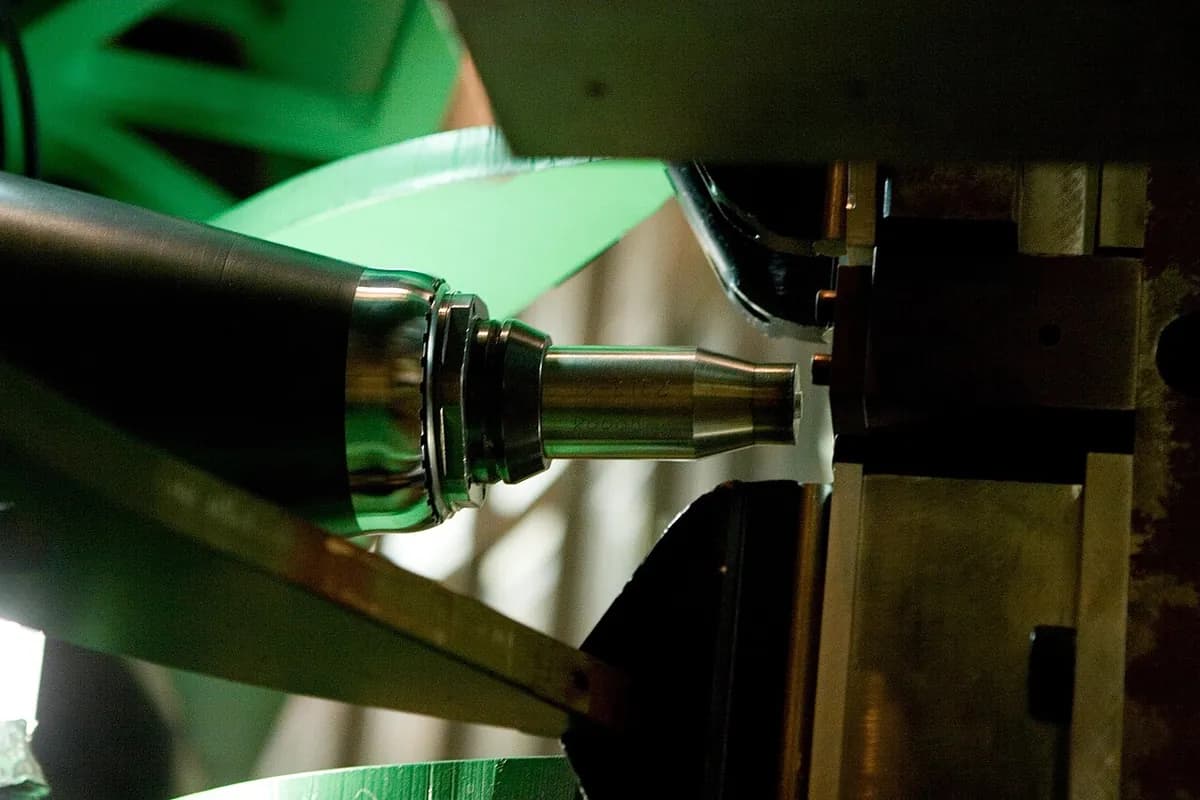
How it works
Clamp firmly. The plates are butted together on a backing bar and clamped hard, because the tool pushes them apart with large forces.
Spin and plunge. A hard tool, typically turning a few hundred to about 2,000 rpm, pushes its pin into the joint until the wider shoulder touches the surface.
Heat by friction. The shoulder rubbing on the metal heats it to roughly 70–90% of its melting temperature. The metal goes soft like modeling clay but stays solid.
Travel and stir. The tool moves along the joint. The threaded pin sweeps softened metal from the front around to the back, mixing the two edges together.
Forge and finish. The shoulder presses the stirred metal down as it cools into a solid seam with fine grains. At the end the tool lifts out, leaving a small exit hole, often on a scrap tab.
Why no melting helps. Melting and refreezing cause most weld defects: gas bubbles, cracks and weak cast grains. Friction stir welds avoid them, so aluminum alloys that are hard to fusion weld join well, with little distortion and no fumes, sparks or filler.
Key facts
- Materials
- Mainly aluminum alloys; also magnesium, copper and dissimilar pairs; steel and titanium with costly special tools
- Typical parts
- Rocket fuel tanks, rail car bodies, ship deck panels, battery trays, heat sinks
- Part size
- Sheets of about 1 mm up to aluminum plates several centimeters thick; seams many meters long
- Precision
- Low distortion; seam position within a fraction of a millimeter on CNC machines
- Surface finish
- Smooth seam with fine half-moon ripples, slightly below the surface; small flash (burrs) at the edges
- Batch size it suits
- Medium to large series of long, straight or gently curved seams
- Tooling and machine cost
- Tens of thousands for a CNC conversion to well over $1 million for large dedicated machines
- Speed
- Typically 0.1–2 m of seam per minute, in a single pass
Strengths and limits
Strengths
- No melting, so no porosity or hot cracks
- Joins aluminum alloys that are hard to fusion weld
- Low distortion, and strong, fine-grained welds
- No filler, no gas, no fumes or sparks
Limits
- Needs heavy, rigid machines and strong clamping
- Leaves an exit hole at the end of each seam
- Best on simple straight or flat joints
- Steel and titanium wear tools quickly
Where it's used
- SpaceFuel and oxidizer tanks of launch vehicles
- RailAluminum car bodies of high-speed and commuter trains
- ShipbuildingLarge aluminum deck and hull panels
- AutomotiveBattery trays for electric cars, wheels, suspension parts
- Electronics and heatingHeat sinks, cold plates, boiler heat exchangers
How to recognize it
- A smooth, flat seam with fine, evenly spaced half-moon marks all pointing the same way.
- A slight dip where the shoulder pressed, with thin curled burrs (flash) along the edges.
- A round exit hole at the end of the seam, unless it was cut off.
Compare with
Watch it
TheGrenzebachGroup · The principle, explained by a machine maker
RIFTEC GmbH - Videos · Plunge, travel and the solid-state joint, step by step
Manufacturing Technology, Inc. (MTI) · A real weld from plunge to exit hole
ESAB · An industrial machine at work
See real photos
- Wikipedia: Friction stir welding — the tool, the stirred zone, and rail, space, ship and car uses
- Wikimedia Commons photo search
Remember
- Friction, not a flame or an arc, heats the metal, and it never melts.
- The pin stirs the two softened edges into one, and the shoulder forges them down.
- It shines on long aluminum seams: strong, clean and with little distortion.
More in Joining
All 100 processes
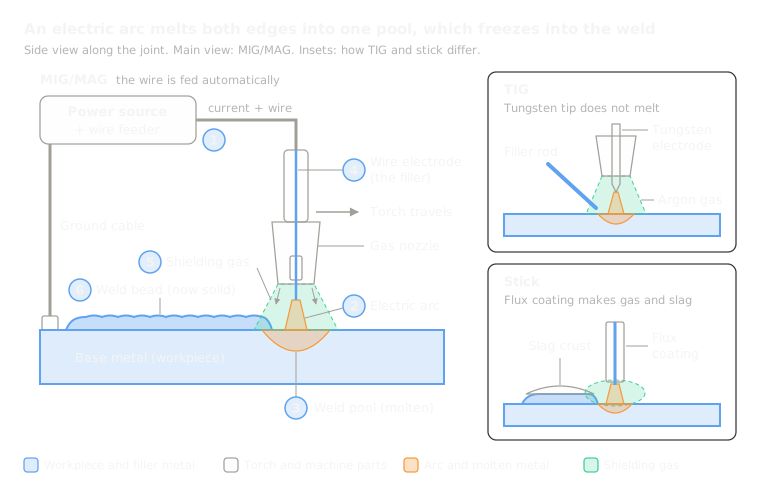 7.1ShortArc welding (MIG/MAG, TIG, stick)Fusion: an electric arc melts the edges and usually a fillerOpen the lesson
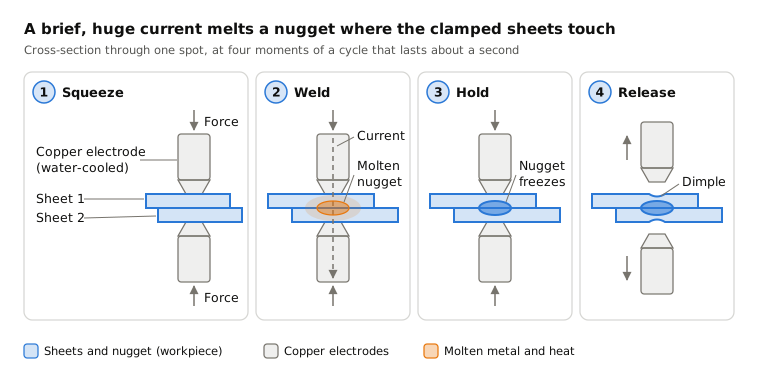
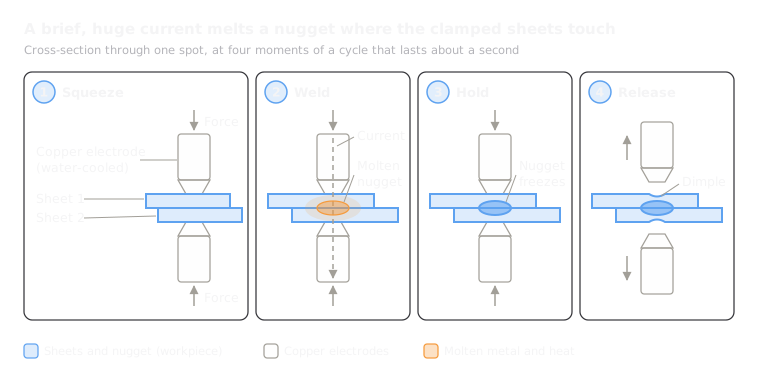 7.2Resistance spot weldingFusion: a pulse of current melts a nugget between clamped sheetsOpen the lesson
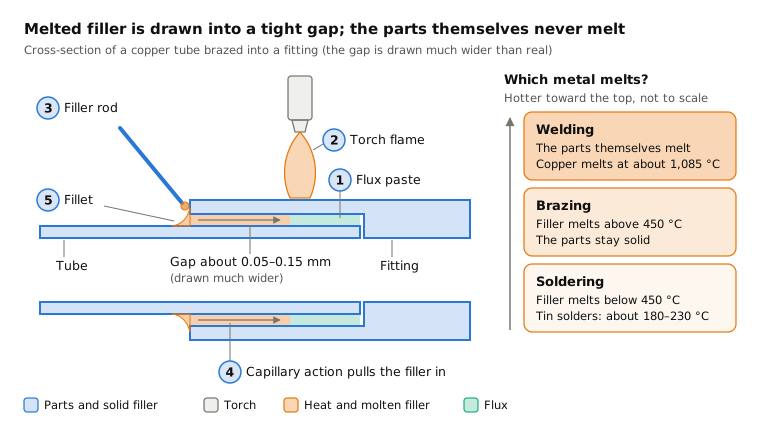
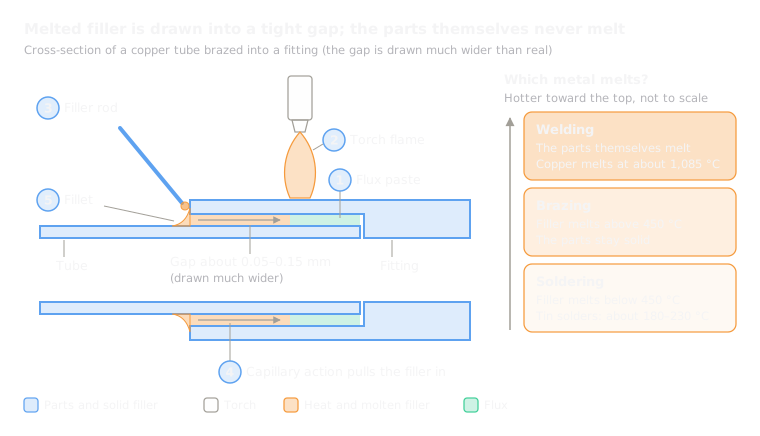 7.3Brazing and solderingFiller only: a lower-melting filler flows into a tight gapOpen the lesson
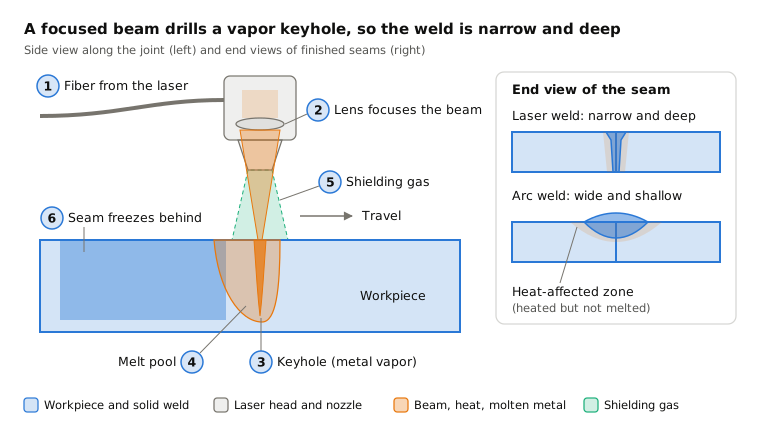
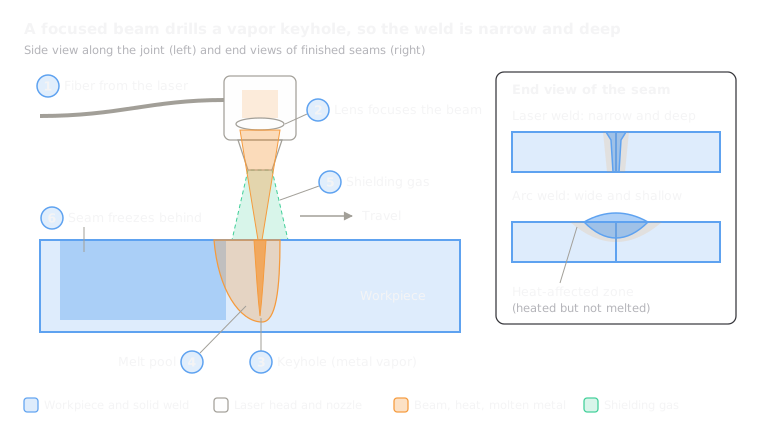 7.4Laser weldingFusion: a focused laser drills a keyhole for narrow, deep weldsOpen the lesson
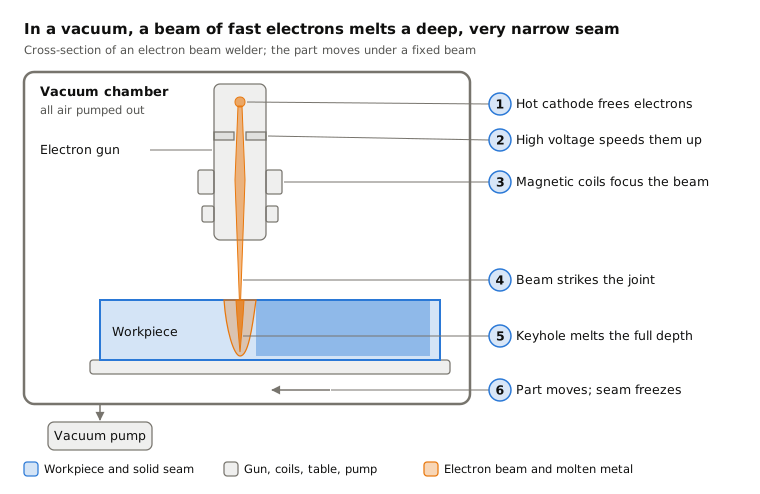
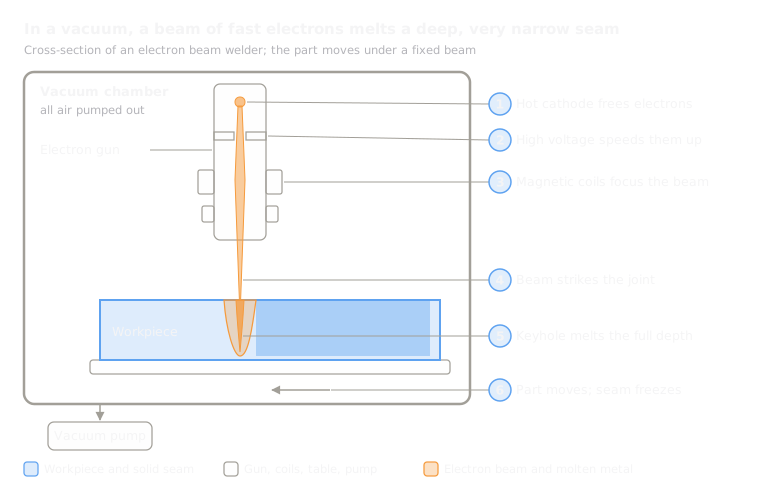 7.5Electron beam weldingFusion: an electron beam in a vacuum welds very thick metalOpen the lesson
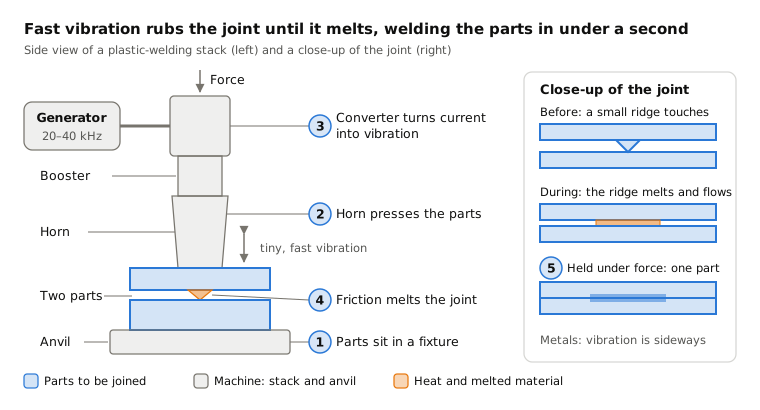
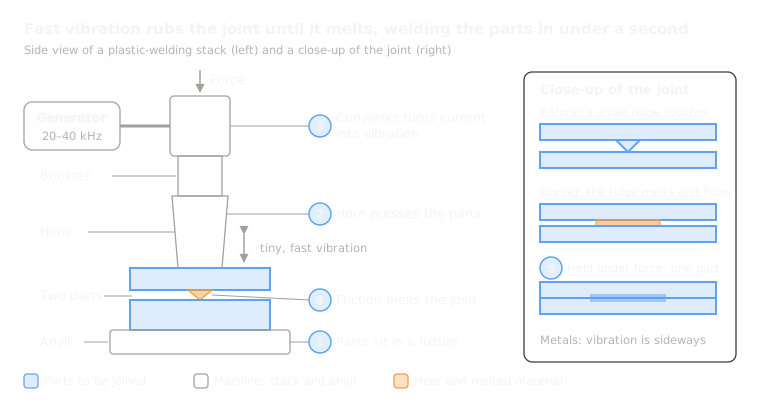 7.7Ultrasonic weldingSolid state: fast vibration bonds small joints in under a secondOpen the lesson
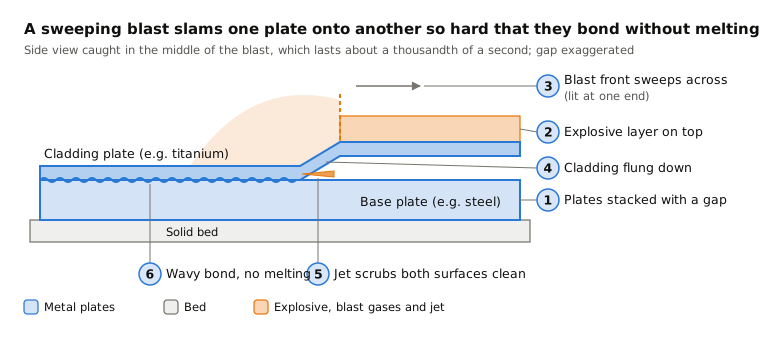
 7.8Explosion welding (cladding)Solid state: a blast slams one plate onto anotherOpen the lesson
Try it
Put AI to work in your CAD.
Model parts, generate drawings and automate the repetitive work inside your CAD software.