

Explosion welding (cladding)
Solid state: a blast slams one plate onto another
Explosion welding bonds a thin plate of one metal onto a thick plate of another by slamming them together with a controlled blast. The impact is so fast and violent that the clean surfaces join solidly without melting. It makes cladded plates (a cheap structural metal covered with a costly corrosion-resistant one), such as titanium on steel, that no other welding method can join.
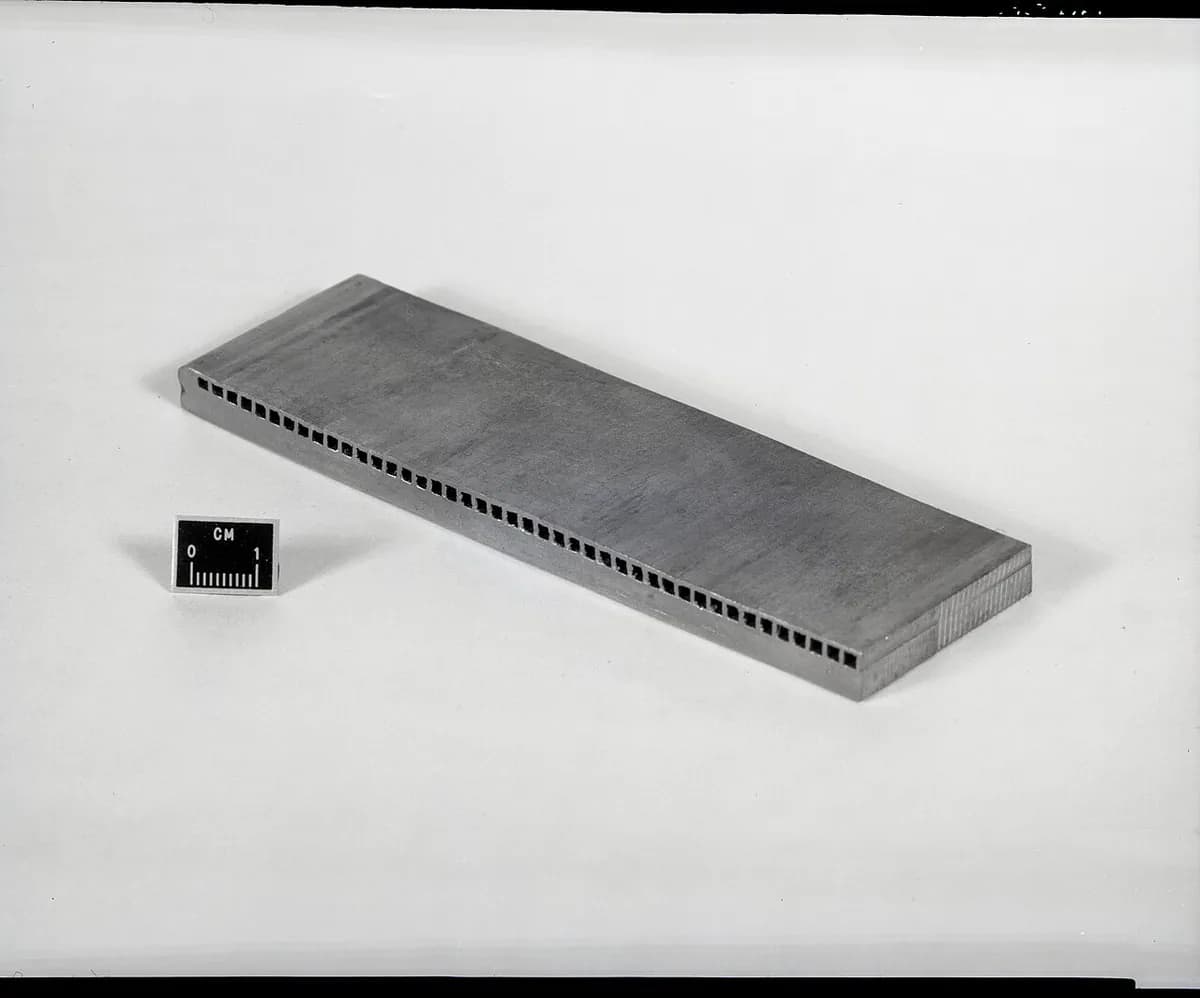
How it works
Stack the plates. The thick base plate lies on a solid bed of sand or steel. The thinner cladding plate sits above it on small spacers, leaving a gap of typically a few millimeters.
Spread the explosive. An even layer of a slow, granular explosive, often a few centimeters thick, covers the cladding plate.
Detonate at one end. The detonation front sweeps across the plate at typically about 2,000–3,000 meters per second.
Fling the cladding down. Behind the front, the cladding plate bends and hits the base plate at several hundred meters per second, at a small angle.
Scrub with a jet. At the moving collision point, the enormous pressure squirts a thin jet of surface metal forward. It strips away oxides and dirt from both plates.
Bond without melting. The freshly cleaned surfaces are pressed together so hard that their atoms bond, leaving a typical wavy interface. The whole weld takes about a thousandth of a second.
Why it is special. Metals such as titanium and steel form brittle compounds when melted together, so fusion welding them fails. Because explosion welding never melts them, it joins pairs that nothing else can, over areas of many square meters at once.
Key facts
- Materials
- Almost any pair of ductile metals: steel with stainless steel, titanium, zirconium, nickel alloys, copper or aluminum
- Typical parts
- Clad plates for pressure vessels, heat-exchanger tube sheets, aluminum-to-steel transition joints, electrical connectors for smelters
- Part size
- Cladding typically a few millimeters to a few centimeters thick; plates up to several meters across
- Precision
- Low: plates are flattened, cut and machined after bonding
- Surface finish
- Rough and marked by the blast; the outer face is ground or polished afterward
- Batch size it suits
- One-off plates and small batches made to order
- Tooling and machine cost
- Little machinery, but a licensed remote blast site, explosives and specialist staff; each plate costs thousands of dollars or more
- Speed
- The weld takes about a millisecond; preparing and finishing a plate takes hours to days
Strengths and limits
Strengths
- Joins metal pairs that cannot be fusion welded
- Bonds very large areas in one shot
- No heat-affected zone: each metal keeps its properties
- Bond is often stronger than the weaker of the two metals
Limits
- Needs explosives, a remote site and strict safety rules
- Mostly limited to flat plates and simple tubes
- Noise and vibration restrict where and when it can be done
- Brittle metals crack under the impact
Where it's used
- Chemicals and oilReactor vessels and columns with titanium or zirconium linings
- Power and desalinationHeat-exchanger tube sheets in condensers
- ShipbuildingAluminum-to-steel transition strips for joining aluminum decks to steel hulls
- Aluminum smeltingAluminum-to-steel electrical connectors
- ArtSculptures made by blasting layered metal sheets
How to recognize it
- A plate with two different metals bonded face to face, with a perfectly sharp boundary on the cut edge.
- Under a magnifier, that boundary is wavy, like a frozen ripple, instead of straight.
- No weld beads anywhere: the joint is the whole face of the plate.
Compare with
Watch it
NobelClad · What explosion welding is and why it bonds
NobelClad · Plate preparation, standoff, explosive layer and detonation, step by step
NobelClad · The industrial process from start to finished plate
Sichuan Jinglei Science and Technology Co., Ltd. · A real outdoor blast cladding a large plate
See real photos
- Wikipedia: Explosion welding — history, materials and limits; few photos
- Wikimedia Commons photo search
Remember
- A blast flings one plate onto another so fast that their clean surfaces bond without melting.
- A jet of metal at the collision point scrubs both surfaces clean just before they touch.
- It is the go-to method for cladding: joining costly corrosion-resistant metals onto cheap steel over large areas.
More in Joining
All 100 processes
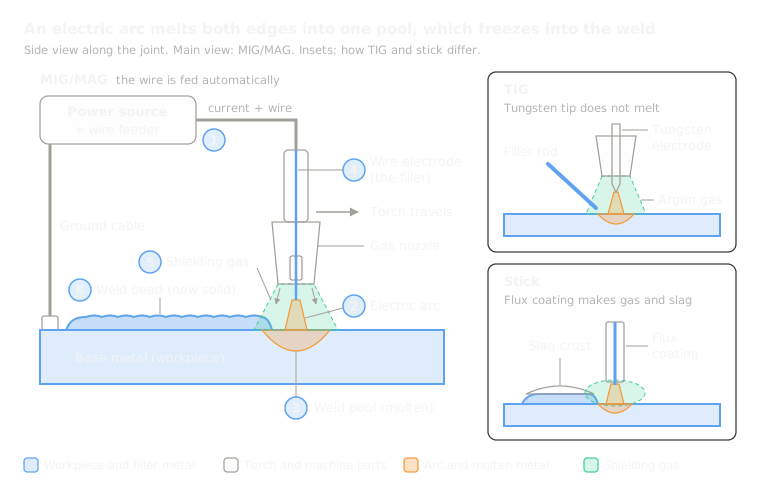 7.1ShortArc welding (MIG/MAG, TIG, stick)Fusion: an electric arc melts the edges and usually a fillerOpen the lesson
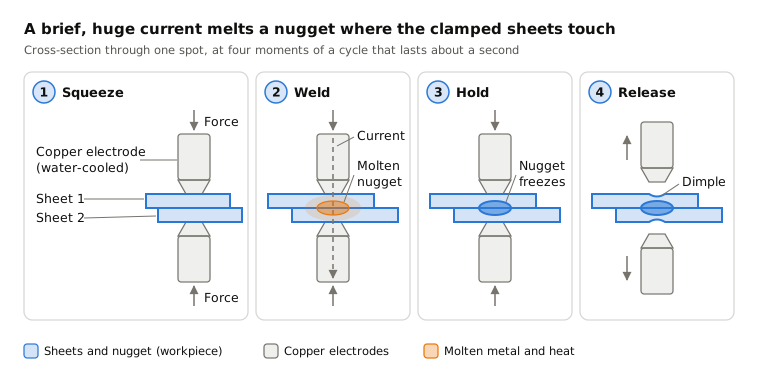
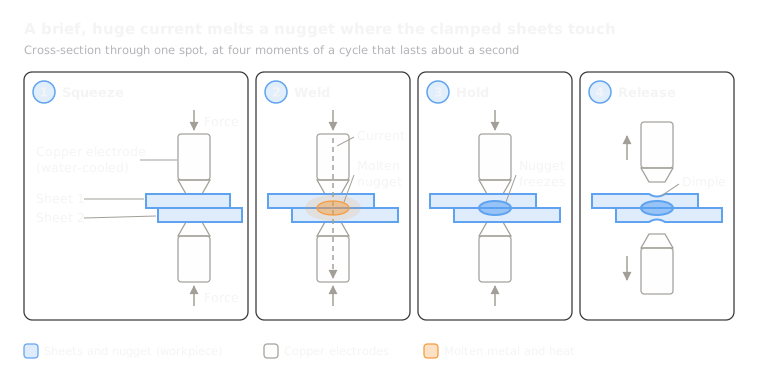 7.2Resistance spot weldingFusion: a pulse of current melts a nugget between clamped sheetsOpen the lesson
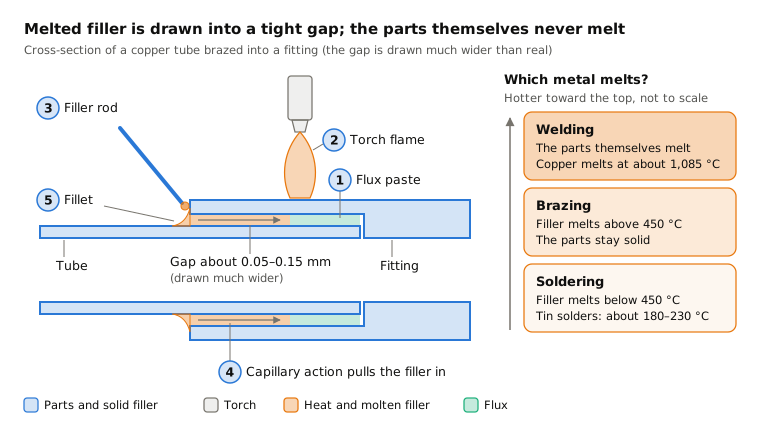
 7.3Brazing and solderingFiller only: a lower-melting filler flows into a tight gapOpen the lesson
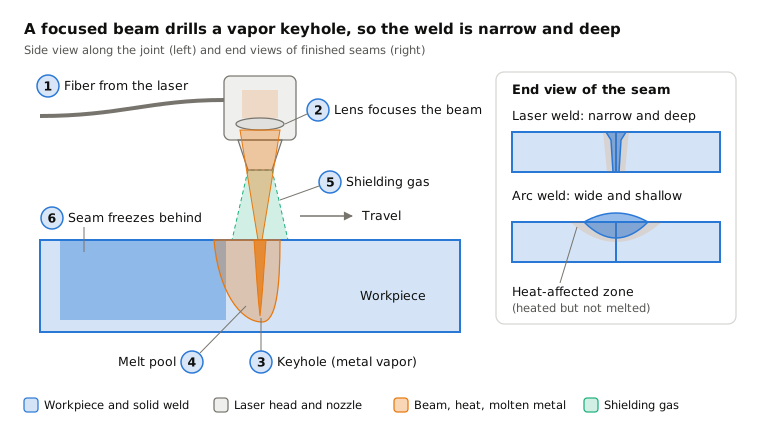
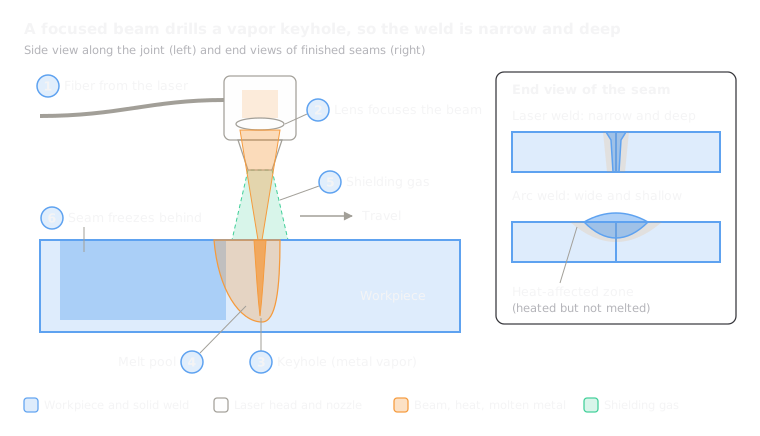 7.4Laser weldingFusion: a focused laser drills a keyhole for narrow, deep weldsOpen the lesson
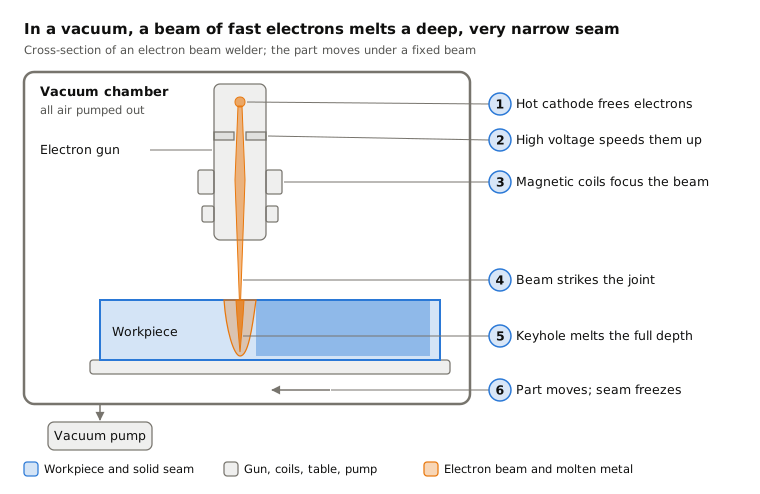
 7.5Electron beam weldingFusion: an electron beam in a vacuum welds very thick metalOpen the lesson
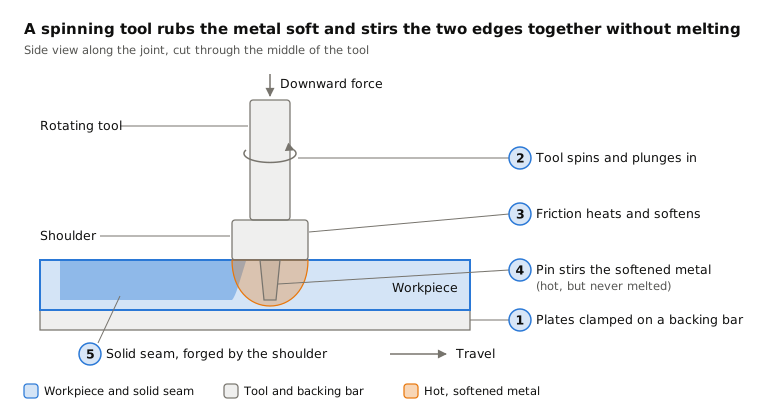
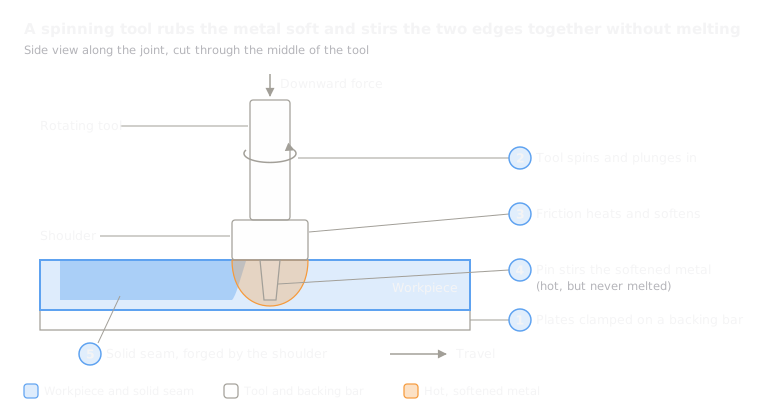 7.6Friction stir weldingSolid state: a spinning tool stirs softened edges togetherOpen the lesson
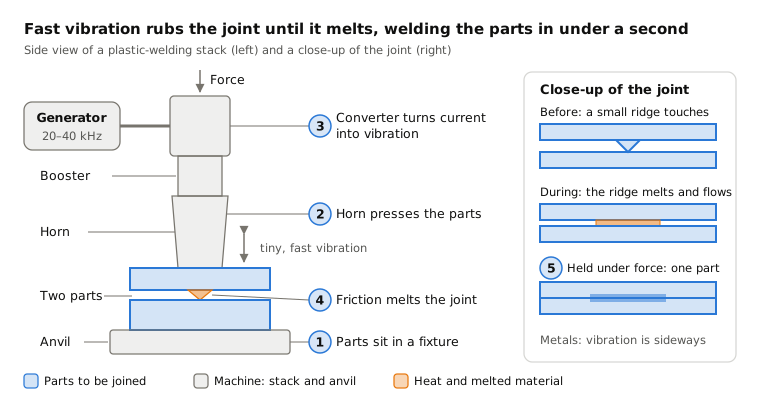
 7.7Ultrasonic weldingSolid state: fast vibration bonds small joints in under a secondOpen the lesson
Try it
Put AI to work in your CAD.
Model parts, generate drawings and automate the repetitive work inside your CAD software.