

Laser welding
Fusion: a focused laser drills a keyhole for narrow, deep welds
Laser welding melts the joint with a tightly focused beam of light, making narrow, deep welds at high speed. Because the heat is so concentrated, parts barely warp. It joins car bodies, battery cells and medical implants, usually with robots or fast-moving mirrors.
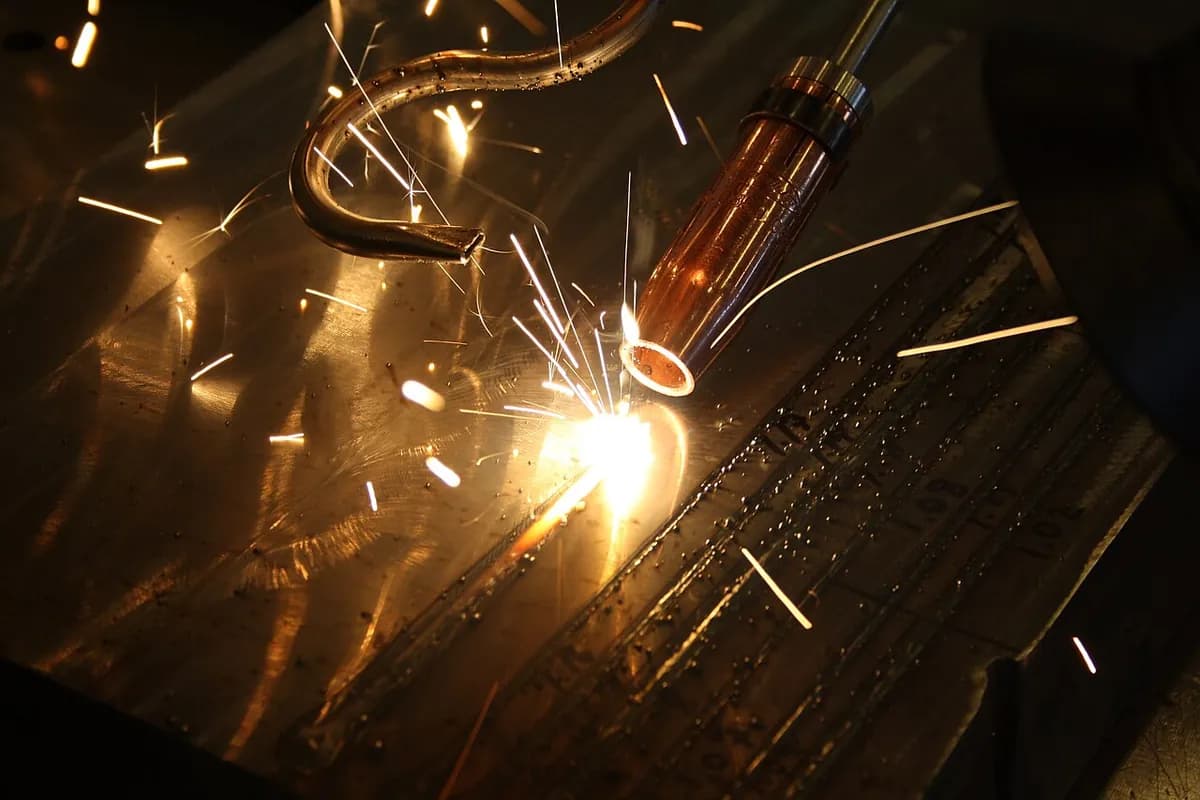
How it works
Make and deliver the beam. A laser source, today usually a fiber laser of about 1–10 kW, makes an intense infrared beam. An optical fiber carries it to the welding head.
Focus it. A lens squeezes the beam into a spot a few tenths of a millimeter wide. That puts more than a million watts on each square centimeter.
Drill a keyhole. The metal under the spot melts and partly boils. The vapor pressure holds open a thin channel, the keyhole, which lets the beam reach deep into the joint.
Let the melt flow around. As the head moves, molten metal flows around the keyhole and closes up behind it.
Shield the pool. A gas such as argon, helium or nitrogen protects the hot metal from air and pushes away the plume (the cloud of metal vapor above the spot).
Freeze fast. The small pool solidifies almost instantly into a narrow, deep seam. The heat-affected zone (metal changed by heat but not melted) stays thin.
Two modes. At lower power density the laser only melts the surface, giving a shallow, smooth seam (conduction mode) for thin sheet and visible joints. Above a threshold it opens a keyhole, which can make welds up to about ten times deeper than they are wide.
Key facts
- Materials
- Carbon and stainless steels, aluminum, titanium, nickel alloys; copper with green or blue lasers or special settings; some plastics
- Typical parts
- Car roofs and doors, tailored blanks (sheets of different thickness joined before stamping), battery tabs, gears, pacemaker cases
- Part size
- From foils under 0.1 mm to plates of roughly 20 mm in one pass with high power; parts as large as a car body with robots
- Precision
- Beam placed within about ±0.1 mm; very low distortion, but parts must fit with gaps of roughly 0.1 mm or less
- Surface finish
- Narrow, smooth seam, often nearly flush; little spatter
- Batch size it suits
- Large series with automation; handheld units now also serve job shops
- Tooling and machine cost
- Roughly $10,000 and up for a handheld fiber laser welder; several hundred thousand dollars or more for a robotic cell
- Speed
- Typically 1–10 m of seam per minute on thin sheet; scanner heads jump between welds in milliseconds
Strengths and limits
Strengths
- Narrow, deep welds with little heat and distortion
- Very fast and easy to automate, even from a distance with scanning mirrors
- Welds from one side, without touching the part
- Precise enough for tiny medical and electronic parts
Limits
- Expensive equipment and strict laser safety: the beam and its reflections can blind
- Needs tight fit-up: gaps and misalignment cause defects
- Shiny metals like copper and aluminum reflect much of the beam
- Very fast cooling can make hard, brittle welds in high-carbon steels
Where it's used
- AutomotiveRoofs, doors, tailored blanks, gears and transmission parts
- Batteries and e-mobilityCell tabs, busbars (thick connecting strips), battery housings
- MedicalPacemaker and implant housings, surgical instruments
- ElectronicsSensor housings, connectors, sealed packages
- Kitchen equipmentStainless sinks, appliance panels and tubes
How to recognize it
- A very thin, even seam, often only 1–2 mm wide, with fine regular ripples.
- Little or no heat tint or warping beside the seam.
- Rows of tiny overlapping dots on small parts, made by a pulsed laser (for example on medical devices or repaired jewelry).
Compare with
Watch it
Mech Vidya · The keyhole principle, animated
Ricky Explains Lasers · The laser source, fiber and welding head, opened up
TRUMPF Inc. · A scanner head jumping between welds at high speed
TRUMPFtube · A laser welding cell in a real factory
See real photos
- Wikipedia: Laser beam welding — principle, keyhole and conduction modes, with links to photos
- Wikimedia Commons photo search
Remember
- A focused laser concentrates so much power that it opens a vapor keyhole and welds deep in one pass.
- Narrow seams mean little heat, little distortion and high speed.
- The price is costly equipment, strict safety rules and parts that must fit together closely.
More in Joining
All 100 processes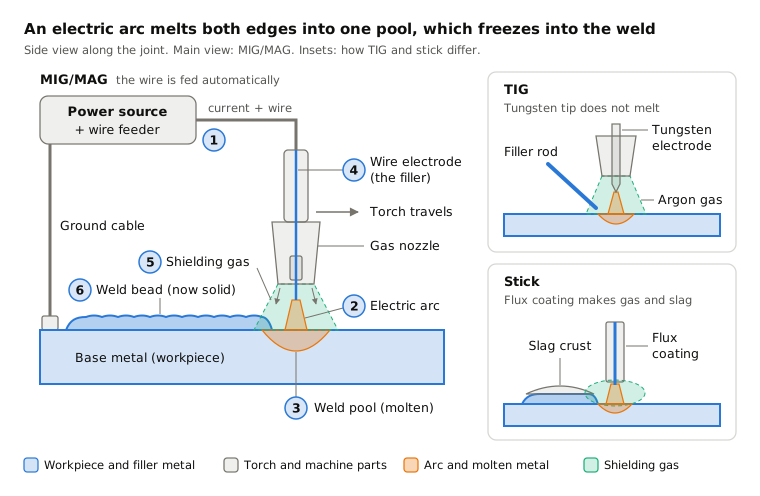
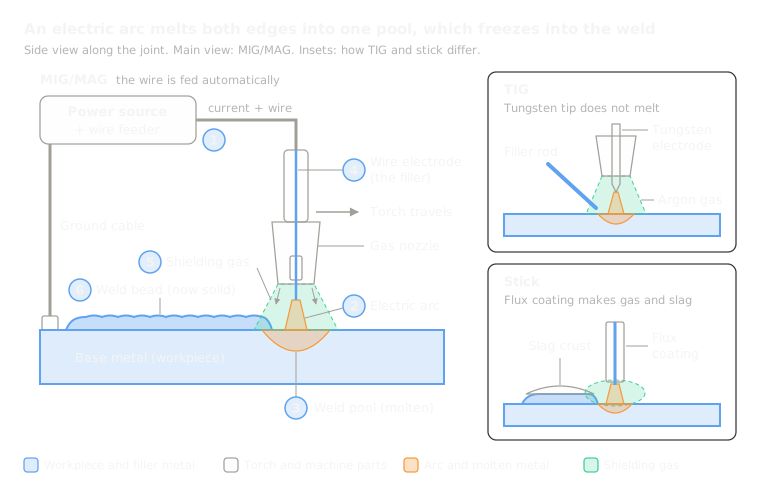 7.1ShortArc welding (MIG/MAG, TIG, stick)Fusion: an electric arc melts the edges and usually a fillerOpen the lesson
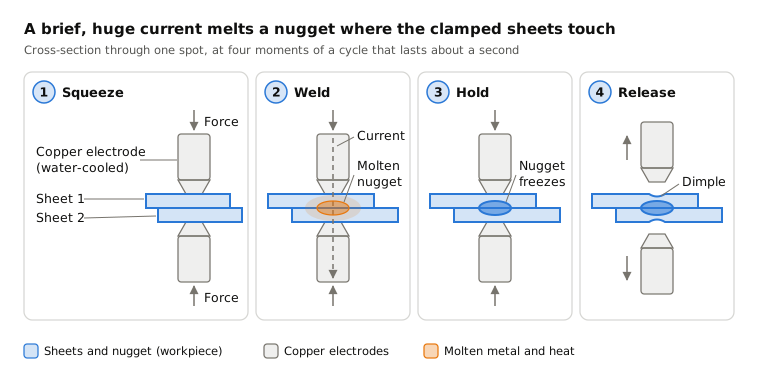
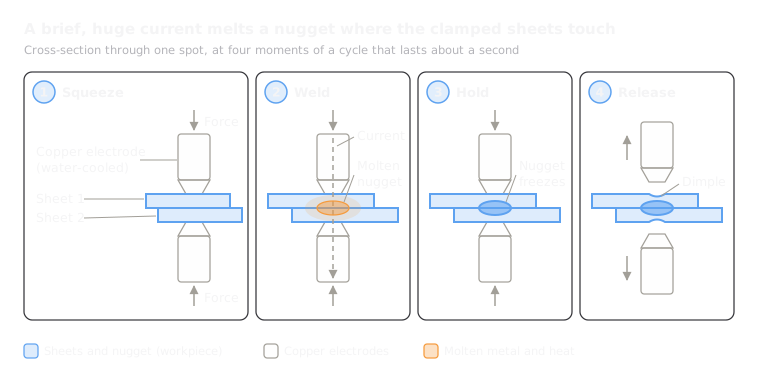 7.2Resistance spot weldingFusion: a pulse of current melts a nugget between clamped sheetsOpen the lesson
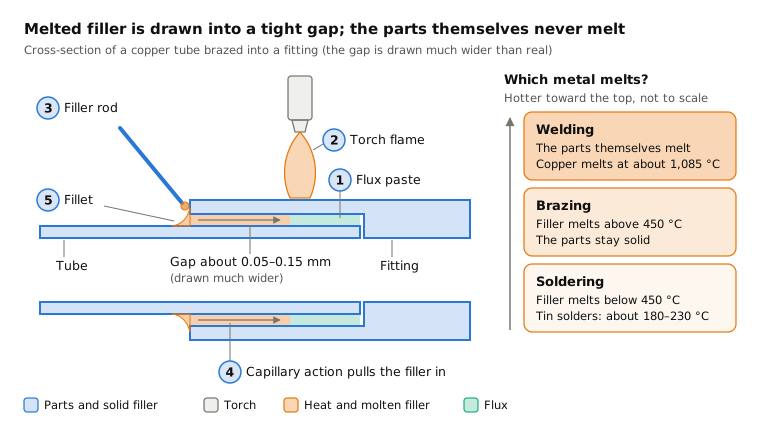
 7.3Brazing and solderingFiller only: a lower-melting filler flows into a tight gapOpen the lesson
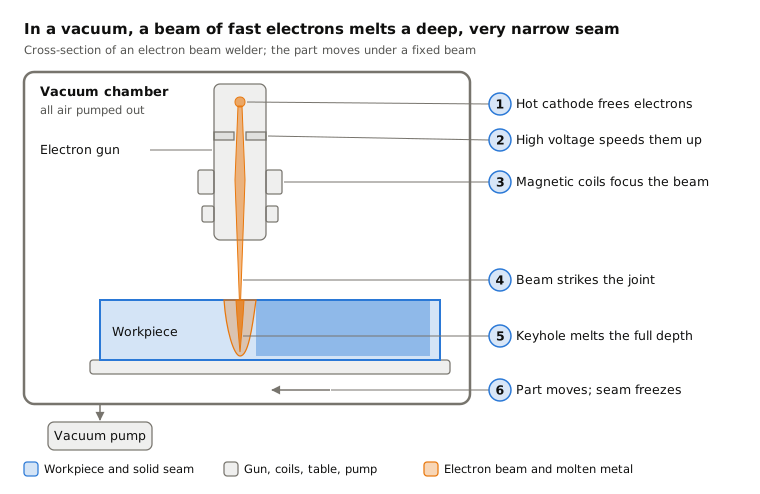
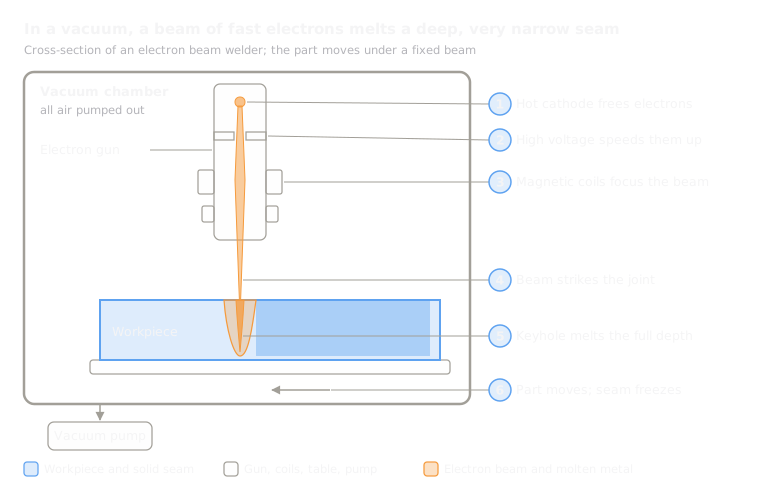 7.5Electron beam weldingFusion: an electron beam in a vacuum welds very thick metalOpen the lesson
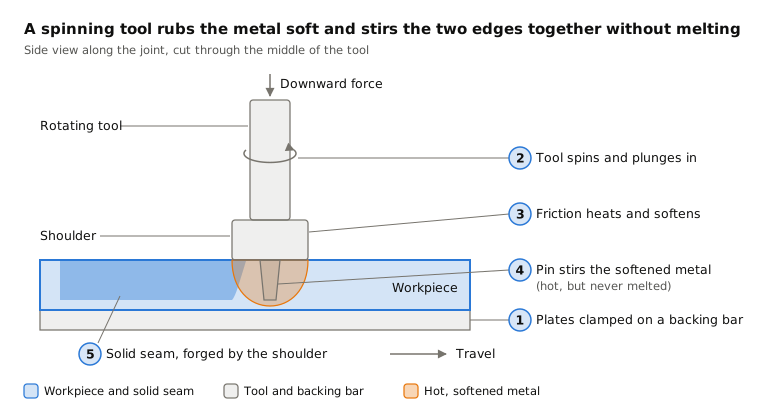
 7.6Friction stir weldingSolid state: a spinning tool stirs softened edges togetherOpen the lesson
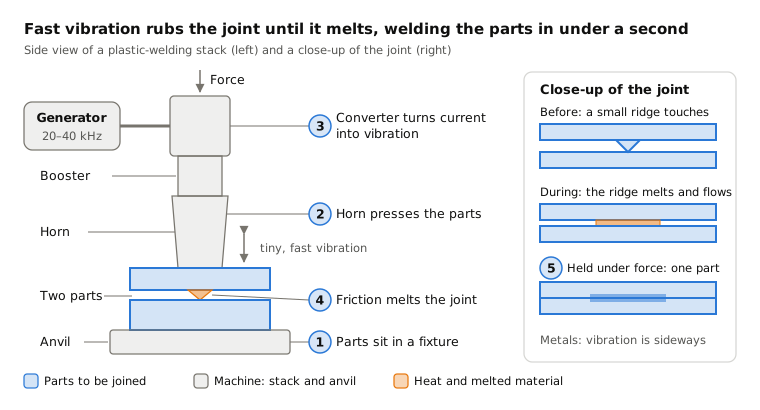
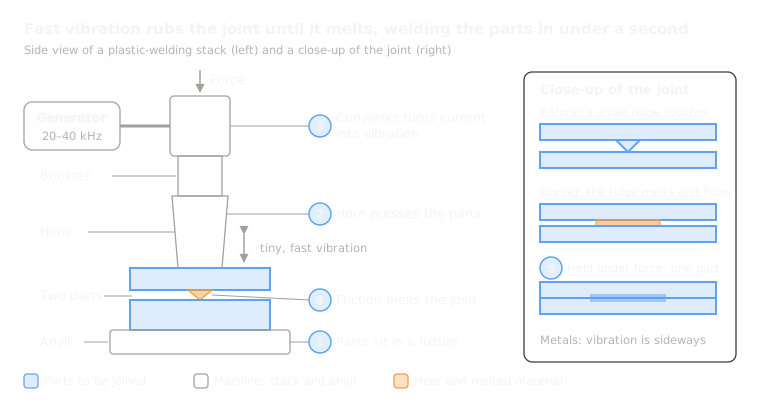 7.7Ultrasonic weldingSolid state: fast vibration bonds small joints in under a secondOpen the lesson
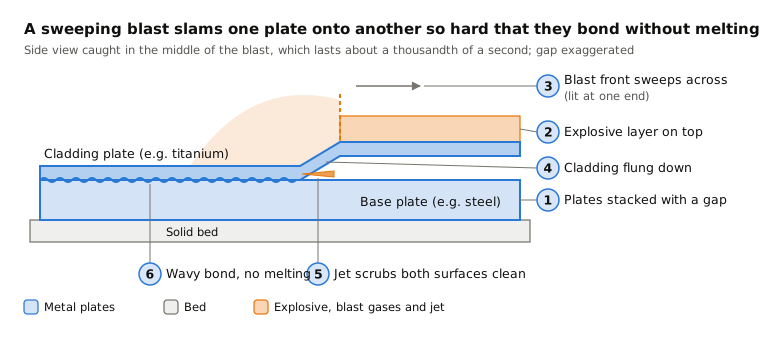
 7.8Explosion welding (cladding)Solid state: a blast slams one plate onto anotherOpen the lesson
Try it
Put AI to work in your CAD.
Model parts, generate drawings and automate the repetitive work inside your CAD software.