

Electron beam welding
Fusion: an electron beam in a vacuum welds very thick metal
Electron beam welding melts the joint with a focused stream of electrons fired at high speed inside a vacuum chamber. It makes the deepest, narrowest and cleanest fusion welds of all, through steel more than 10 cm thick in one pass. Aircraft engines, rocket parts and particle accelerators rely on it.
How it works
Free the electrons. A tungsten cathode (the negative electrode) is heated until it gives off electrons, much like the filament of an old light bulb.
Accelerate them. A high voltage, typically about 30–150 kV, pulls the electrons through a hole in the anode (the positive plate). They leave at a large fraction of the speed of light.
Focus and steer. Magnetic coils act as lenses: they squeeze the beam to a spot well under a millimeter and can wiggle it to shape the weld.
Strike the joint. When the electrons hit the metal, their energy of motion turns into heat almost instantly. The vacuum (air pressure roughly a millionth of normal or less) stops air molecules from scattering the beam.
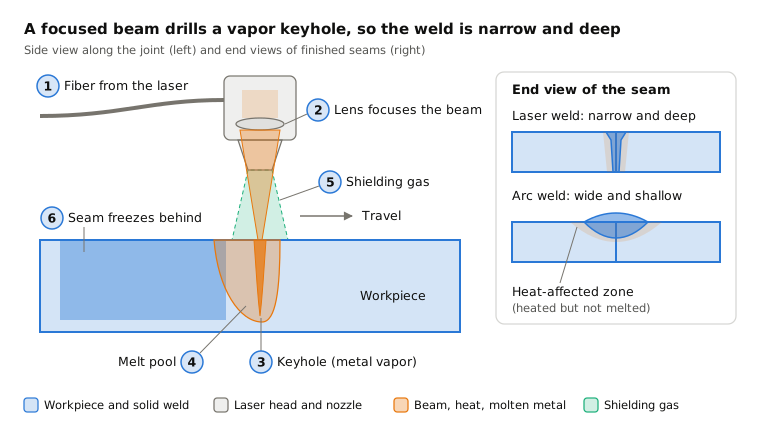
Drill a keyhole. As in laser welding, the metal melts and partly boils, opening a narrow vapor channel that reaches through the full thickness.
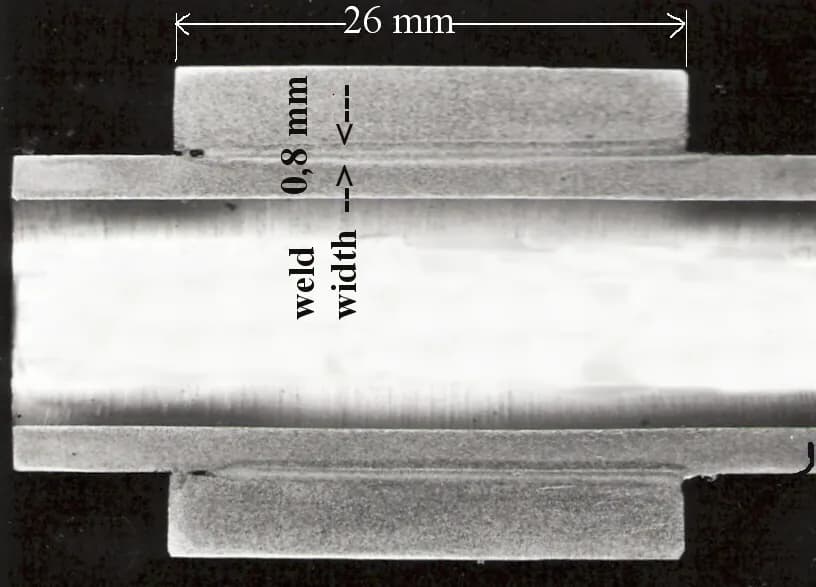
Move and freeze. The table moves the part under the fixed beam. Behind the keyhole the melt closes up and freezes into a seam that can be about 20 times deeper than it is wide.
Why the vacuum matters. It is both the strength and the weakness. No air means no oxidation and no shielding gas, which suits reactive metals like titanium. But every batch must wait while the chamber is pumped down, often several minutes.
Key facts
- Materials
- Steels, stainless steel, titanium, nickel superalloys, copper, refractory metals such as niobium and tantalum; many dissimilar pairs
- Typical parts
- Jet-engine rotors and gears, rocket and satellite parts, transmission gears, accelerator cavities, nuclear components
- Part size
- From tiny sensors to parts several meters long; the chamber sets the limit
- Precision
- Very low distortion; parts can often be welded close to finished size, within about ±0.1 mm
- Surface finish
- Narrow, smooth seam on both faces when fully penetrated; little or no spatter
- Batch size it suits
- Small to medium batches of high-value parts; some car gear plants run it in volume
- Tooling and machine cost
- Roughly several hundred thousand to a few million dollars, plus fixtures
- Speed
- Fast welding, often around 1 m per minute, but minutes of pump-down for each chamber load
Strengths and limits
Strengths
- Deepest single-pass welds of any process
- Very narrow weld, so little distortion
- Vacuum keeps reactive metals perfectly clean
- Joins hard-to-weld and dissimilar metals
Limits
- Needs a vacuum chamber, which limits part size and adds pump-down time
- Very expensive machines and skilled operators
- Produces X-rays, so the chamber must be shielded
- Parts must fit tightly and be demagnetized, or the beam drifts
Where it's used
- AerospaceJet-engine compressor rotors, titanium structures, rocket nozzles
- SpaceSatellite fuel tanks and thruster parts
- AutomotiveTransmission gears and gear clusters
- Science and energyParticle-accelerator cavities, nuclear reactor parts
- Medical and electronicsSensors and sealed device housings
How to recognize it
- An extremely narrow, straight seam, often under 1–2 mm wide even on thick parts.
- The same thin seam visible on the back face (full penetration).
- Bright, oxide-free metal next to the seam, with no heat tint, even on titanium.
Compare with
Watch it
Cambridge Vacuum Engineering · The gun, the beam and the keyhole, animated
Aluminium Guide Videos · A plain-language overview of the process
TWI Ltd · Real machines and chambers in a research lab
TWI Ltd · How very large parts fit in giant vacuum chambers
See real photos
- Wikipedia: Electron-beam welding — principle, gun and chamber diagrams, with links to photos
- Wikimedia Commons photo search
Remember
- Electrons fired at high voltage carry so much energy that they open a keyhole through very thick metal.
- The vacuum keeps the beam focused and the weld perfectly clean.
- It gives the deepest, narrowest welds, at the cost of a chamber, pump-down time and a high price.
More in Joining
All 100 processes
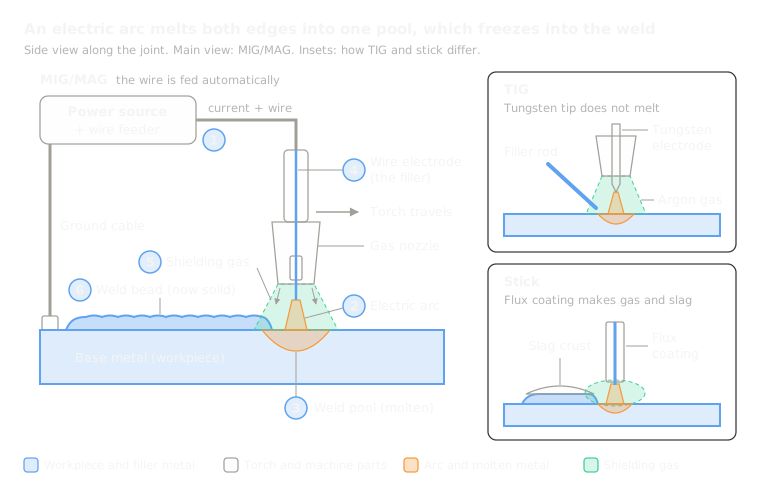 7.1ShortArc welding (MIG/MAG, TIG, stick)Fusion: an electric arc melts the edges and usually a fillerOpen the lesson
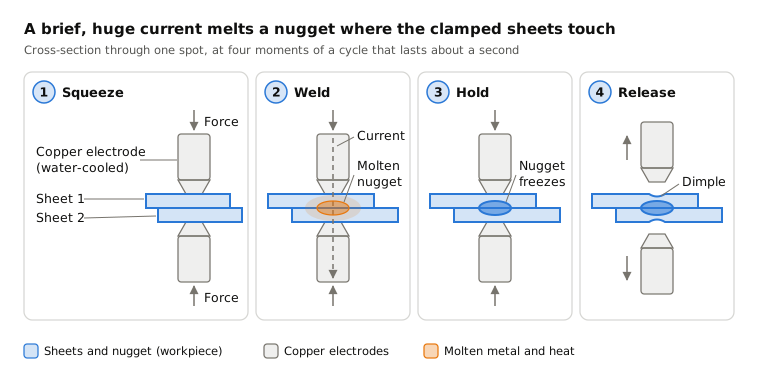
 7.2Resistance spot weldingFusion: a pulse of current melts a nugget between clamped sheetsOpen the lesson
 7.3Brazing and solderingFiller only: a lower-melting filler flows into a tight gapOpen the lesson
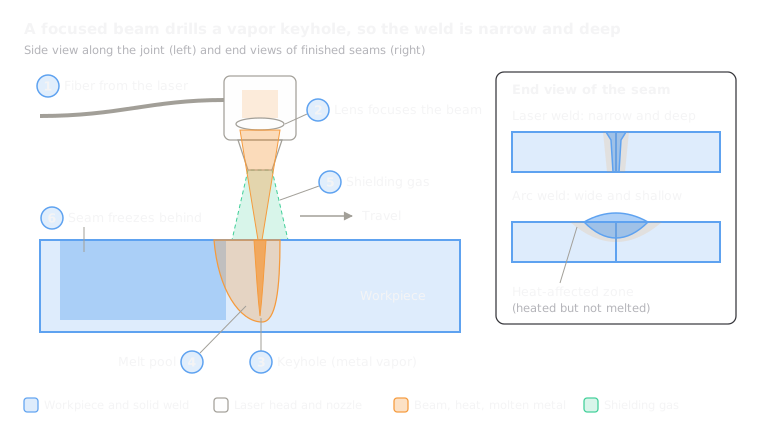 7.4Laser weldingFusion: a focused laser drills a keyhole for narrow, deep weldsOpen the lesson
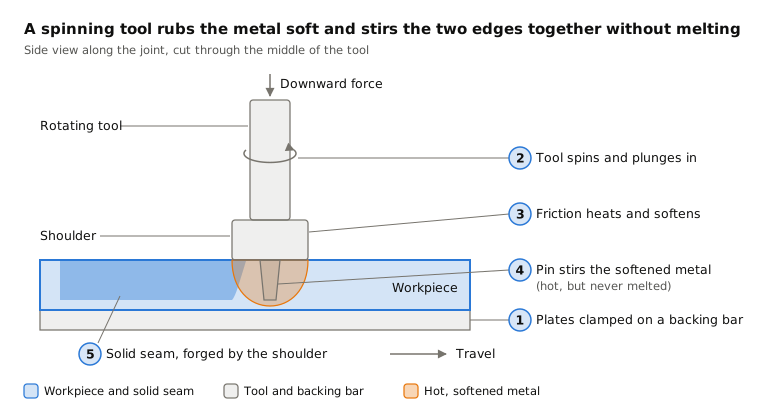
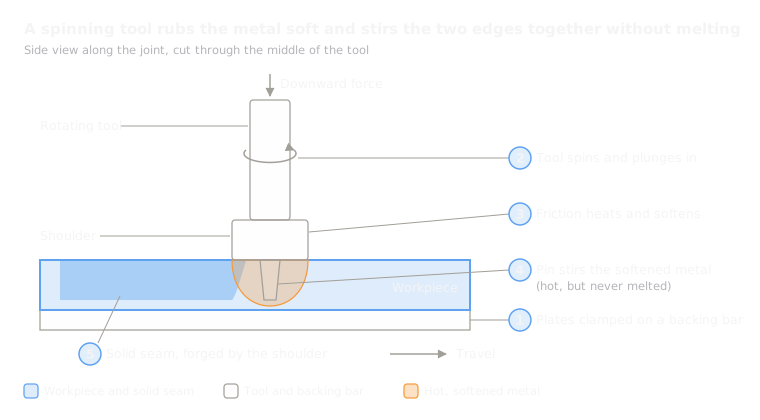 7.6Friction stir weldingSolid state: a spinning tool stirs softened edges togetherOpen the lesson
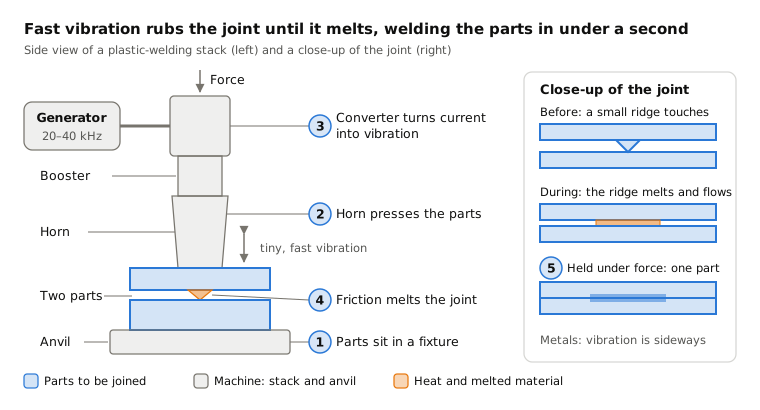
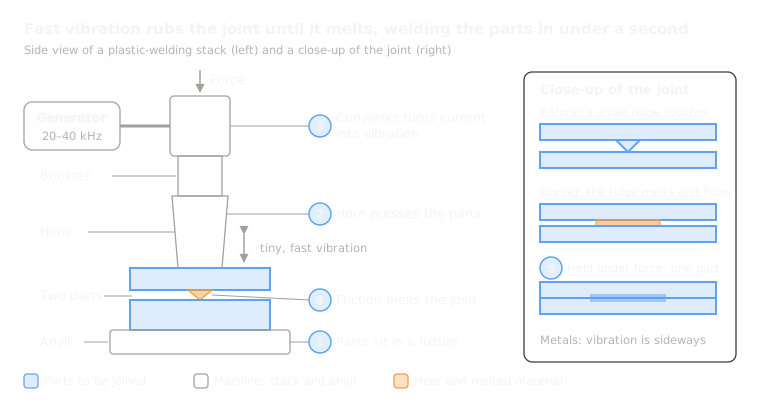 7.7Ultrasonic weldingSolid state: fast vibration bonds small joints in under a secondOpen the lesson
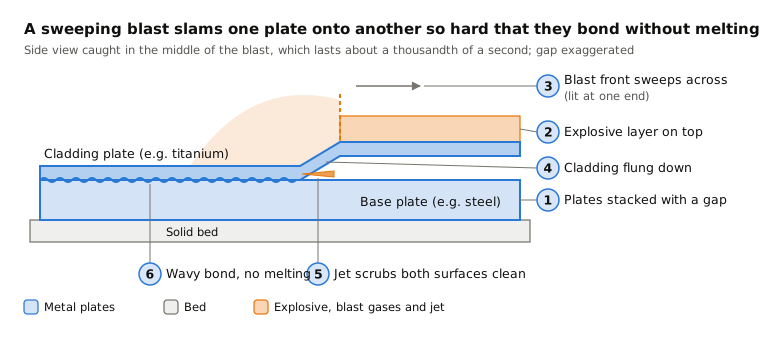
 7.8Explosion welding (cladding)Solid state: a blast slams one plate onto anotherOpen the lesson
Try it
Put AI to work in your CAD.
Model parts, generate drawings and automate the repetitive work inside your CAD software.