

Brazing and soldering
Filler only: a lower-melting filler flows into a tight gap
Brazing and soldering join parts with a melted filler metal that flows into the joint and freezes, a bit like hot glue made of metal. The parts themselves never melt, so delicate, thin or dissimilar metals can be joined. Every circuit board is soldered, and most air-conditioning pipes are brazed.
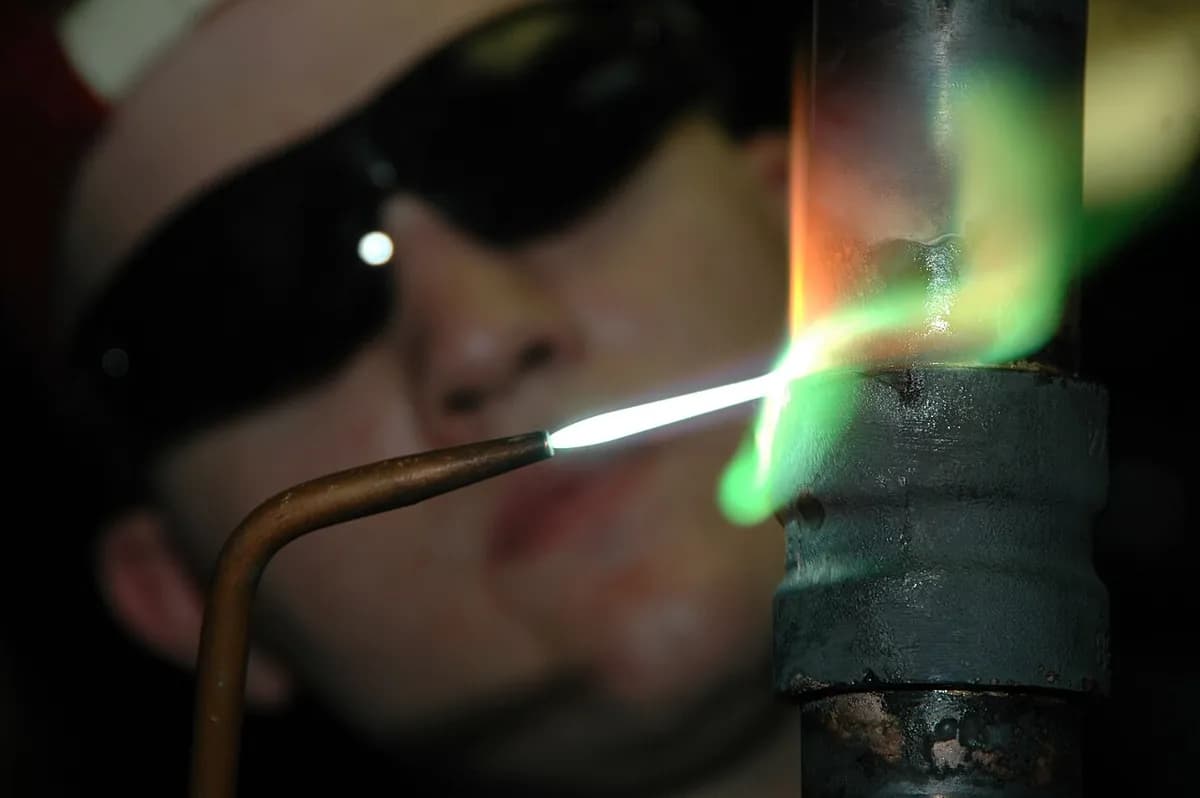
How it works
Clean and flux. The surfaces are cleaned and coated with flux (a paste that dissolves oxide films and keeps air off). Filler only sticks to clean metal.
Heat the joint. A torch, furnace, induction coil or soldering iron heats both parts evenly. They must get hotter than the filler's melting point but stay well below their own.
Feed the filler. The filler rod or wire touches the hot joint and melts on contact. The heat should come from the parts, not straight from the flame, so the filler flows toward the hottest metal.
Let capillary action work. The liquid filler wets (spreads over) the clean surfaces and is sucked into the narrow gap, even uphill. This only works if the gap is tight, roughly 0.05–0.15 mm for brazing.
Cool and clean. The filler freezes into a thin layer bonded to both parts, with a small fillet (a curved bead) at the edge. Leftover flux is washed off because it can cause corrosion.
Brazing or soldering? The official difference is only temperature. Soldering uses fillers that melt below 450 °C, such as tin alloys at about 180–230 °C. Brazing uses fillers that melt above 450 °C, often 600–900 °C for silver or copper-phosphorus alloys, and makes much stronger joints.
Key facts
- Materials
- Almost any metal pair, even dissimilar ones (copper to steel, carbide to steel); ceramics with special fillers
- Typical parts
- Plumbing and air-conditioning tubes, heat exchangers, carbide-tipped tools, circuit boards, lugged bike frames
- Part size
- From chip leads under 1 mm to heat exchangers a meter or more across, brazed in furnaces
- Precision
- Good: the parts do not melt, so assemblies typically stay within a few tenths of a millimeter, better in furnaces
- Surface finish
- A smooth, thin fillet at the joint edge; flux residue must be cleaned off
- Batch size it suits
- One-offs by hand up to millions of joints a day in furnaces and reflow ovens
- Tooling and machine cost
- Tens of dollars for a torch or soldering iron; tens to hundreds of thousands for furnaces and reflow lines
- Speed
- Seconds to a minute per joint by hand; a furnace or reflow oven makes thousands of joints in one pass of several minutes
Strengths and limits
Strengths
- Joins dissimilar metals and thin parts that welding would burn through
- The parts do not melt, so there is little distortion or damage
- Many joints at once in a furnace or oven
- Neat, sealed joints that conduct heat and electricity well
Limits
- Joints are weaker than the parts, especially soldered ones
- Needs tight, clean gaps and careful fit-up
- Flux residue can corrode and must be removed
- Weakens at high temperature, so not for hot service
Where it's used
- ElectronicsEvery component on a circuit board (soldering)
- Plumbing and HVACCopper water pipes (soldered), air-conditioning and refrigerant lines (brazed)
- AutomotiveAluminum radiators and condensers (furnace brazed)
- ToolsCarbide tips on saw blades and drill bits (brazed)
- Jewelry and instrumentsSilver and gold pieces, brass wind instruments
- BicyclesClassic lugged steel frames (brazed)
How to recognize it
- A thin, smooth fillet of a different color at the joint edge: silvery solder, or a gold, silver or copper-colored braze line.
- Parts that overlap or slot into each other (tube in socket, lugs) rather than meeting edge to edge.
- No weld ripples and no melted-looking edges on the parts.
- On circuit boards: shiny little cones of solder around each component lead.
Compare with
Watch it
James Sword Engineering · How the three joining methods differ, for beginners
Lucas-Milhaupt · Why a tight gap pulls the filler through the joint
Lucas-Milhaupt · A torch-brazed copper tube joint, start to finish
Eurocircuits · Circuit boards soldered in a reflow oven
See real photos
- Wikipedia: Brazing — photos of torch brazing and brazed joints
- Wikipedia: Soldering — hand soldering, solder joints on circuit boards and copper pipes
- Wikimedia Commons photo search
Remember
- The filler melts; the parts never do. That is what separates brazing and soldering from welding.
- A tight, clean, fluxed gap lets capillary action pull the filler all the way through the joint.
- Below 450 °C it is soldering; above 450 °C it is brazing, which is much stronger.
More in Joining
All 100 processes
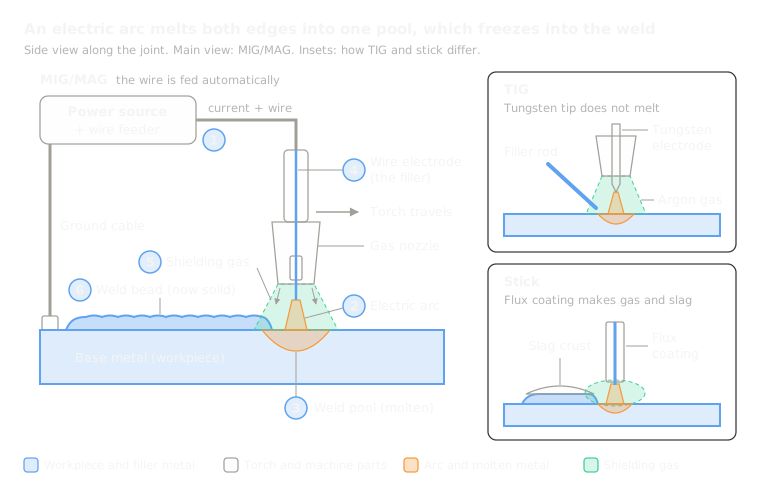 7.1ShortArc welding (MIG/MAG, TIG, stick)Fusion: an electric arc melts the edges and usually a fillerOpen the lesson
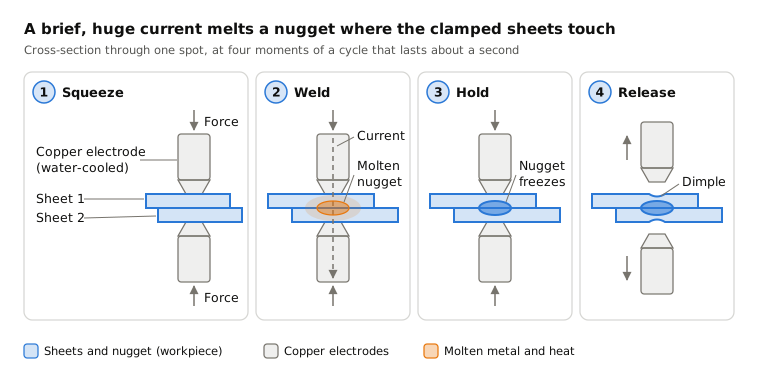
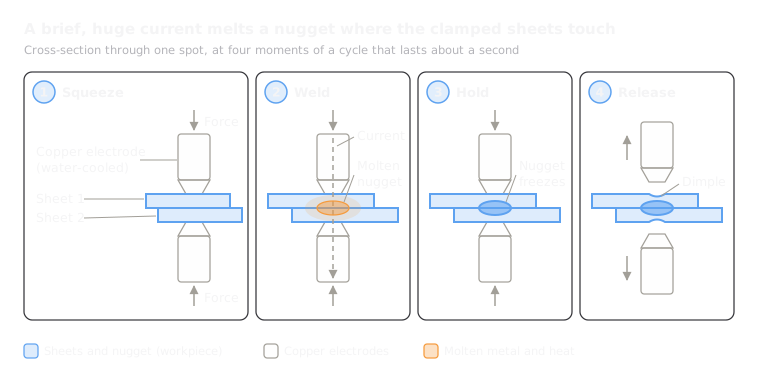 7.2Resistance spot weldingFusion: a pulse of current melts a nugget between clamped sheetsOpen the lesson
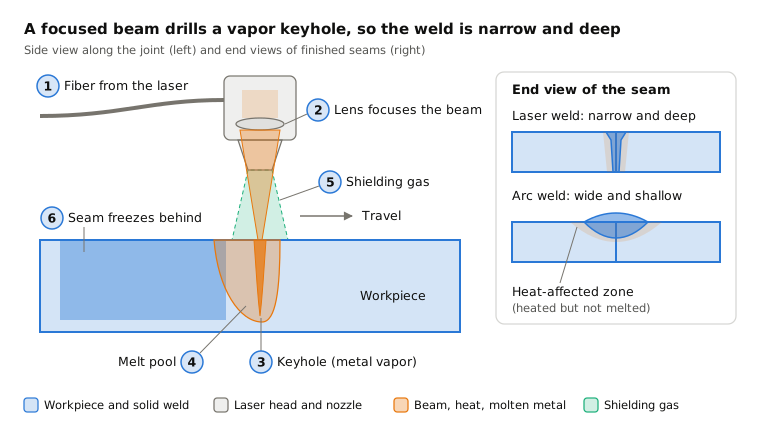
 7.4Laser weldingFusion: a focused laser drills a keyhole for narrow, deep weldsOpen the lesson
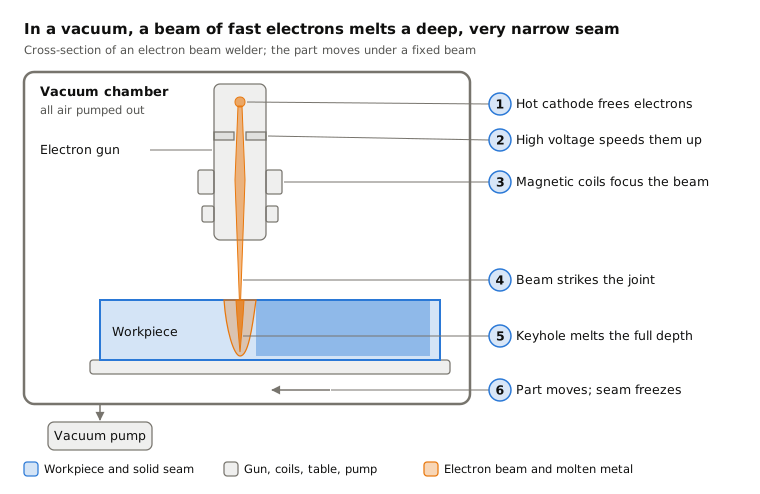
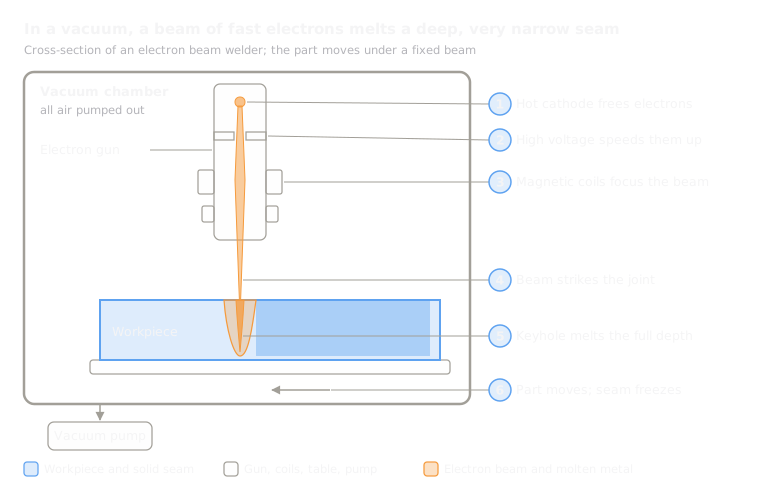 7.5Electron beam weldingFusion: an electron beam in a vacuum welds very thick metalOpen the lesson
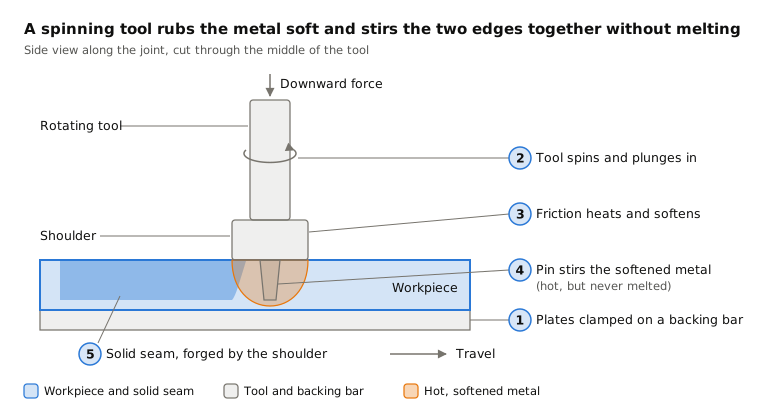
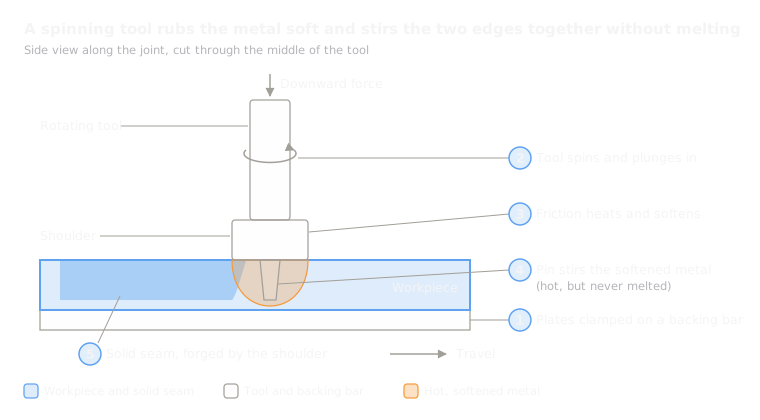 7.6Friction stir weldingSolid state: a spinning tool stirs softened edges togetherOpen the lesson
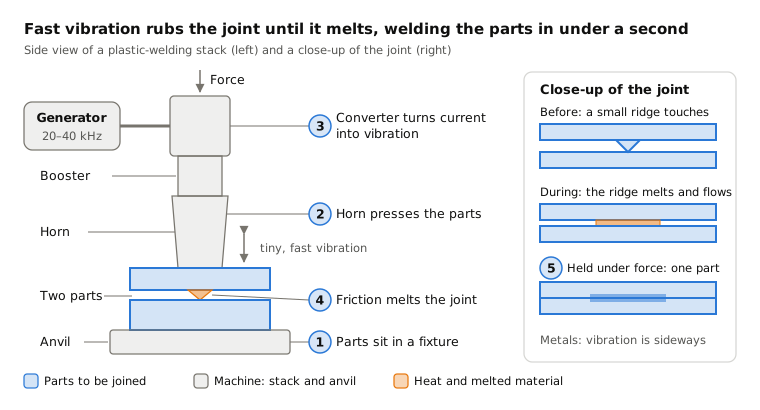
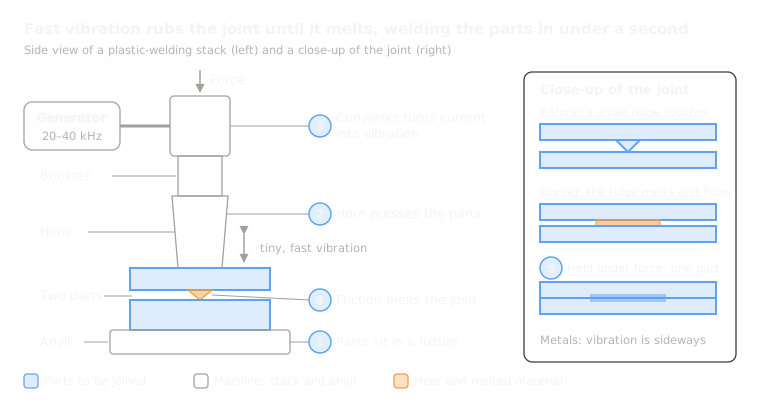 7.7Ultrasonic weldingSolid state: fast vibration bonds small joints in under a secondOpen the lesson
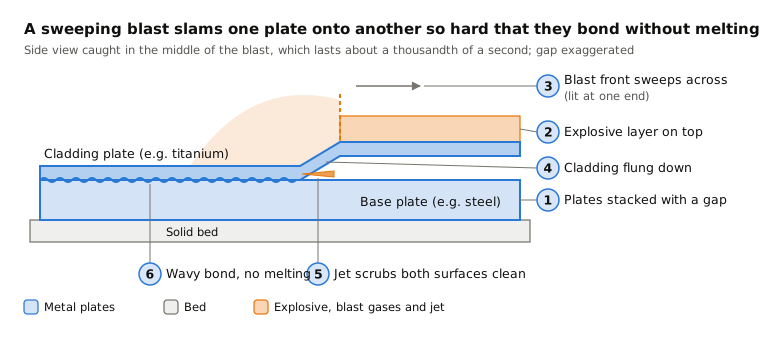
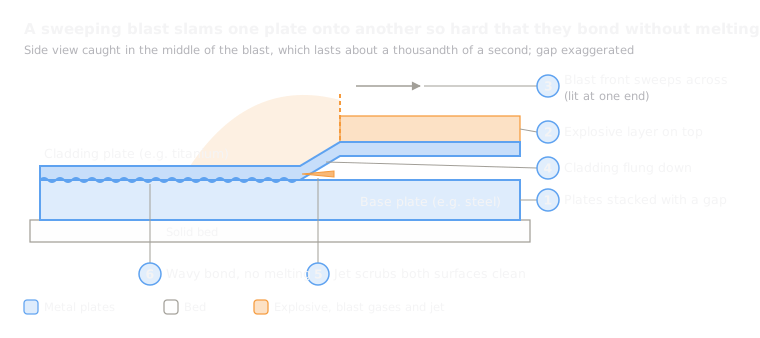 7.8Explosion welding (cladding)Solid state: a blast slams one plate onto anotherOpen the lesson
Try it
Put AI to work in your CAD.
Model parts, generate drawings and automate the repetitive work inside your CAD software.