

Resistance spot welding
Fusion: a pulse of current melts a nugget between clamped sheets
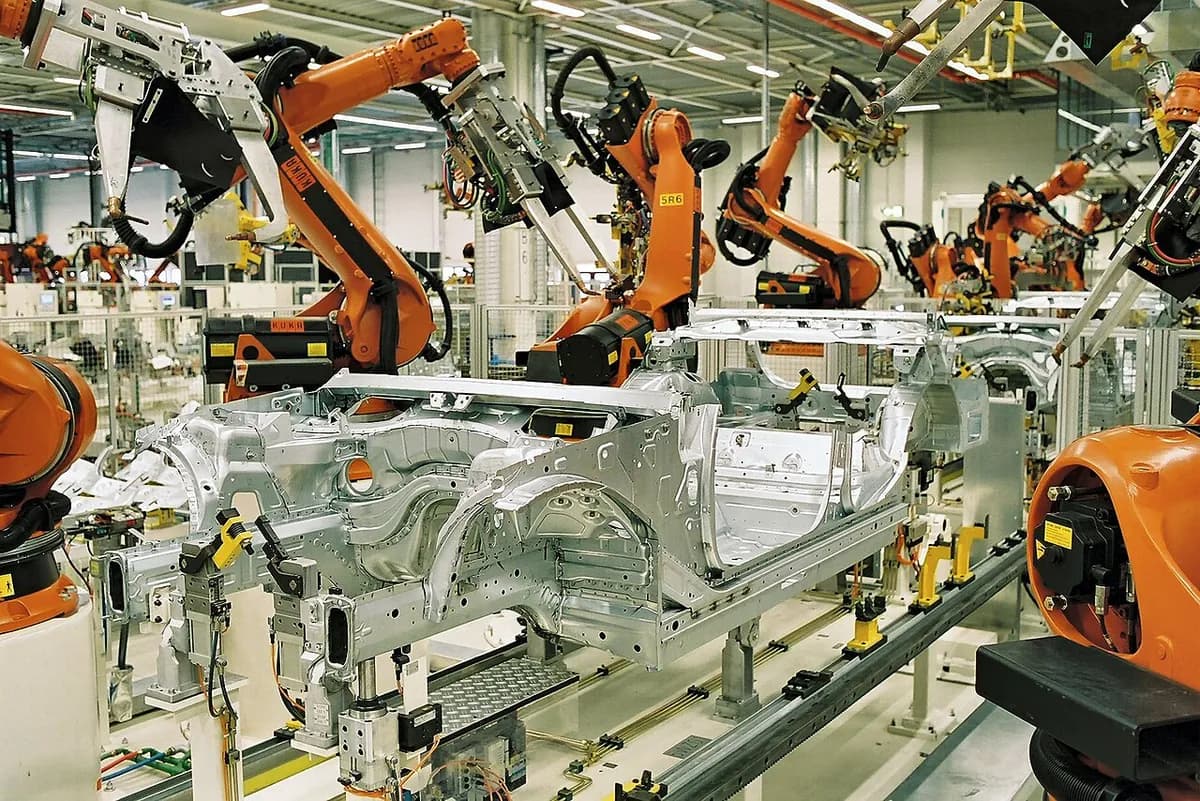
Resistance spot welding joins two overlapping metal sheets at small points by squeezing them between copper electrodes and passing a huge electric current. Each spot takes well under a second and needs no filler metal or gas. It is how car bodies are built: look inside any car door opening and you will see rows of small round dimples.
How it works
Squeeze. A robot or press closes two water-cooled copper-alloy electrodes on the overlapping sheets. They press with a force of a few kilonewtons, roughly the weight of a few hundred kilograms.
Weld. A current of about 5,000–20,000 amps flows for a tenth to a few tenths of a second, at only a few volts. Resistance (a material's opposition to current) turns it into heat, as in a toaster wire. The contact between the two sheets resists most, so it heats first. There a lens-shaped nugget (a small pocket of melted metal) forms, typically 4–8 mm across.
Hold. The current stops, but the electrodes keep pressing while the nugget cools and freezes. Water flowing inside the electrodes pulls the heat out, so the copper stays cool and does not weld to the sheet.
Release. The electrodes open, leaving a shallow dimple on each face. The robot moves to the next spot, usually a few centimeters along the flange (the flat overlapping edge).
Why only the middle melts. Copper conducts electricity and heat several times better than steel, so the electrodes barely warm up. The sheet-to-sheet contact is the hottest point, so the nugget grows from the inside out, hidden from view.
Key facts
- Materials
- Low-carbon and zinc-coated steel sheet, stainless steel; aluminum with special high-current machines; nickel strips for batteries
- Typical parts
- Car bodies, doors and hoods, appliance cabinets, steel shelving, battery packs
- Part size
- Sheets typically 0.5–3 mm thick each; assemblies as large as a whole car body
- Precision
- Spot placed within about ±1 mm by a robot; overall part accuracy comes from the clamping fixture
- Surface finish
- A small round dimple on each face; usually hidden in a flange or painted over
- Batch size it suits
- Mass production; small bench machines also serve repair shops and battery builders
- Tooling and machine cost
- A few hundred dollars for a small bench unit; around $100,000 or more for a robot with its weld gun
- Speed
- Well under a second per spot; a robot makes roughly one spot every 1–3 seconds, including moves
Strengths and limits
Strengths
- Very fast and easy to automate
- No filler, gas or flux: very low cost per weld
- Heat stays local, so parts barely distort
- Repeatable once current, force and time are tuned
Limits
- Only for overlapping (lap) joints in thin sheet
- Joins at points, not a continuous seam, so it does not seal against leaks
- The nugget is hidden inside, so quality is hard to check without destructive tests
- Electrode tips wear and must be redressed (reshaped); aluminum needs much higher current
Where it's used
- AutomotiveBody-in-white (the bare welded body shell), doors, hoods, seat frames
- AppliancesWashing machine, oven and refrigerator cabinets
- BatteriesNickel tabs joining cells in e-bike and power-tool packs
- Metal furniture and enclosuresSteel shelving, lockers, electrical cabinets
- RailStainless-steel railcar body panels
How to recognize it
- Rows of small round dimples, about 5–8 mm across, evenly spaced along a flange.
- The same dimple appears on both faces of the joint.
- On bare or stainless metal, a faint ring of heat color around each spot.
- Open a car door or hood: the edges of the body shell are lined with them.
Compare with
Watch it
Welding Fabrication World · The process, its strengths and its uses, for beginners
The Weld Nugget · How current, force and time form the nugget
FANUC America Corporation · Robots welding a car body side, with a spark at each spot
ABB Robotics · A real car-body line at Volvo
See real photos
- Wikipedia: Spot welding — photos of spot-welding robots and machines, plus a process diagram
- Wikimedia Commons photo search
Remember
- Current, squeezing force and time are the three settings of every spot weld.
- Heat appears where the sheets touch, because that contact resists the current most.
- A car body is held together by several thousand of these spots, nearly all made by robots.
More in Joining
All 100 processes
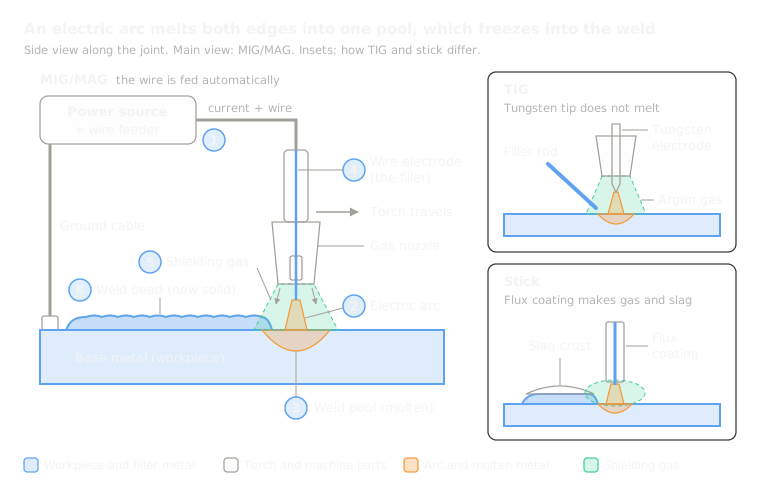 7.1ShortArc welding (MIG/MAG, TIG, stick)Fusion: an electric arc melts the edges and usually a fillerOpen the lesson
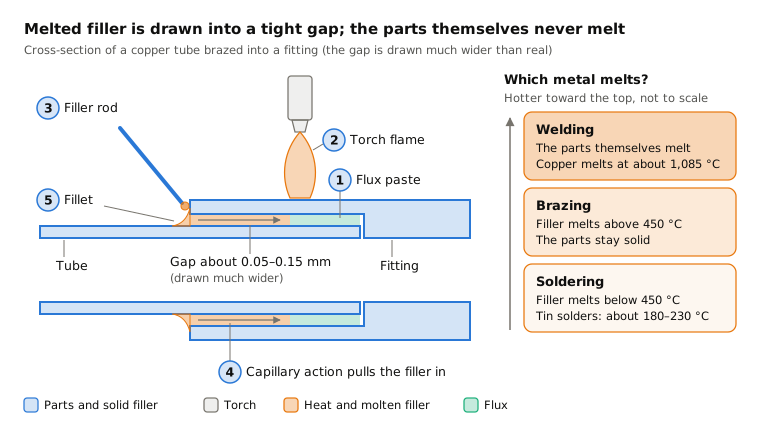
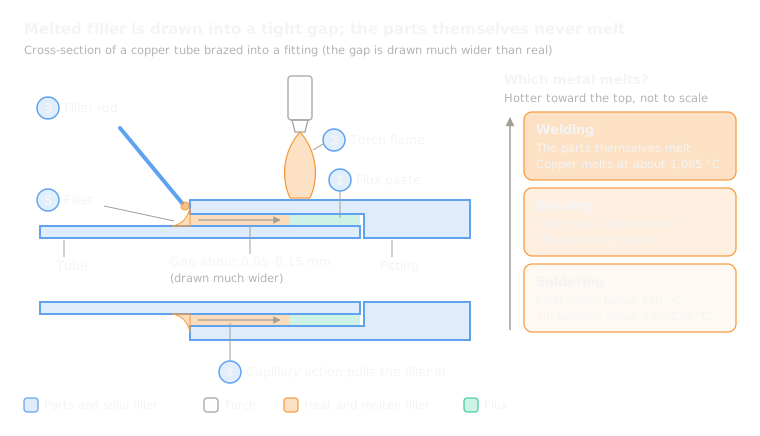 7.3Brazing and solderingFiller only: a lower-melting filler flows into a tight gapOpen the lesson
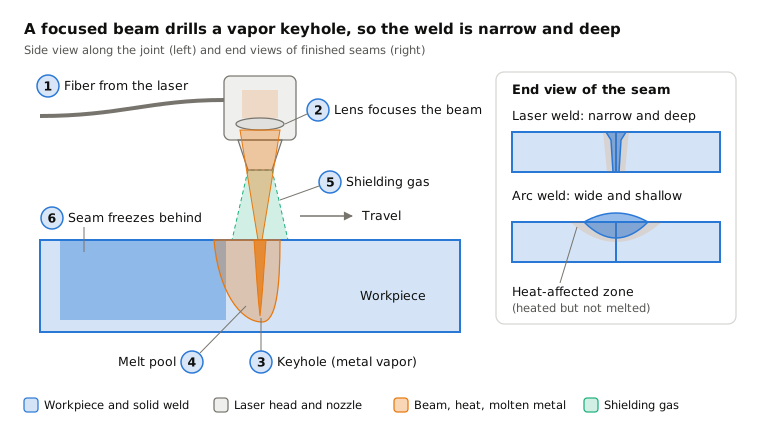
 7.4Laser weldingFusion: a focused laser drills a keyhole for narrow, deep weldsOpen the lesson
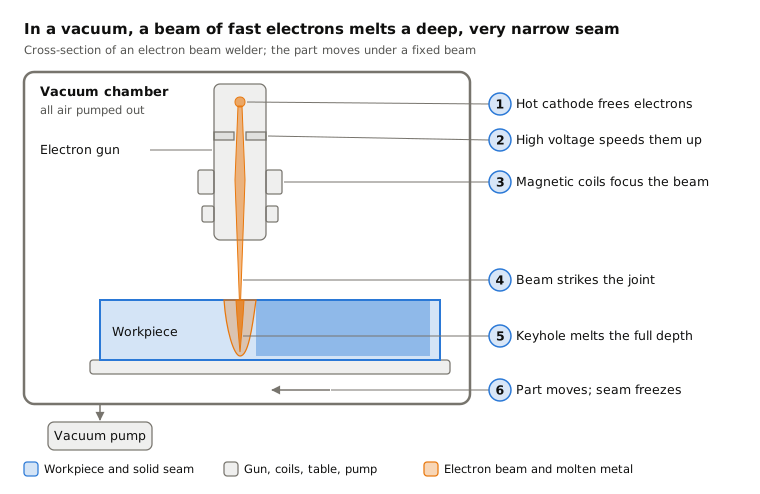
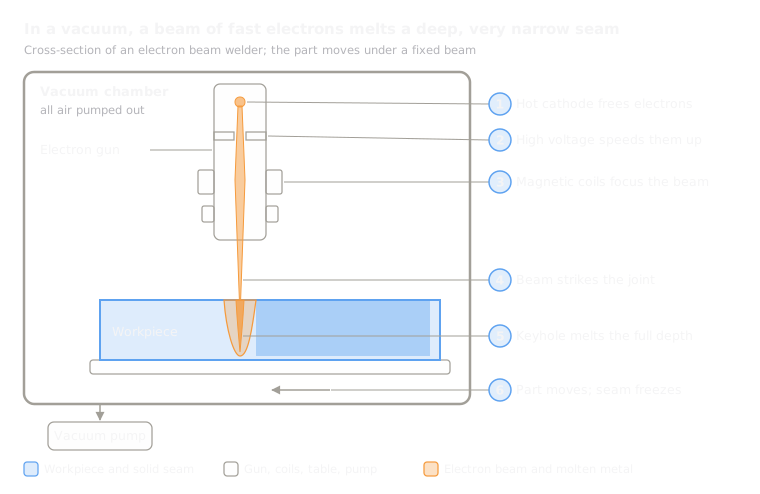 7.5Electron beam weldingFusion: an electron beam in a vacuum welds very thick metalOpen the lesson
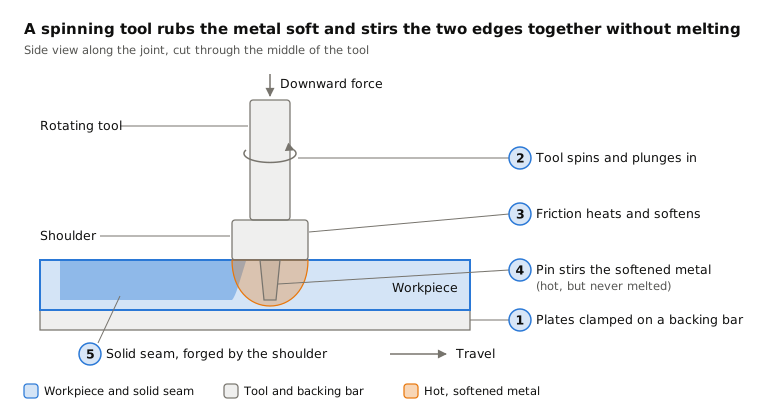
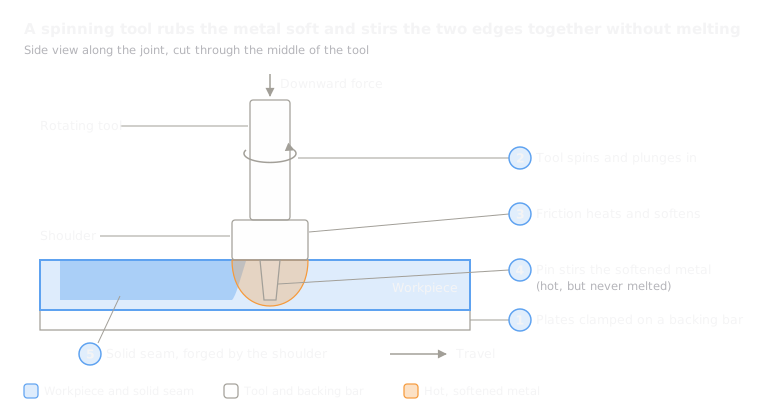 7.6Friction stir weldingSolid state: a spinning tool stirs softened edges togetherOpen the lesson
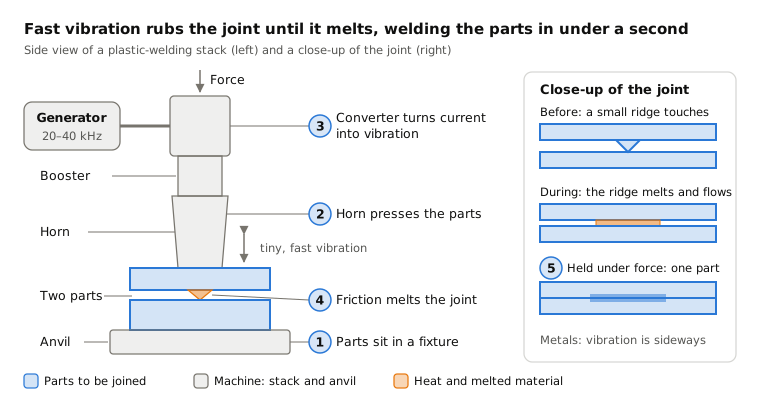
 7.7Ultrasonic weldingSolid state: fast vibration bonds small joints in under a secondOpen the lesson
 7.8Explosion welding (cladding)Solid state: a blast slams one plate onto anotherOpen the lesson
Try it
Put AI to work in your CAD.
Model parts, generate drawings and automate the repetitive work inside your CAD software.