

Additive manufacturing
Additive manufacturing, better known as 3D printing, builds a part by adding material only where it is needed, usually one thin layer at a time, straight from a computer model. No mold, die or cutting tool is shaped for the part, so one-offs, complex internal shapes and quick design changes cost little. The ten processes in this chapter differ mainly in how they add material and fix it in place.
The big idea
Every process here slices a 3D model into a stack of thin layers, or paths, and builds them one on top of the other. Think of building a loaf of bread slice by slice instead of carving it from a block: nothing is cut away, so shapes that no tool could reach become possible. The international standard ISO/ASTM 52900 sorts these processes into seven families by how the material is added: extruded through a nozzle (material extrusion), cured from a vat of resin by light (vat photopolymerization), fused in a powder bed (powder bed fusion), glued in a powder bed (binder jetting), jetted as droplets (material jetting), melted where it lands by a focused energy beam (directed energy deposition), and stacked as welded sheets (sheet lamination). Volumetric printing is a newer approach that cures a whole volume of resin at once, without layers.
The 10 processes in this chapter
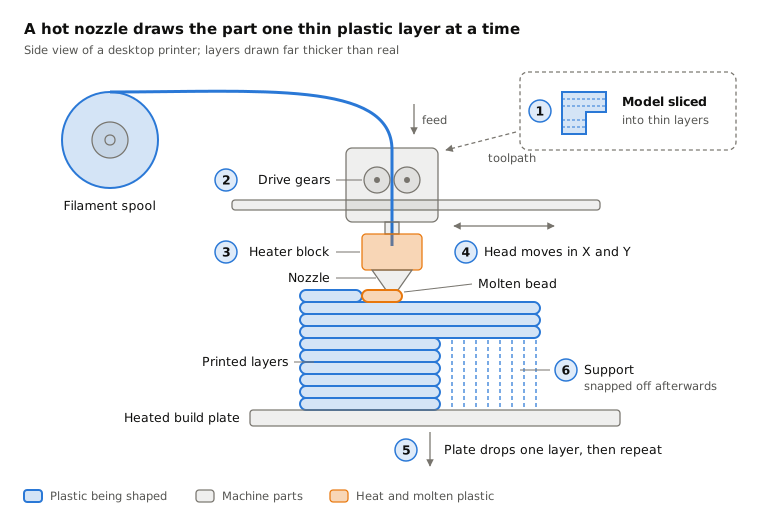
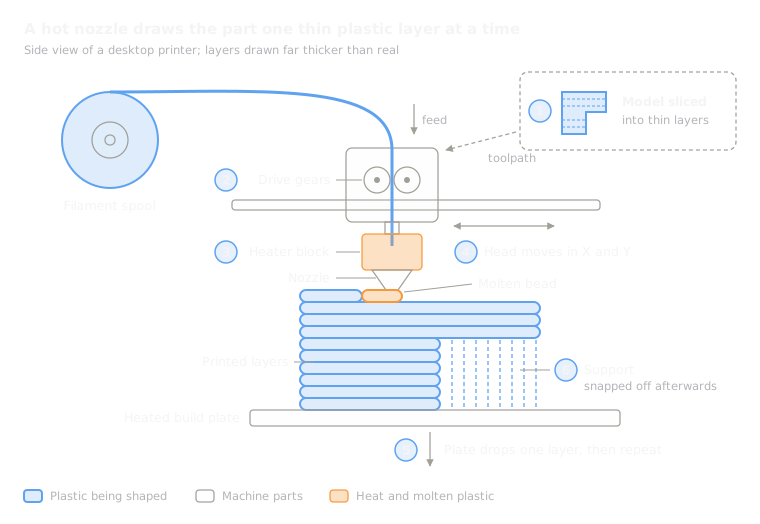 8.1ShortFDM (fused deposition modeling)Extrudes molten plastic filament through a moving nozzle (material extrusion)Open the lesson
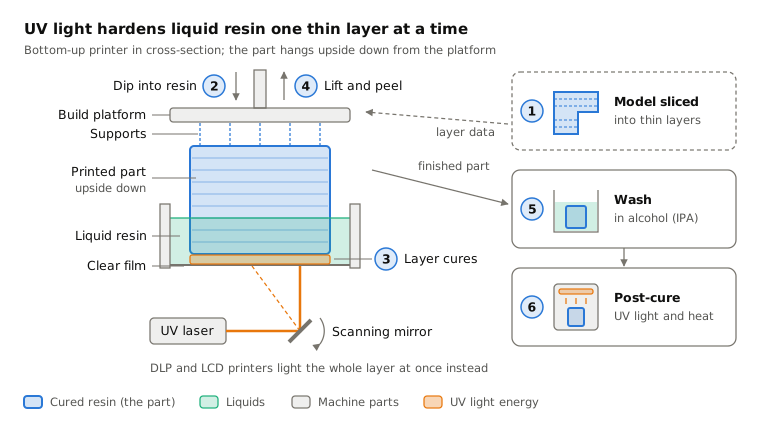
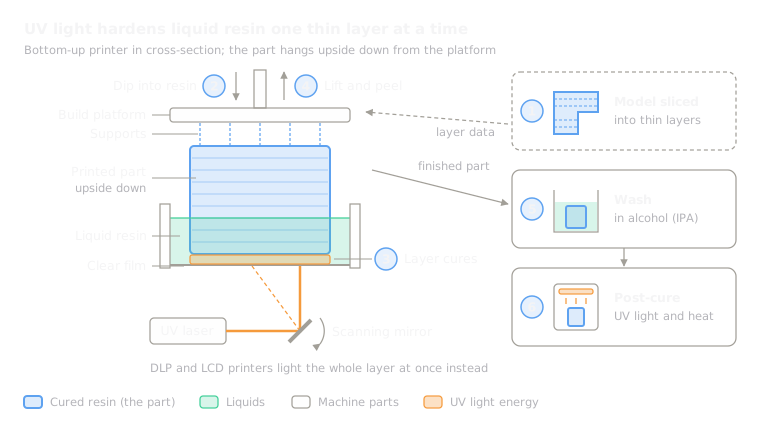 8.2Stereolithography (SLA/DLP)Hardens liquid resin layer by layer with a laser or projector (vat photopolymerization)Open the lesson
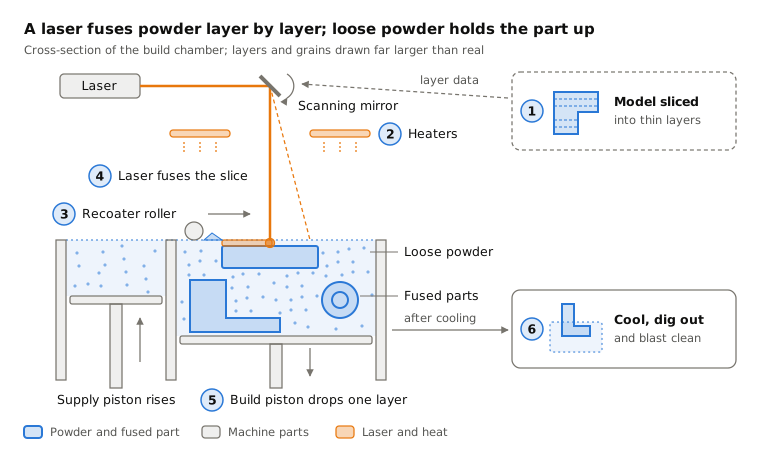
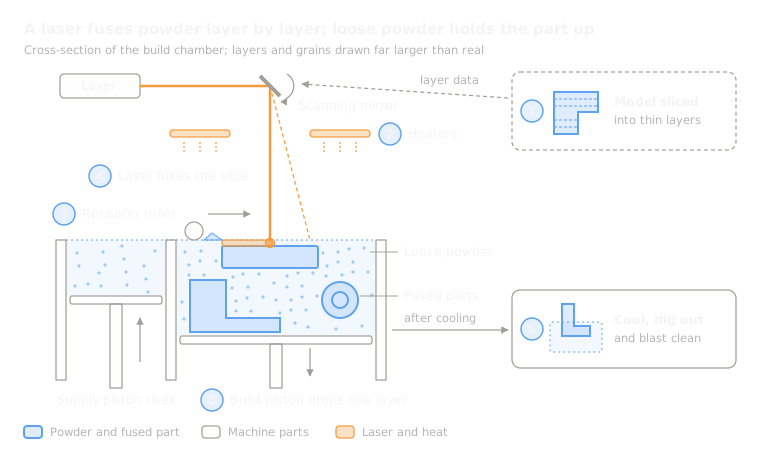 8.3Selective laser sintering (SLS)A laser fuses nylon powder in a bed; the loose powder supports the part (powder bed fusion)Open the lesson
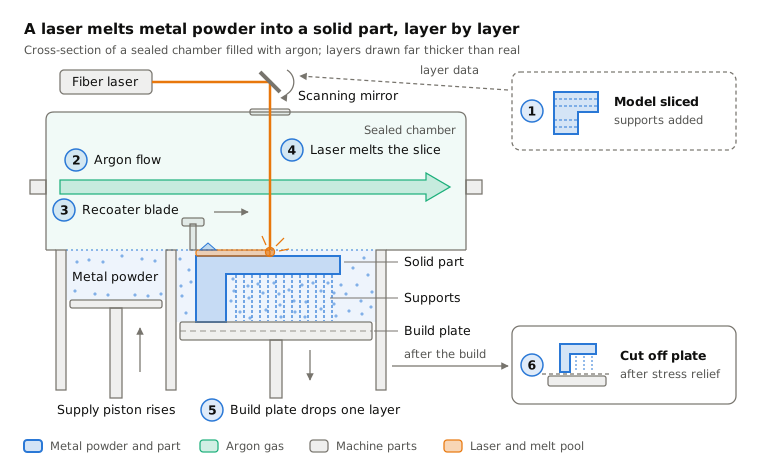
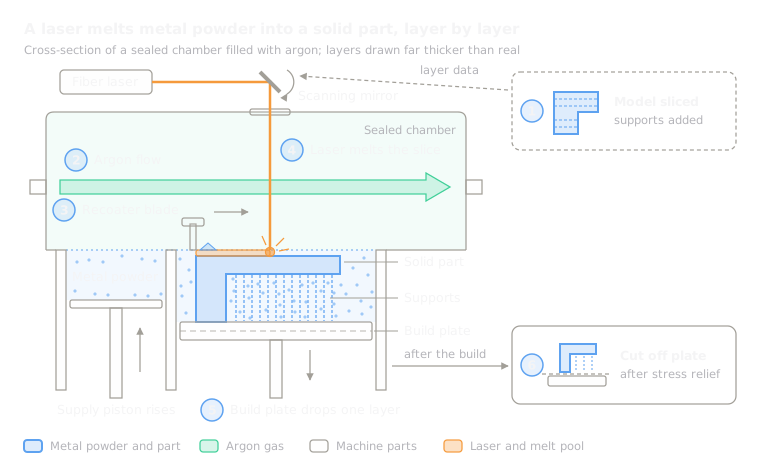 8.4Laser powder bed fusion (metal, SLM/DMLS)A laser melts thin layers of metal powder (powder bed fusion)Open the lesson
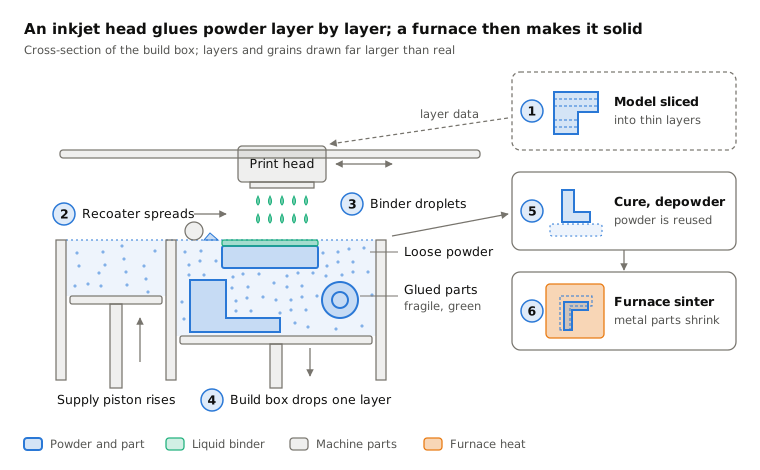
 8.5Binder jettingInkjet heads glue powder, then the part is cured or sintered (binder jetting)Open the lesson
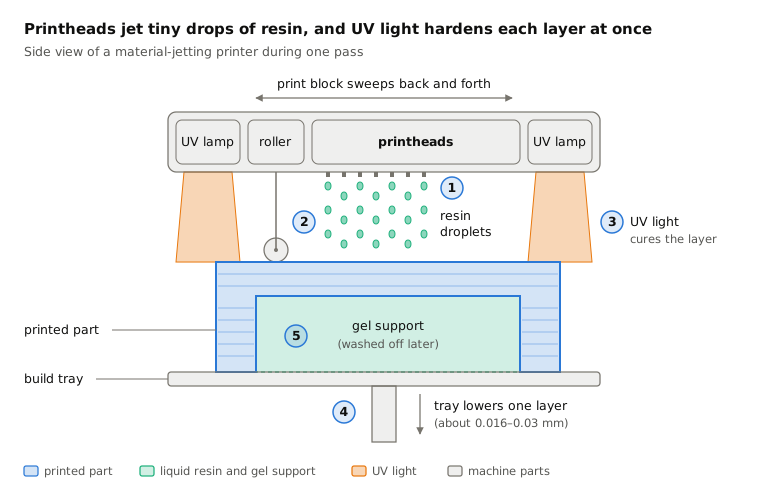
 8.6Material jetting (PolyJet)Jets droplets of resin and cures them with UV light (material jetting)Open the lesson
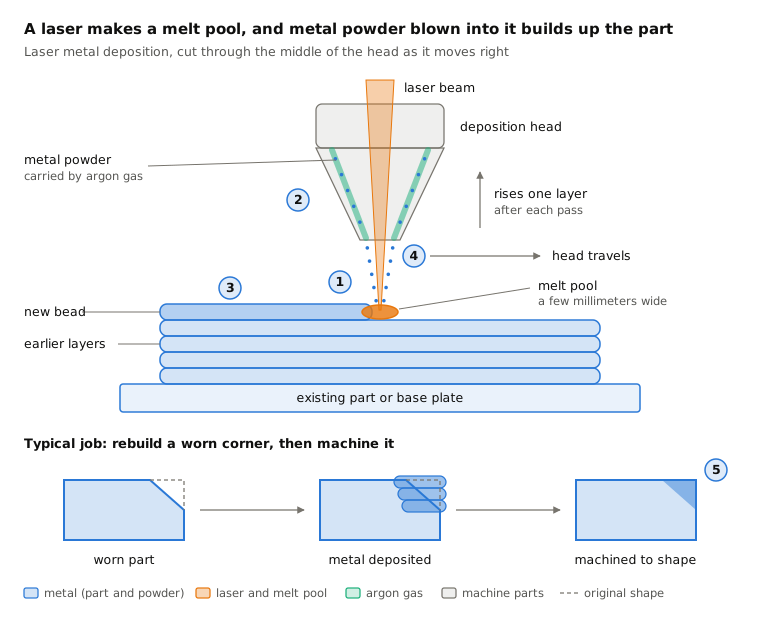
 8.7Directed energy deposition (DED/LMD)A laser melts a pool on the part; blown powder adds metal (directed energy deposition)Open the lesson
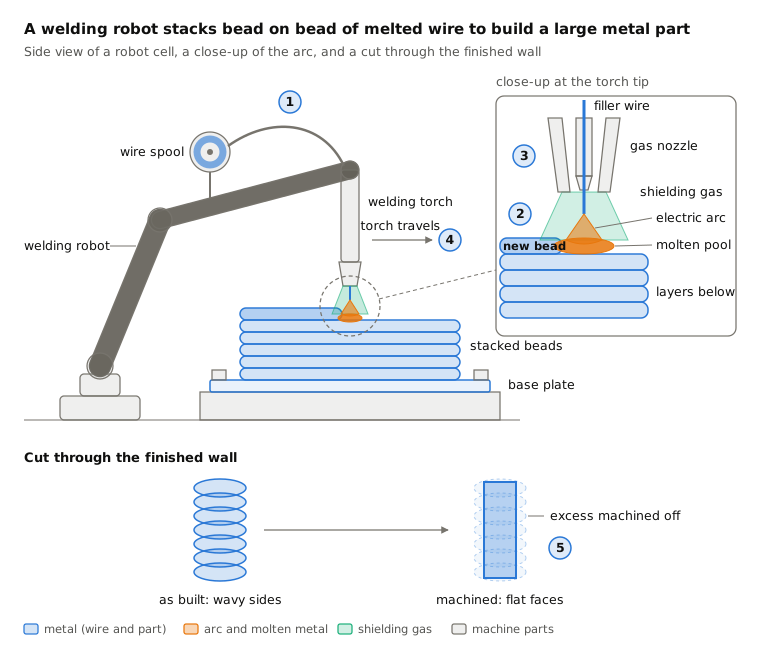
 8.8Wire arc additive manufacturing (WAAM)A welding robot stacks arc-melted wire into beads (directed energy deposition)Open the lesson
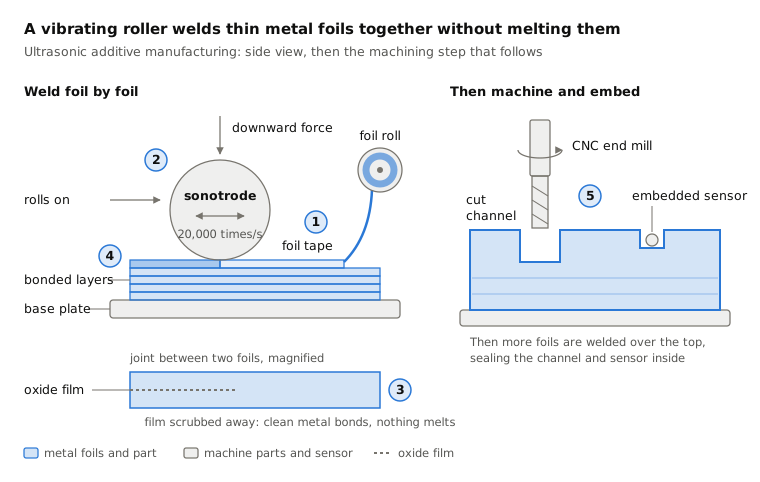
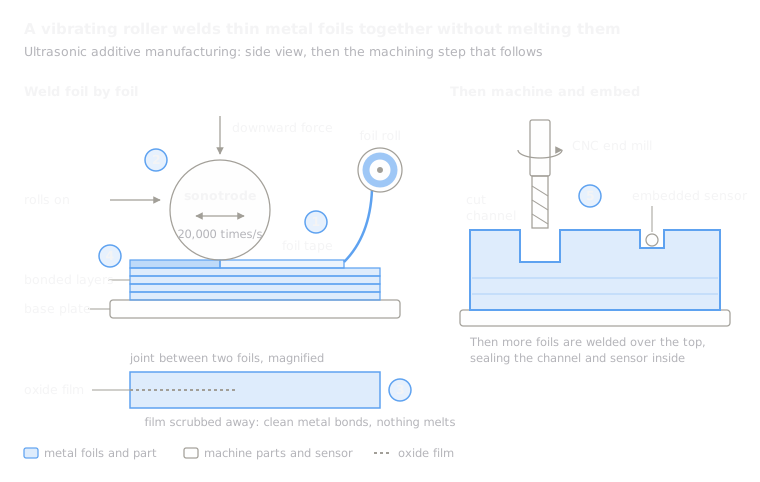 8.9Ultrasonic additive manufacturing (UAM)Ultrasonic vibration welds metal foils without melting, then a mill trims them (sheet lamination)Open the lesson
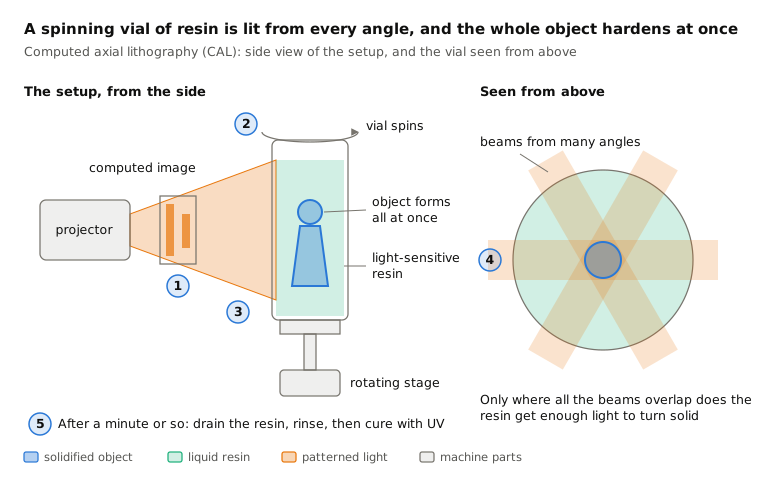
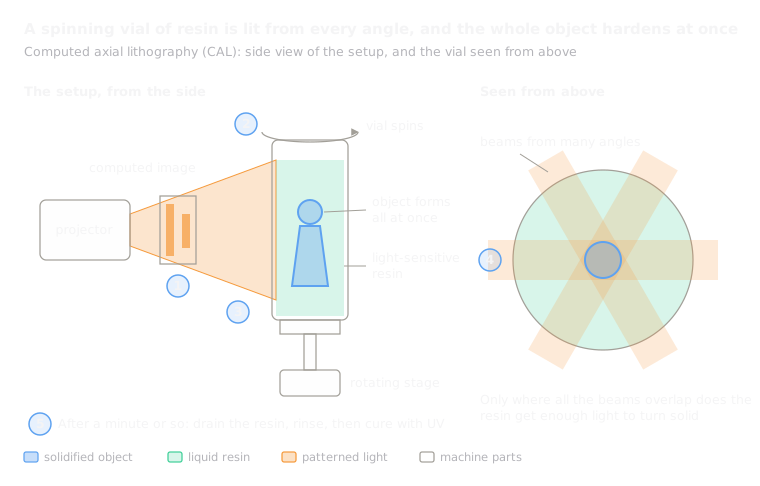 8.10Volumetric printing (CAL)Light from every angle cures a spinning vial of resin all at once (volumetric printing)Open the lesson
Side by side
| Process | In one line | Best for | Batch size | Precision |
|---|---|---|---|---|
| 8.1FDM (fused deposition modeling) | Extrudes molten plastic filament through a moving nozzle (material extrusion) | Cheap prototypes, jigs, hobby parts | 1 to 100s | About ±0.2–0.5 mm |
| 8.2Stereolithography (SLA/DLP) | Hardens liquid resin layer by layer with a laser or projector (vat photopolymerization) | Fine-detail models, dental parts, jewelry patterns | 1 to 1,000s | About ±0.05–0.1 mm |
| 8.3Selective laser sintering (SLS) | A laser fuses nylon powder in a bed; the loose powder supports the part (powder bed fusion) | Tough functional plastic parts with no supports | 10s to 10,000s | About ±0.3 mm |
| 8.4Laser powder bed fusion (metal, SLM/DMLS) | A laser melts thin layers of metal powder (powder bed fusion) | Complex metal parts, lattices, internal channels | 1 to 1,000s | About ±0.1 mm |
| 8.5Binder jetting | Inkjet heads glue powder, then the part is cured or sintered (binder jetting) | Sand molds, full-color models, metal parts in volume | 10s to 10,000s | About ±0.2 mm (more shrink in metal) |
| 8.6Material jetting (PolyJet) | Jets droplets of resin and cures them with UV light (material jetting) | Realistic multi-material, multi-color prototypes | 1 to 100 | About ±0.1 mm |
| 8.7Directed energy deposition (DED/LMD) | A laser melts a pool on the part; blown powder adds metal (directed energy deposition) | Repairs, cladding, adding features to parts | 1 to 10s | About ±0.5 mm before machining |
| 8.8Wire arc additive manufacturing (WAAM) | A welding robot stacks arc-melted wire into beads (directed energy deposition) | Large metal parts, meters long | 1 to 10s | About ±1 mm before machining |
| 8.9Ultrasonic additive manufacturing (UAM) | Ultrasonic vibration welds metal foils without melting, then a mill trims them (sheet lamination) | Embedded sensors, channels, mixed metals | 1 to 10s | About ±0.05 mm (machined) |
| 8.10Volumetric printing (CAL) | Light from every angle cures a spinning vial of resin all at once (volumetric printing) | Fast, smooth small parts; research | 1 to 10s | About 0.1–0.3 mm features |
How to choose within this family
- Plastic prototype on a budget: start with FDM; move to SLA or material jetting when looks and fine detail matter.
- Strong plastic parts in quantity: SLS, because loose powder supports every part and many parts nest in one build.
- Complex metal parts: laser powder bed fusion for detail and accuracy; binder jetting when you need many small parts at lower cost.
- Large metal parts or repairs: directed energy deposition (DED) for precision, WAAM for size and speed; plan to machine both.
- Special cases: UAM to bury sensors or join dissimilar metals; volumetric printing for small, layer-free resin parts in seconds.
Key words
- Layer height
- the thickness of each printed slice; thinner layers mean finer detail but longer builds.
- Support
- temporary material that holds up overhangs during printing and is removed afterward.
- Photopolymer
- a liquid resin that hardens when exposed to light, usually ultraviolet.
- Powder bed
- a thin, flat layer of powder spread across the build area, selectively fused or glued.
- Melt pool
- the small puddle of molten metal under a laser or arc as it builds.
- Sintering
- heating powder until its grains bond together without fully melting.
- Near-net shape
- a part made close to its final shape, needing only light machining.
- Post-processing
- everything done after printing, such as removing supports, curing, heat treatment or machining.
Try it
Put AI to work in your CAD.
Model parts, generate drawings and automate the repetitive work inside your CAD software.