

Material jetting (PolyJet)
Jets droplets of resin and cures them with UV light (material jetting)
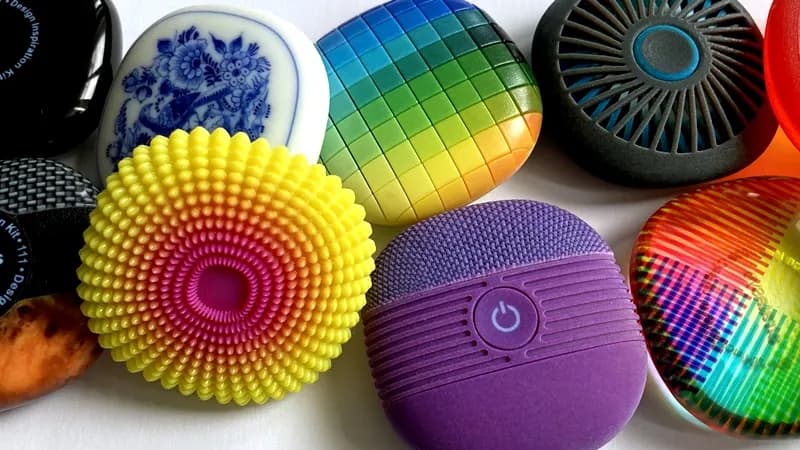
Material jetting works like an inkjet printer, but its “ink” is a liquid plastic that hardens under ultraviolet (UV) light. Thousands of thin layers of droplets stack up into a solid object. PolyJet, the best-known version, makes prototypes that look and feel like real products: colored, clear and soft-touch in one print.
How it works
Jet the droplets. The print block sweeps across the build tray. Its printheads (inkjet heads with hundreds of nozzles) fire droplets of photopolymer (a resin that hardens under light) where the layer needs material. Different heads can fire different resins in the same pass.
Level the layer. A roller skims the wet droplets flat, so every layer has exactly the same thickness.
Cure it with UV light. UV lamps ride on both ends of the block. They flood the fresh layer with ultraviolet light, which hardens it almost instantly.
Lower and repeat. The tray drops by one layer, about 0.016–0.03 mm, and the block makes its next pass. A part needs thousands of passes, so even small parts take hours.
Wash off the support. Under overhangs, other nozzles jetted a soft gel support (temporary material that holds up the part). After printing, you blast it away with a water jet or soak it off.
Key facts
- Materials
- Acrylic-based photopolymers: rigid, rubber-like, transparent and full-color resins, plus a gel support. Two resins can be blended drop by drop for in-between stiffness
- Typical parts
- Look-and-feel prototypes, soft-grip handles, clear housings, anatomical and dental models
- Part size
- From a few millimeters to about 0.5 m on most machines; the largest reach about 1 m
- Precision
- About ±0.1 mm on small features, up to about ±0.2 mm across a large part
- Surface finish
- Very smooth with barely visible layers; glossy or matte depending on where support touched
- Batch size it suits
- One-offs and small batches, roughly 1 to 100 parts
- Tooling and machine cost
- No tooling. Printers cost from tens of thousands to several hundred thousand dollars; resin costs far more per kilogram than FDM filament
- Speed
- A palm-sized part takes a few hours; a full tray usually runs overnight
Strengths and limits
Strengths
- Rigid, rubbery, clear and colored materials in one print
- Very fine detail and smooth surfaces straight off the printer
- No tooling: a changed design is just a new file
- Many small parts can share one tray and one run
Limits
- Parts are weaker and more brittle than molded plastics
- Resins yellow and turn brittle in sunlight and with age
- Printers and resins are expensive, and support gel is wasted material
- Not suited to load-bearing or hot parts
Where it's used
- Consumer productsLook-and-feel prototypes of phones, remotes and toothbrushes with soft grips
- MedicalAnatomical models for planning surgery, with soft and hard tissues in different materials
- DentalDental models and surgical guides
- AutomotiveDashboard and interior prototypes with real colors and textures
- ManufacturingShort-run injection mold inserts, jigs and fixtures
- Fashion and designEyewear and footwear prototypes; prints made directly onto fabric
How to recognize it
- Several materials in one seamless piece: a rigid body turns rubbery or transparent with no joint or glue line.
- Very smooth surfaces; layer lines are hard to see, even on curves.
- Glossy and matte zones on the same part: the matte areas are where gel support touched it.
- Full-color parts with printed textures, labels or color gradients.
Compare with
Watch it
Stratasys · The maker of PolyJet explains droplets, UV curing and support
Protolabs · An animation of the printheads, UV lamps and gel support at work
TriMech · Real PolyJet machines and the kinds of parts they make
Proto3000 · Close-ups of clear, soft and full-color printed parts
See real photos
- Wikipedia: 3D printing processes — overview of every printing family, including material jetting
- Wikipedia: Objet Geometries — the company that invented PolyJet and its printer lines
- Wikimedia Commons photo search
Remember
- Material jetting builds parts from droplets of liquid resin, hardened layer by layer with UV light.
- Its superpower is mixing rigid, rubbery, clear and colored materials in one print.
- Use it for realistic prototypes and models, not for strong, long-lasting parts.
More in Additive manufacturing
All 100 processes
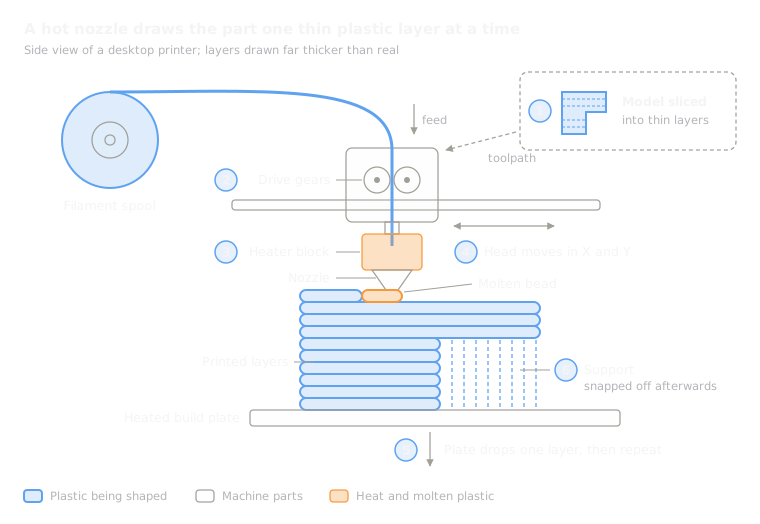 8.1ShortFDM (fused deposition modeling)Extrudes molten plastic filament through a moving nozzle (material extrusion)Open the lesson
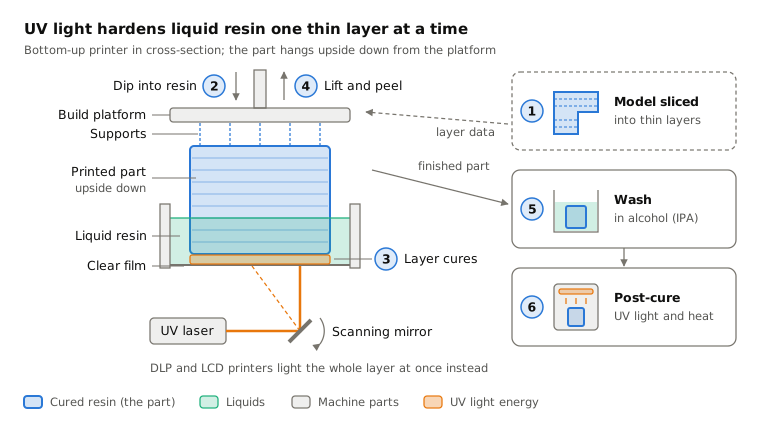
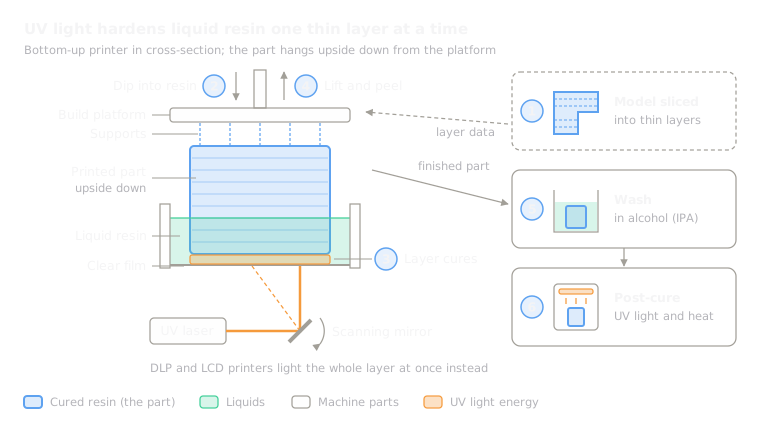 8.2Stereolithography (SLA/DLP)Hardens liquid resin layer by layer with a laser or projector (vat photopolymerization)Open the lesson
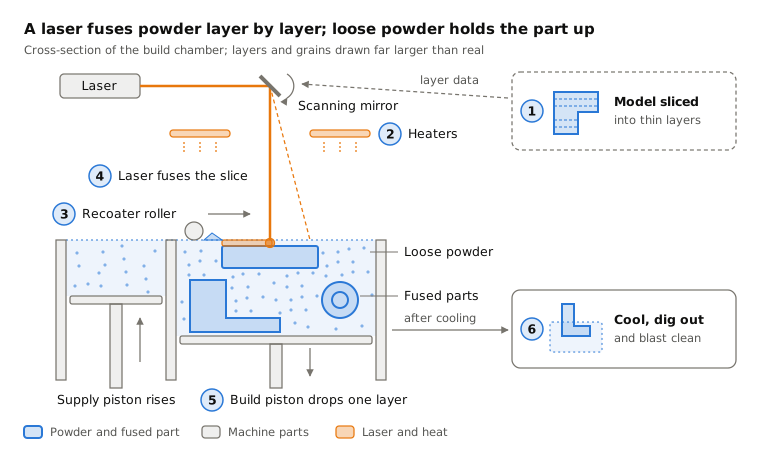
 8.3Selective laser sintering (SLS)A laser fuses nylon powder in a bed; the loose powder supports the part (powder bed fusion)Open the lesson
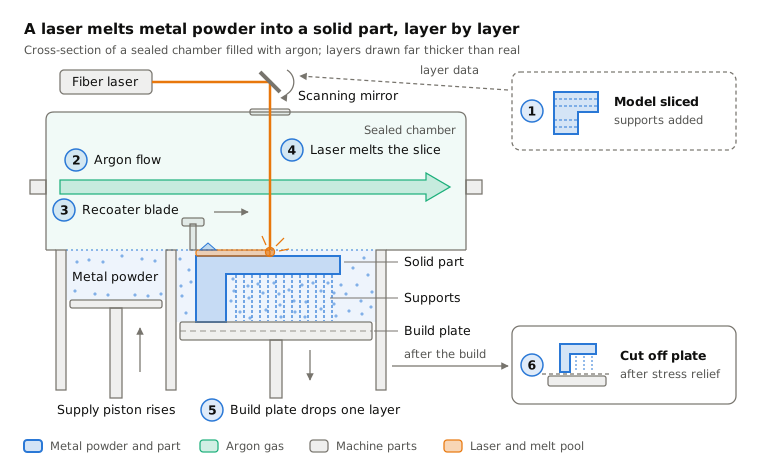
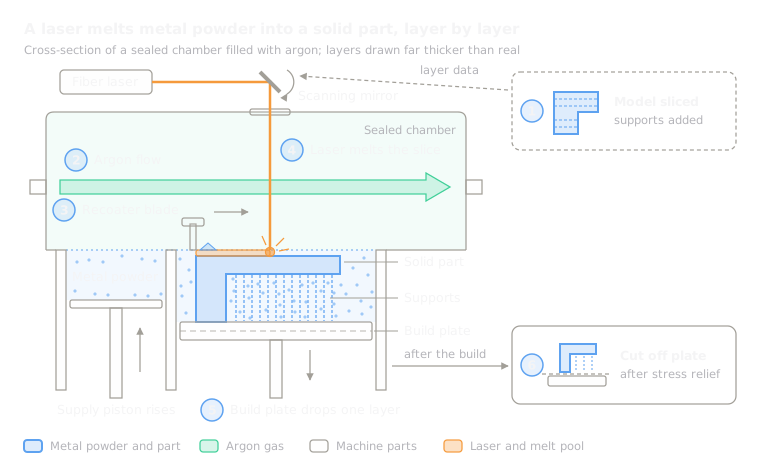 8.4Laser powder bed fusion (metal, SLM/DMLS)A laser melts thin layers of metal powder (powder bed fusion)Open the lesson
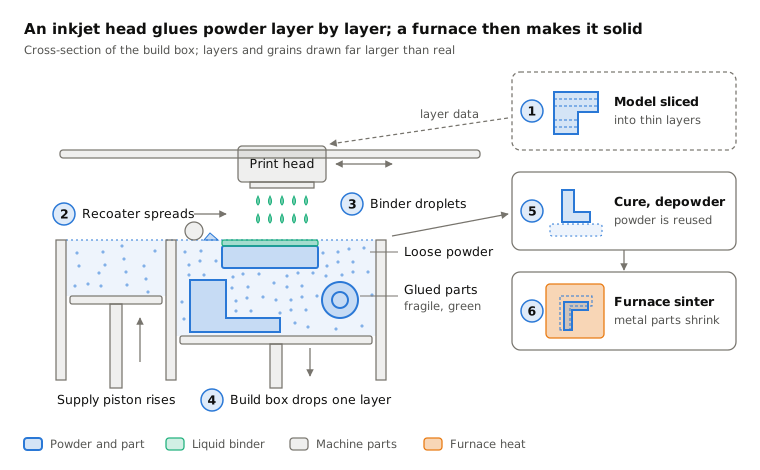
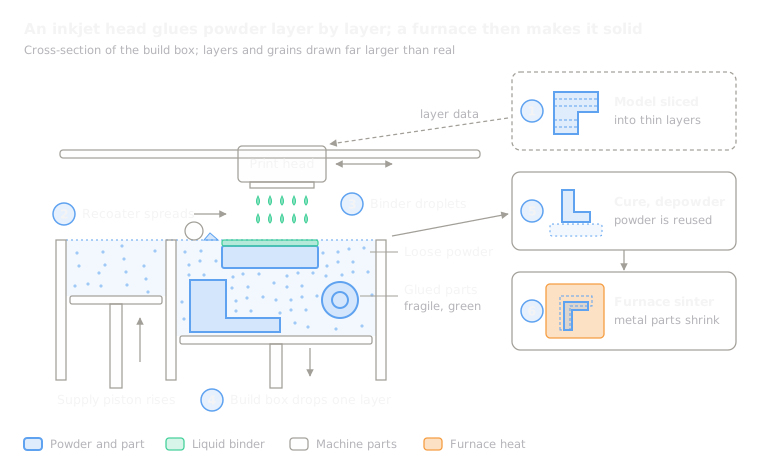 8.5Binder jettingInkjet heads glue powder, then the part is cured or sintered (binder jetting)Open the lesson
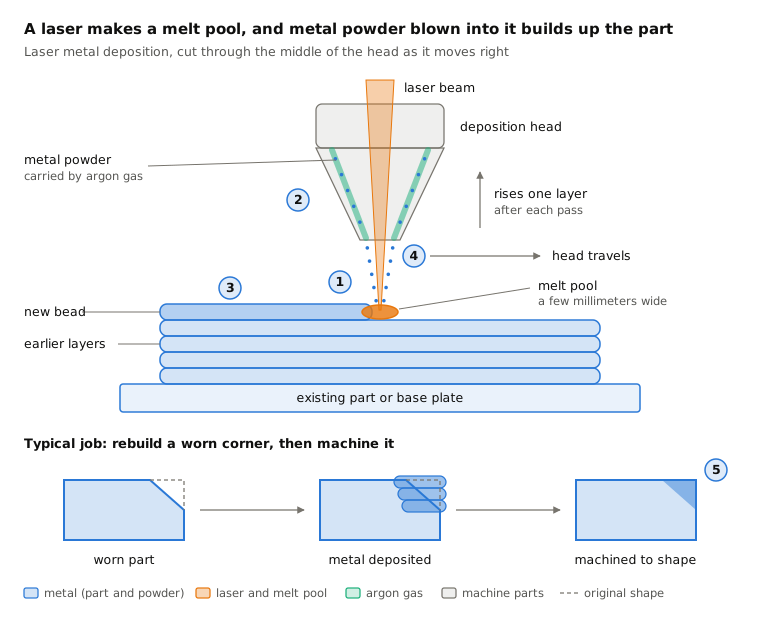
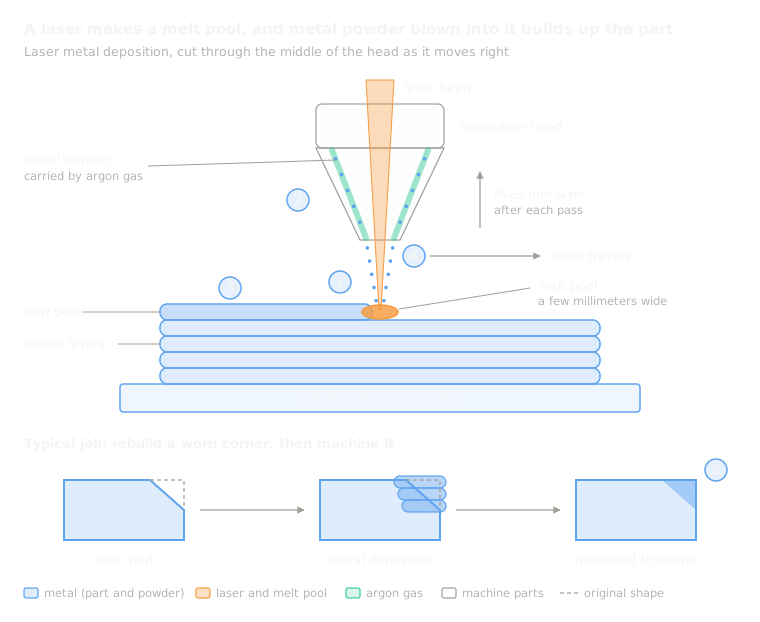 8.7Directed energy deposition (DED/LMD)A laser melts a pool on the part; blown powder adds metal (directed energy deposition)Open the lesson
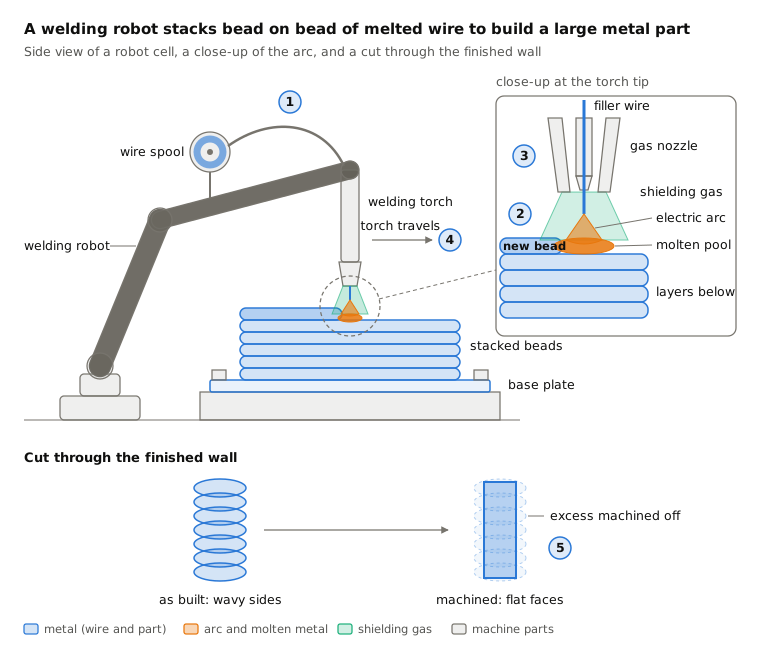
 8.8Wire arc additive manufacturing (WAAM)A welding robot stacks arc-melted wire into beads (directed energy deposition)Open the lesson
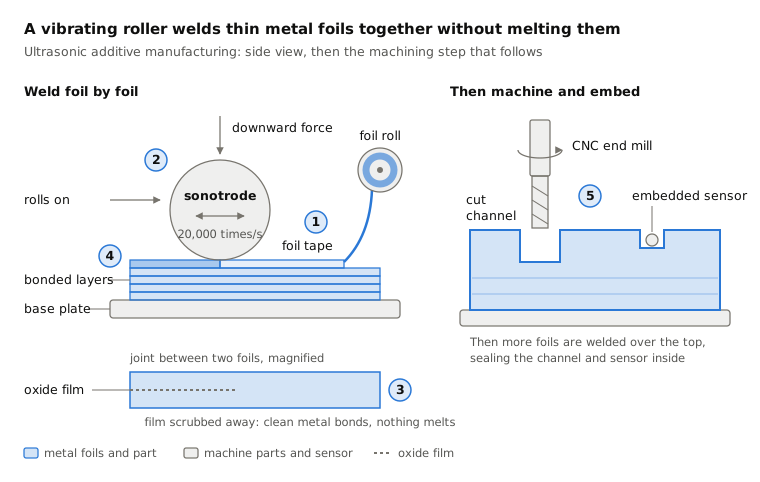
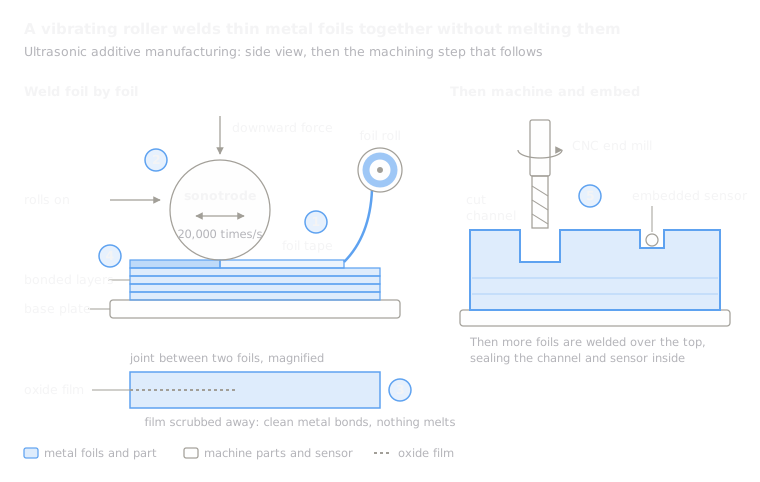 8.9Ultrasonic additive manufacturing (UAM)Ultrasonic vibration welds metal foils without melting, then a mill trims them (sheet lamination)Open the lesson
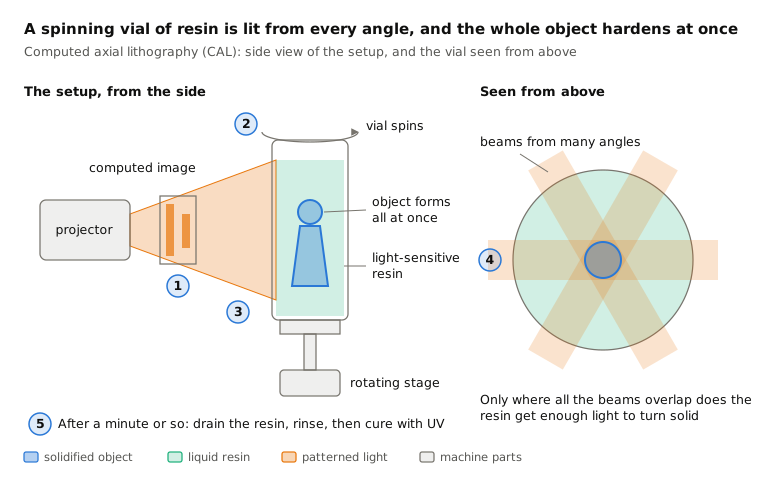
 8.10Volumetric printing (CAL)Light from every angle cures a spinning vial of resin all at once (volumetric printing)Open the lesson
Try it
Put AI to work in your CAD.
Model parts, generate drawings and automate the repetitive work inside your CAD software.