

Wire arc additive manufacturing (WAAM)
A welding robot stacks arc-melted wire into beads (directed energy deposition)
Wire arc additive manufacturing (WAAM) is 3D printing with a welding robot. An electric arc melts ordinary welding wire, and the robot stacks bead after bead into a part that can be meters long. It is the cheapest and fastest way to print big metal parts, from ship propellers to a pedestrian bridge.
How it works
Feed the wire. A feeder pulls welding wire, typically about 1–1.6 mm thick, off a spool and pushes it through the torch.
Strike the arc. An electric arc (a continuous spark, thousands of degrees hot) jumps from the wire tip to the part. It melts the wire, and droplets fall into a molten pool on top of the wall.
Shield the pool. Gas flowing out of the nozzle, usually argon or an argon mix, keeps air away. Without it, the hot metal would oxidize (react with oxygen) and turn weak and porous.
Stack the beads. The robot drags the torch along the wall, and the pool freezes into a bead behind it. After each layer, the torch rises about 1–2 mm and lays the next one.
Cool, then machine. Each layer must cool a little before the next, or the wall sags. At the end, a milling machine cuts the wavy sides flat to the final size.
Key facts
- Materials
- Almost any weldable wire: carbon and stainless steels, aluminum, titanium, nickel alloys and bronze
- Typical parts
- Large near-net-shape parts (close to final shape, still needing machining): propellers, pipe fittings, flanges, aerospace frames, architectural structures
- Part size
- From about 0.2 m to several meters, limited by the robot's reach, its rails or a gantry
- Precision
- About ±0.5–1 mm as built; machining brings it to about ±0.05 mm
- Surface finish
- Rough and wavy as built, with ripples you can feel; machined faces are smooth
- Batch size it suits
- One-offs and small batches of large parts
- Tooling and machine cost
- No tooling. Built from standard welding robots and power sources: typically a few hundred thousand dollars, much less than laser systems. Wire costs far less than metal powder
- Speed
- Typically 1–4 kg of metal per hour, about ten times faster than powder-bed fusion
Strengths and limits
Strengths
- Very high build rate for big parts
- Low-cost equipment and cheap wire
- Almost no size limit: the robot can ride on rails
- Little wasted metal compared with machining from a solid block
Limits
- Rough, wavy surfaces: machining is always needed
- Coarse detail: no small holes, thin walls or fine features
- Heat builds stress and distortion, so parts can warp
- Waiting for each layer to cool slows the build
Where it's used
- MaritimeShip propellers and propeller blades in bronze
- AerospaceLarge titanium and aluminum parts printed as blanks, then machined
- Oil, gas and energyPipe fittings, flanges and valve bodies, often as fast spare parts
- Construction and architectureSteel nodes and structures, such as a printed pedestrian bridge in Amsterdam
- SpaceRocket thrusters and large structural parts
How to recognize it
- Walls made of visible stacked weld beads, like a coil of rope.
- Often a rainbow heat tint (straw, blue and purple colors) on steel and titanium surfaces.
- A thick base plate still attached, or saw marks where it was cut off.
- Machined flat faces right next to rough, rippled ones.
Compare with
Watch it
theworacle · A lab demo of titanium WAAM, including rolling the wall between layers
MX3D · A robot printing a rocket thruster bead by bead
MX3D · A large printed impeller seen up close
MX3D · The printed stainless-steel bridge lifted into place over a canal
See real photos
- Wikipedia: Directed energy deposition — the process family WAAM belongs to; text with few photos
- Wikimedia Commons photo search
- Wikimedia Commons search: MX3D bridge — photos of the printed steel bridge
Remember
- WAAM is robotic arc welding used to stack beads into a part.
- It is the fastest, cheapest route to large metal parts, but they come out rough.
- Expect to machine every functional surface after printing.
More in Additive manufacturing
All 100 processes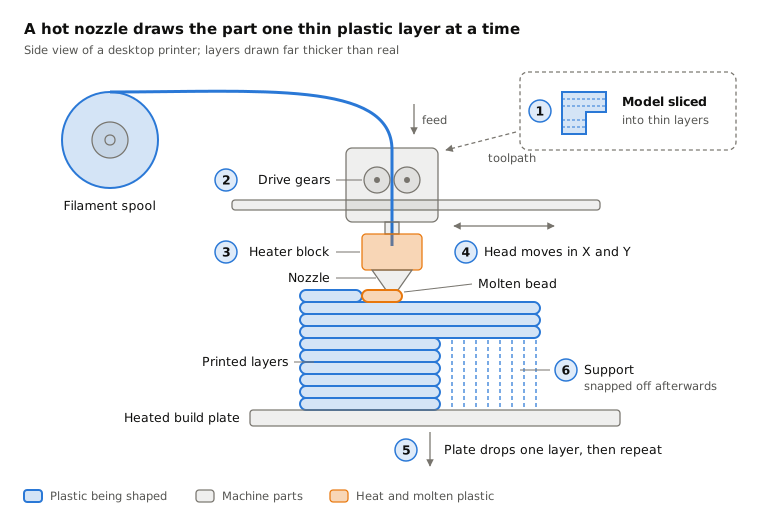
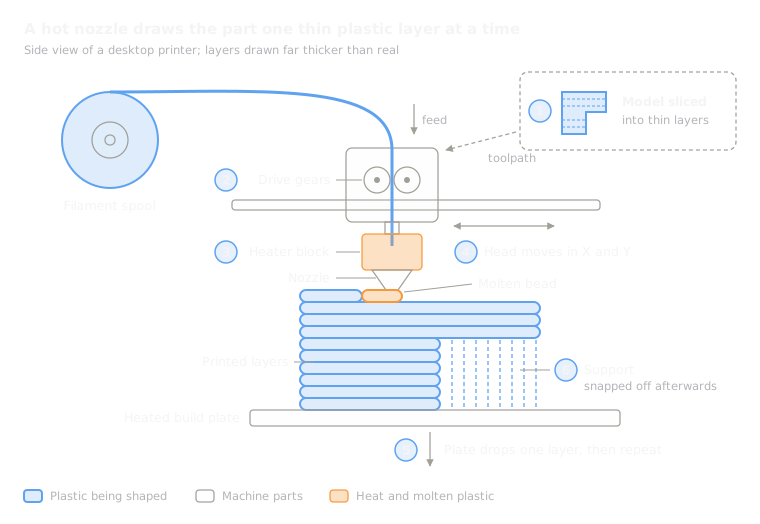 8.1ShortFDM (fused deposition modeling)Extrudes molten plastic filament through a moving nozzle (material extrusion)Open the lesson
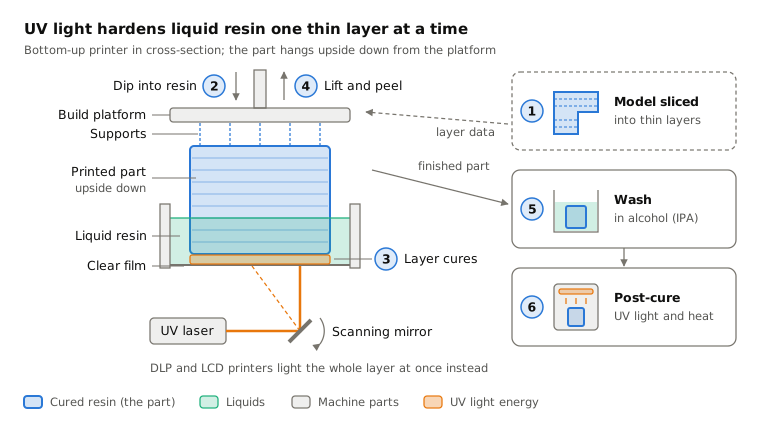
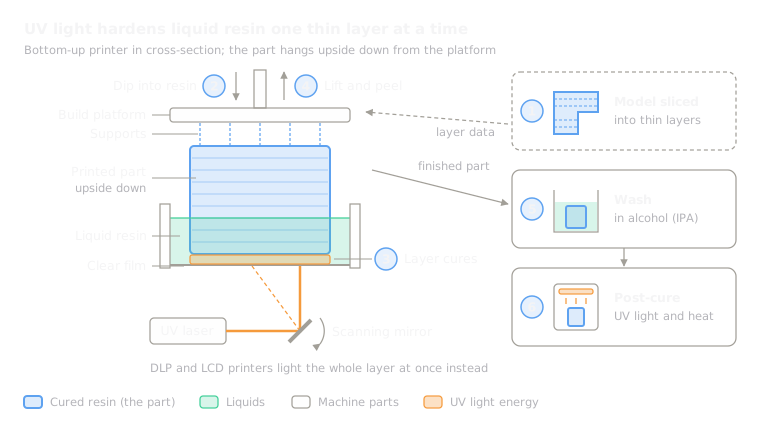 8.2Stereolithography (SLA/DLP)Hardens liquid resin layer by layer with a laser or projector (vat photopolymerization)Open the lesson
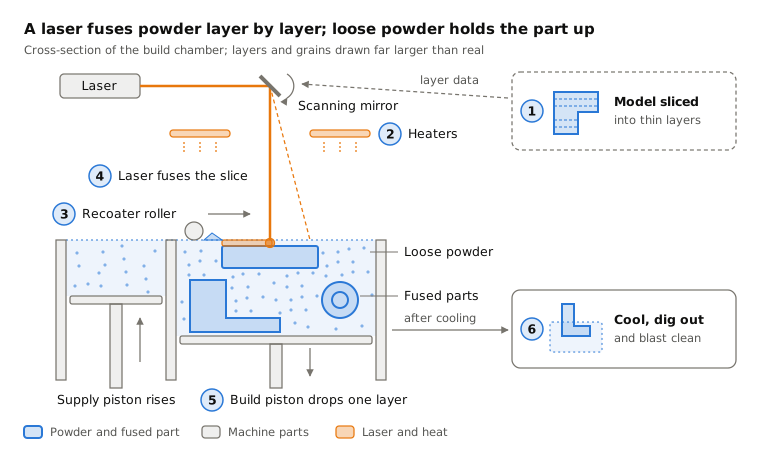
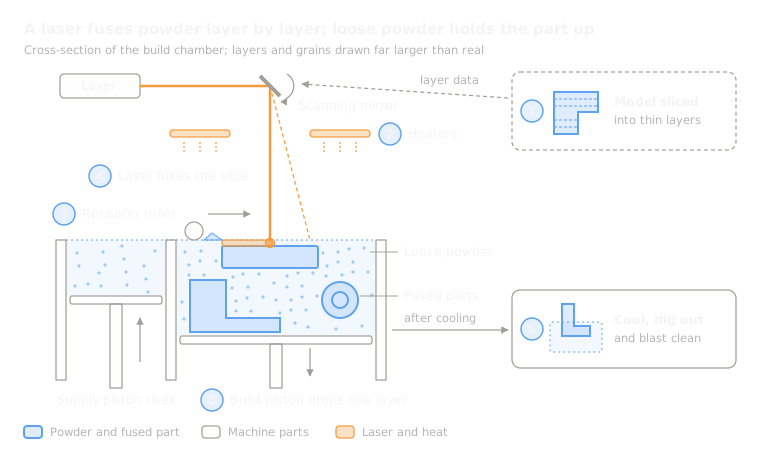 8.3Selective laser sintering (SLS)A laser fuses nylon powder in a bed; the loose powder supports the part (powder bed fusion)Open the lesson
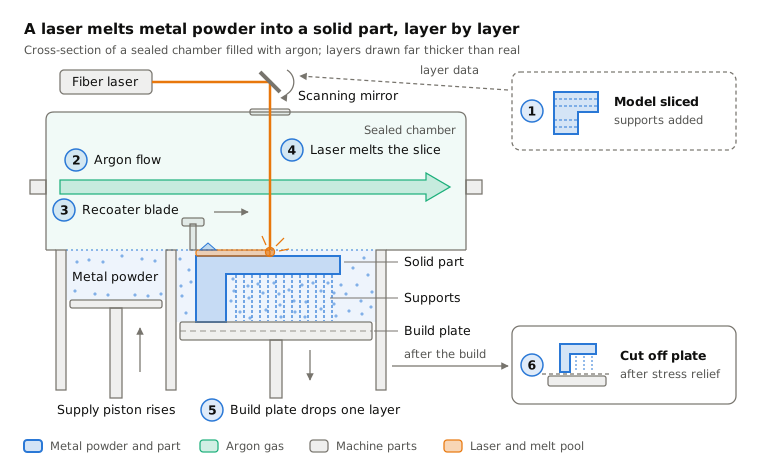
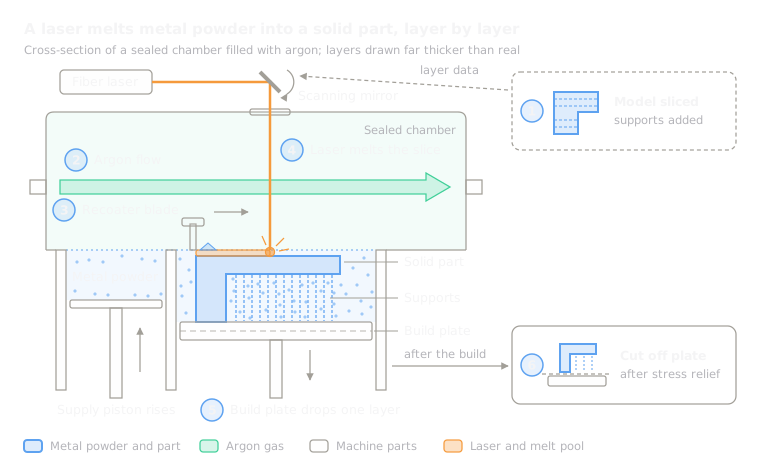 8.4Laser powder bed fusion (metal, SLM/DMLS)A laser melts thin layers of metal powder (powder bed fusion)Open the lesson
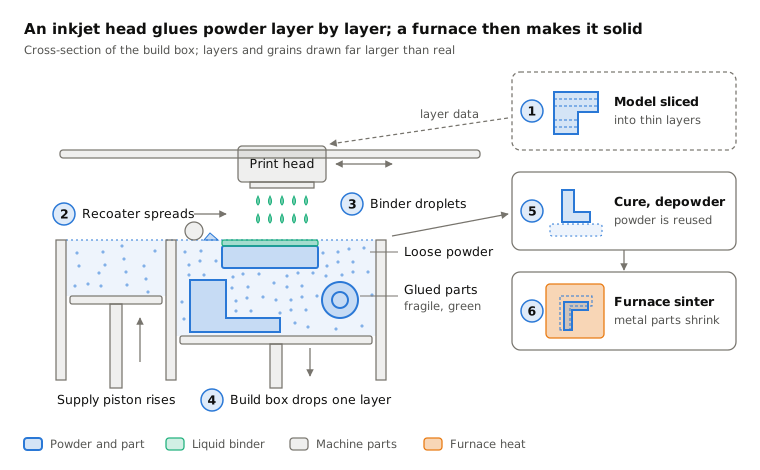
 8.5Binder jettingInkjet heads glue powder, then the part is cured or sintered (binder jetting)Open the lesson
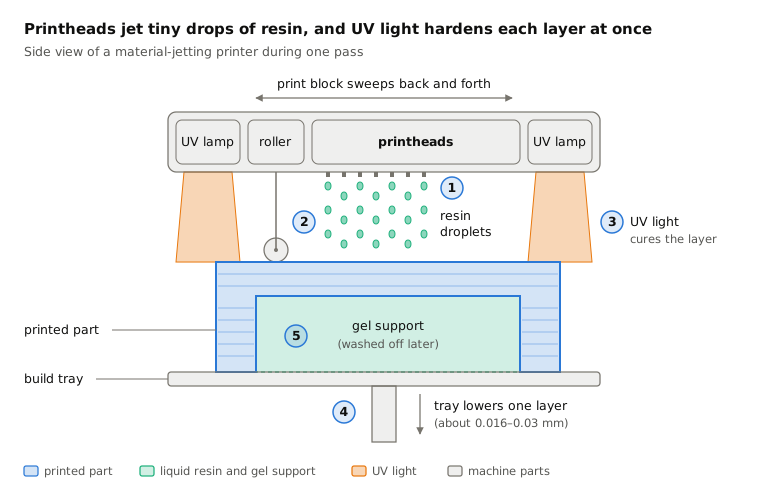
 8.6Material jetting (PolyJet)Jets droplets of resin and cures them with UV light (material jetting)Open the lesson
 8.7Directed energy deposition (DED/LMD)A laser melts a pool on the part; blown powder adds metal (directed energy deposition)Open the lesson
 8.9Ultrasonic additive manufacturing (UAM)Ultrasonic vibration welds metal foils without melting, then a mill trims them (sheet lamination)Open the lesson
 8.10Volumetric printing (CAL)Light from every angle cures a spinning vial of resin all at once (volumetric printing)Open the lesson
Try it
Put AI to work in your CAD.
Model parts, generate drawings and automate the repetitive work inside your CAD software.