

Selective laser sintering (SLS)
A laser fuses nylon powder in a bed; the loose powder supports the part (powder bed fusion)
Selective laser sintering (SLS) uses a laser to fuse fine plastic powder, usually nylon, one thin layer at a time. The loose powder around the part holds it up, so no supports are needed. It matters because it makes strong, working plastic parts in small batches, such as drone frames, ducts and custom braces.
How it works
Slice the model. Software cuts the 3D model into thin layers. Many parts can be packed together, even stacked, to fill the whole build volume.
Heat the chamber. Heaters keep the powder bed just below its melting point, about 170 °C for nylon 12. The laser then only has to add a little extra energy.
Spread a layer. The supply piston rises, and a recoater (a roller or blade) sweeps a thin layer of powder, typically 0.1 mm, across the build area.
Fuse the slice. A laser, steered by fast mirrors, traces the part's cross-section. It sinters the grains (fuses them by partly melting them) to each other and to the layer below.
Lower and repeat. The build piston drops by one layer, and steps 3 to 5 repeat. The unfused powder stays in place and props up every overhang.
Cool, dig out, clean. The block of powder, called the cake, cools slowly, often for about as long as the print took. You then dig out the parts, blast off the clinging powder and mix the leftover powder with fresh powder for reuse.
Key facts
- Materials
- Nylon (PA12, PA11) above all; also glass- or carbon-filled nylon, flexible TPU, polypropylene and high-temperature PEEK
- Typical parts
- Functional prototypes, housings, snap-fits and living hinges, ducts, brackets, custom braces and grips
- Part size
- About 15–30 cm per side on benchtop machines; industrial machines up to about 70 cm
- Precision
- About ±0.3 mm, or about ±0.3% on larger parts
- Surface finish
- Matte and slightly grainy, like fine sandpaper; often dyed, tumbled or vapor-smoothed
- Batch size it suits
- 1 to a few thousand parts; one build can hold dozens to hundreds of small parts
- Tooling and machine cost
- No tooling; benchtop systems cost tens of thousands of dollars, industrial systems hundreds of thousands
- Speed
- About half a day to a day per build, plus several hours or more of cooling
Strengths and limits
Strengths
- No supports, so parts can be nested and stacked to fill the whole volume
- Strong, tough nylon parts, nearly as strong between layers as along them
- Complex shapes: lattices, inner channels, even hinges printed already assembled
- Low cost per part when a build is packed full
Limits
- Machines and powder cost far more than FDM
- Rough, slightly porous surface that needs finishing and can soak up dirt
- Long cooling time before you can unpack the parts
- Dusty powder handling, and some fresh powder must be added each build
Where it's used
- AerospaceAir ducts and brackets for aircraft and drones
- MedicalCustom orthoses, prosthetic sockets, surgical guides
- Consumer productsEyewear frames, sports gear, small-batch housings
- AutomotivePrototypes, clips, ducts and low-volume production parts
- IndustrialRobot grippers, jigs and fixtures, spare parts
How to recognize it
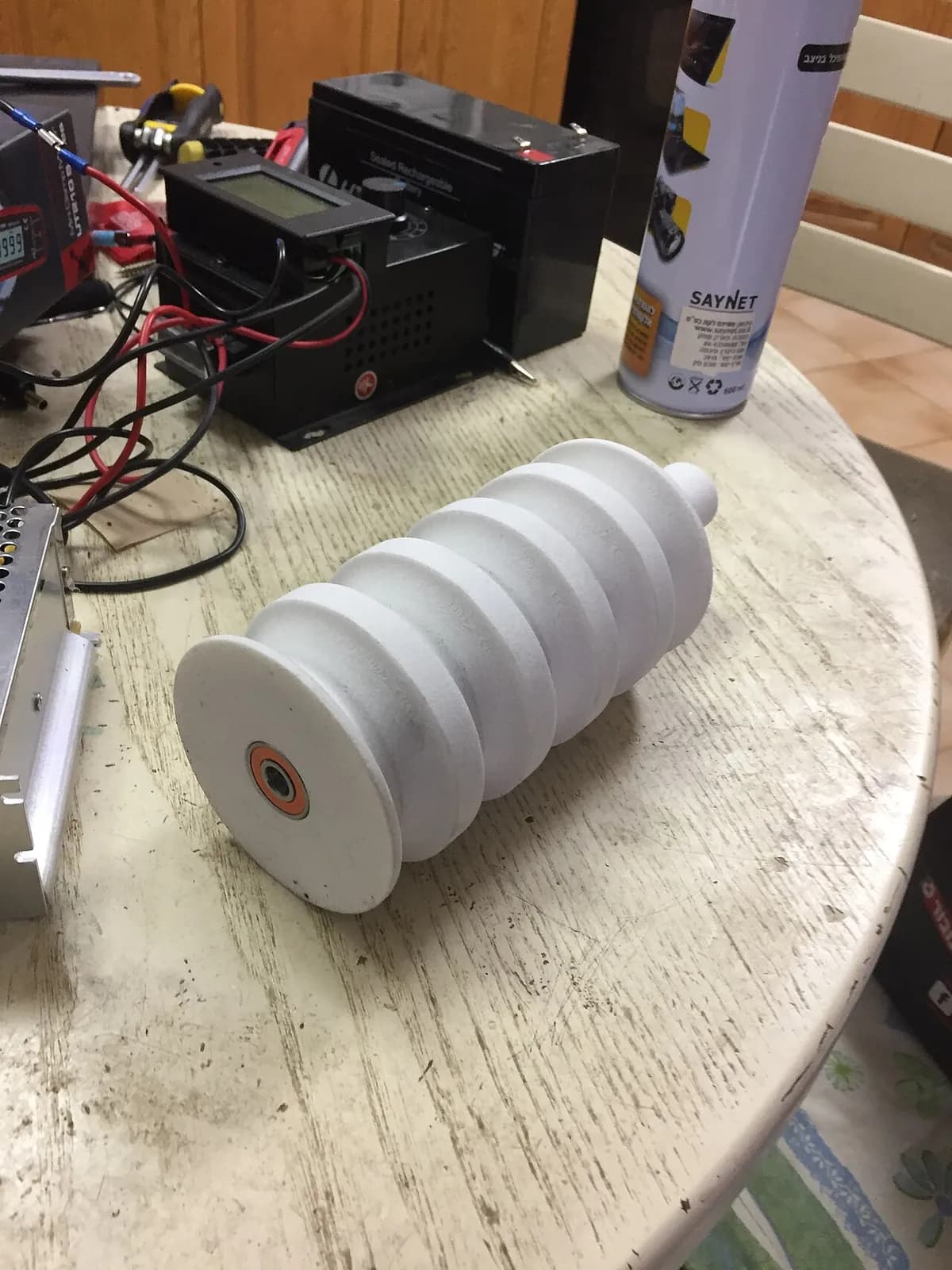
- A matte, slightly sandy surface, often off-white, gray or dyed black.
- No support marks anywhere, even under steep overhangs.
- Faint, soft layer lines on curved surfaces, much less visible than FDM ridges.
- Small escape holes on hollow parts, left so the trapped powder could be poured out.
Compare with
Watch it
Dr. D-Flo · The SLS principle explained for beginners
Formlabs Support · Inside the machine: laser, recoater and heating
Vision Miner · The whole workflow, from printing to digging out and blasting
EOS 3D Printing · Industrial SLS used for series production
See real photos
- Wikipedia: Selective laser sintering — labeled process schematic and photos of SLS parts
- Wikimedia Commons photo search
Remember
- SLS fuses plastic powder with a laser, layer by layer, inside a heated bed.
- The loose powder supports the part, so no supports are needed and parts can be stacked.
- Parts come out strong but grainy, and need hours of cooling and cleaning.
More in Additive manufacturing
All 100 processes
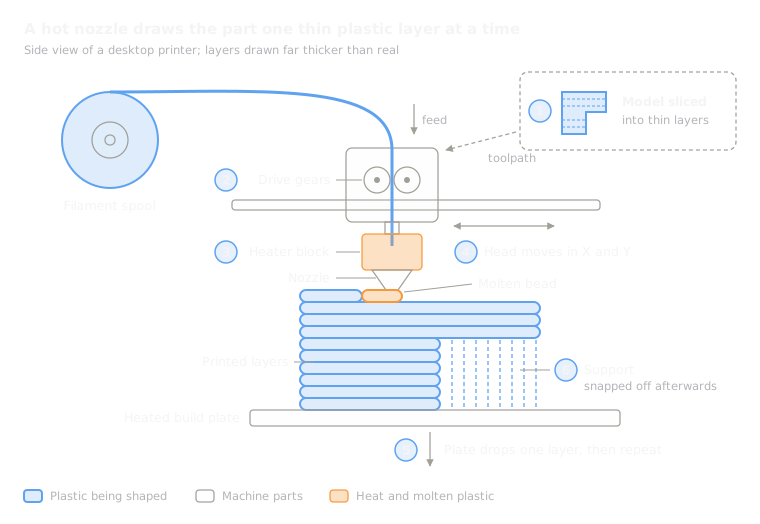 8.1ShortFDM (fused deposition modeling)Extrudes molten plastic filament through a moving nozzle (material extrusion)Open the lesson
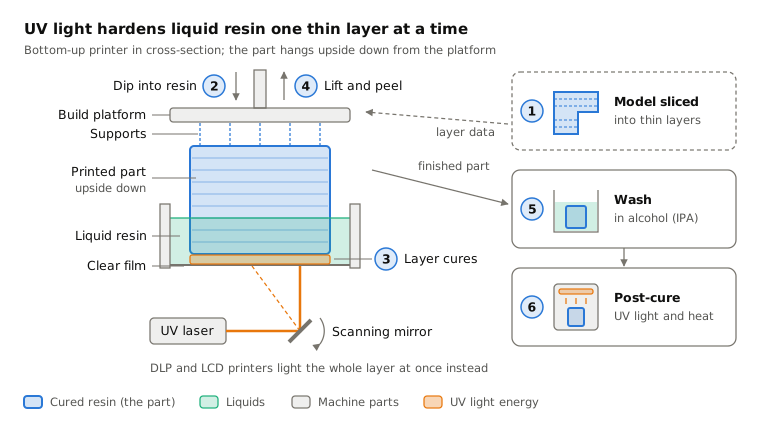
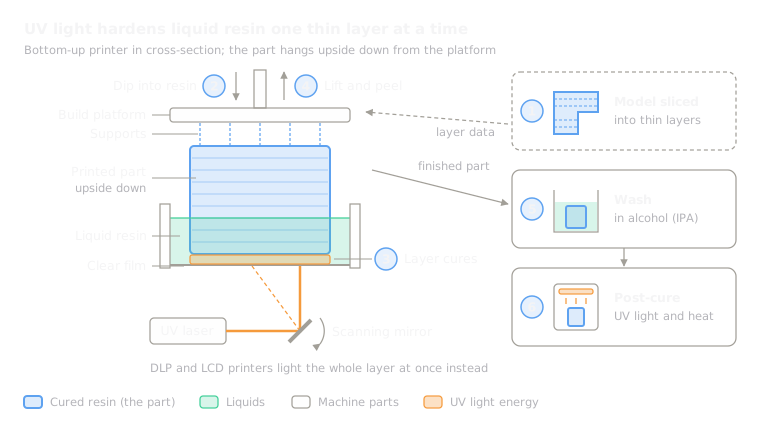 8.2Stereolithography (SLA/DLP)Hardens liquid resin layer by layer with a laser or projector (vat photopolymerization)Open the lesson
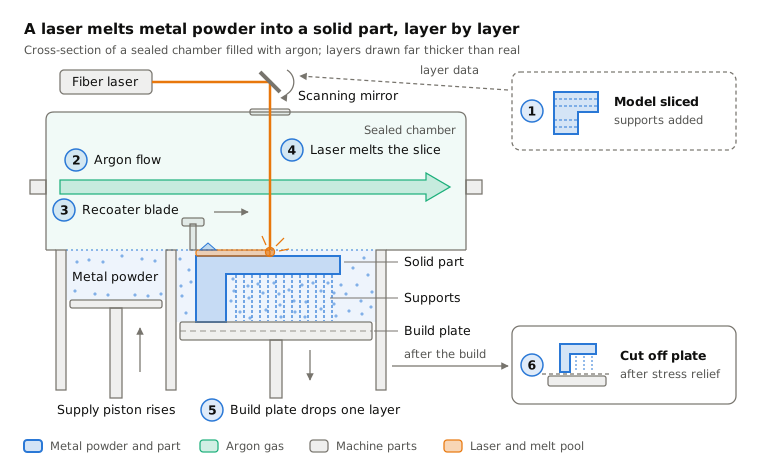
 8.4Laser powder bed fusion (metal, SLM/DMLS)A laser melts thin layers of metal powder (powder bed fusion)Open the lesson
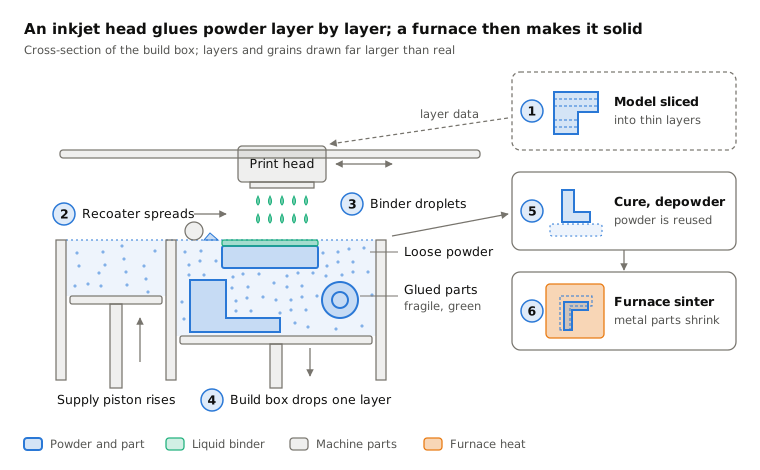
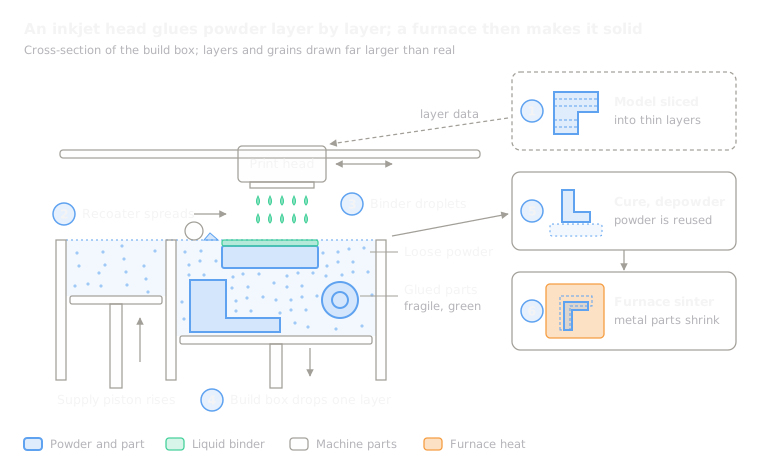 8.5Binder jettingInkjet heads glue powder, then the part is cured or sintered (binder jetting)Open the lesson
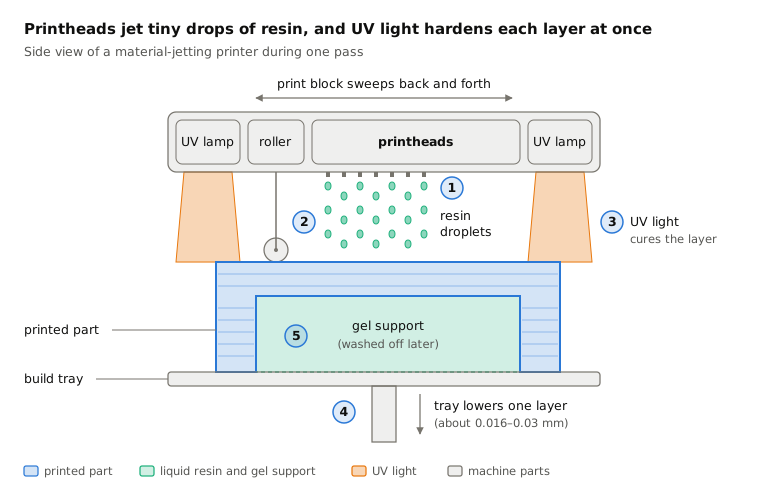
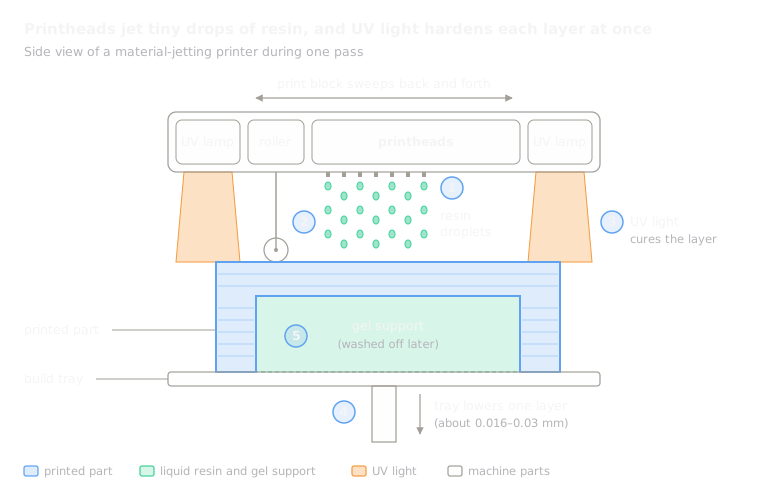 8.6Material jetting (PolyJet)Jets droplets of resin and cures them with UV light (material jetting)Open the lesson
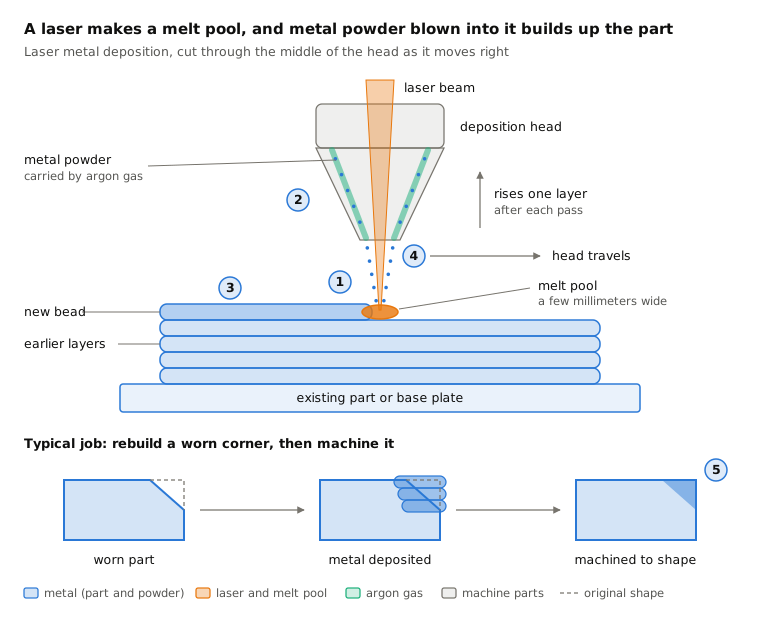
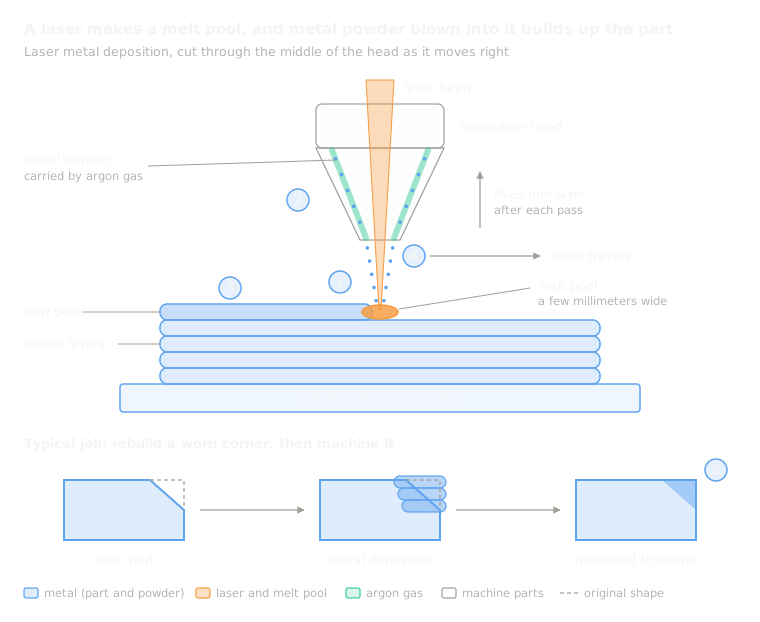 8.7Directed energy deposition (DED/LMD)A laser melts a pool on the part; blown powder adds metal (directed energy deposition)Open the lesson
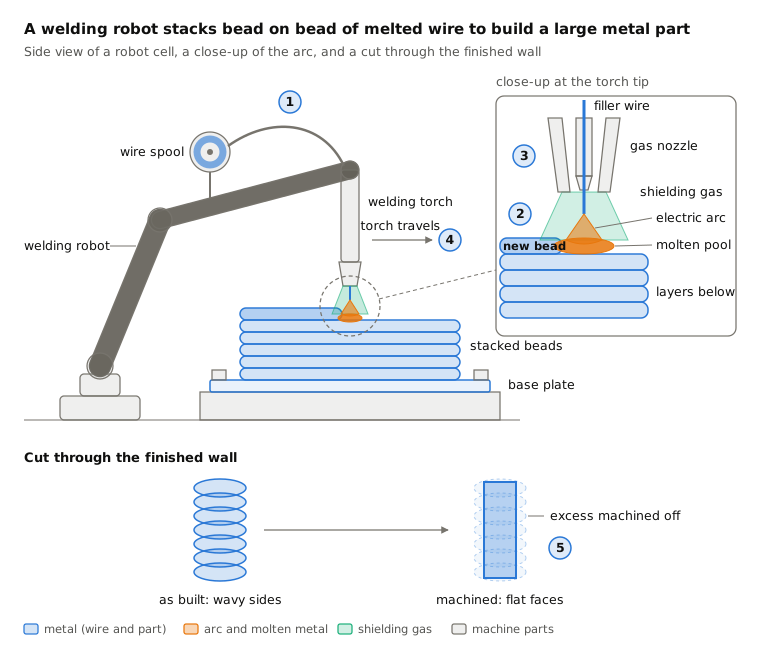
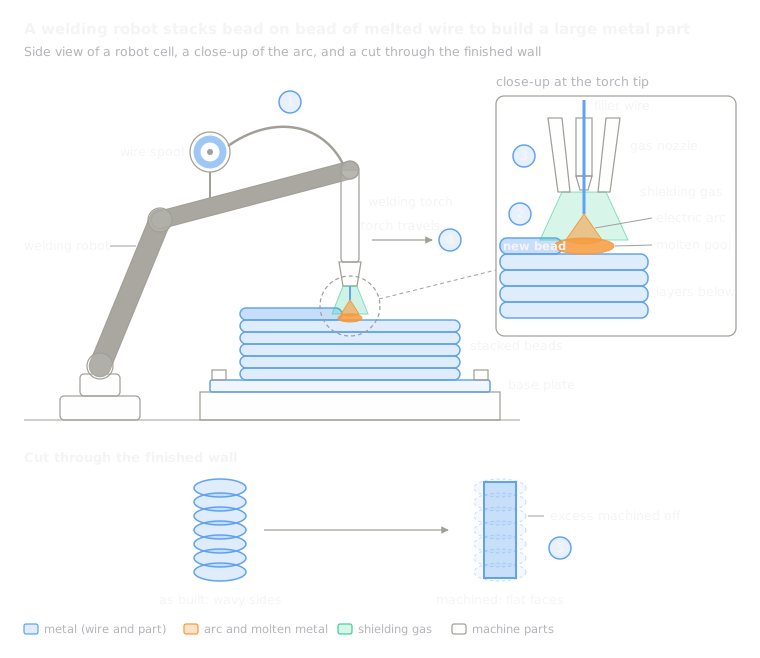 8.8Wire arc additive manufacturing (WAAM)A welding robot stacks arc-melted wire into beads (directed energy deposition)Open the lesson
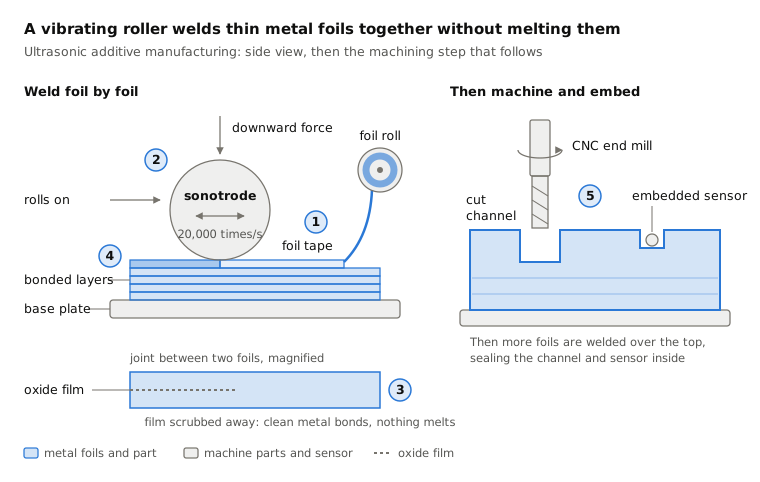
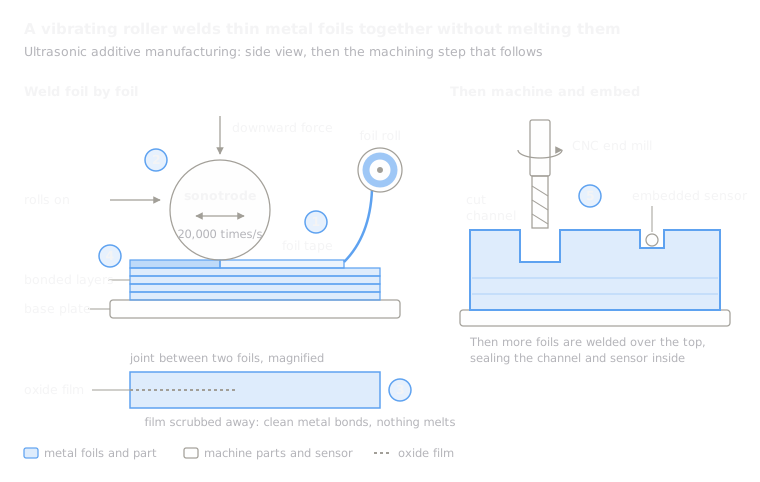 8.9Ultrasonic additive manufacturing (UAM)Ultrasonic vibration welds metal foils without melting, then a mill trims them (sheet lamination)Open the lesson
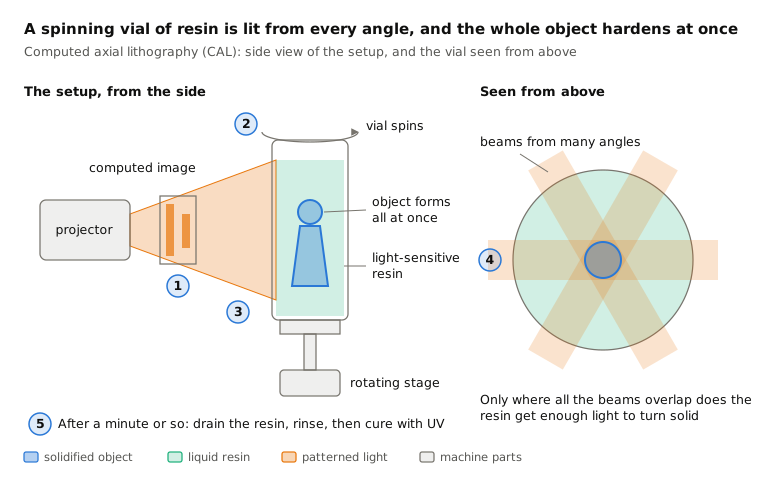
 8.10Volumetric printing (CAL)Light from every angle cures a spinning vial of resin all at once (volumetric printing)Open the lesson
Try it
Put AI to work in your CAD.
Model parts, generate drawings and automate the repetitive work inside your CAD software.