

Spark plasma sintering (SPS)
Pulsed current heats a pressed graphite die in minutes
Spark plasma sintering (SPS) presses powder in a graphite die while a huge pulsed electric current runs through it. The die heats itself, so the powder becomes a dense solid in minutes rather than hours. Labs use it to make new materials, such as ultra-hard ceramics, that ordinary furnaces struggle to densify.
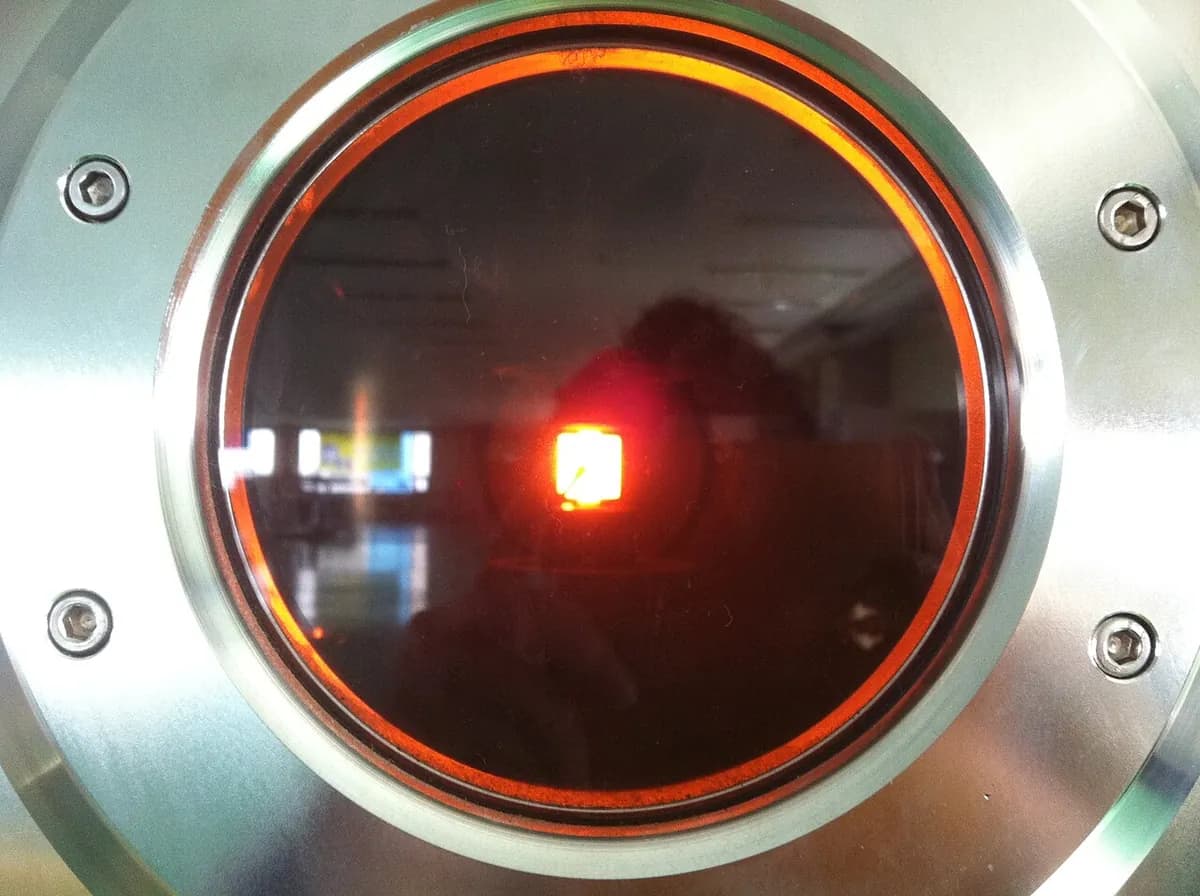
How it works
Fill the die. Powder is poured into a graphite die (a thick tube) between two graphite punches. The die is usually lined with graphite foil so the part releases.
Load and pump down. The die stack goes between the water-cooled rams of a press inside a chamber. The air is pumped out (vacuum) or replaced by argon, so the hot graphite and powder do not burn.
Press and pass current. The rams press at typically 30–100 MPa while a power supply sends pulsed direct current, thousands of amperes at a few volts, through the graphite. The die heats from inside by electrical resistance, like a toaster wire, at 100 °C per minute or more. Despite the name, there is usually no spark or plasma.
Hold briefly. After typically 5–10 minutes at peak temperature (often 1,000–2,000 °C, depending on the material), the particles bond and the pores squeeze out. The ram moves down as the powder shrinks, which shows when it is dense.
Cool and eject. With the power off, the water-cooled rams pull the heat out quickly. The dense disc is pressed out of the die, and its graphite skin is ground off before cutting or finishing.
Key facts
- Materials
- Ceramics (alumina, silicon carbide, borides), hard metals, tungsten and other high-melting metals, thermoelectrics, composites, very fine powders
- Typical parts
- Discs and simple blocks: sputtering targets, armor tiles, cutting-tool blanks, research samples
- Part size
- Mostly 10–50 mm discs in labs; industrial machines make parts up to a few hundred millimeters across
- Precision
- Rough as sintered: the diameter is set by the die, the thickness less exactly; final tolerances come from grinding
- Surface finish
- A gray graphite skin, ground or polished off afterward
- Batch size it suits
- One-offs to small batches: research, prototypes and specialty parts
- Tooling and machine cost
- Graphite dies are consumables costing roughly tens to hundreds of dollars; machines run from a few hundred thousand dollars (lab) to millions (industrial)
- Speed
- Typically 10–30 minutes per run plus cooling, one part or a small stack at a time
Strengths and limits
Strengths
- Very fast: minutes instead of hours
- Keeps grains (the tiny crystals in the material) very fine, which can make it stronger or even transparent
- Densifies hard-to-sinter materials like borides and carbides, often without additives
- Can bond layers of different materials in one run
Limits
- Simple shapes only: discs, blocks, short cylinders
- Small parts and low output per machine
- Graphite tooling limits pressure to about 100 MPa and can add carbon to the surface
- Temperature can be uneven in large parts or in powders that do not conduct
Where it's used
- Research labsNew ceramics, alloys and composites; fast trials of many recipes
- ElectronicsThermoelectric materials, sputtering targets for thin-film coating
- Defense and aerospaceBoron carbide armor, ceramics for extreme heat
- ToolsCutting-tool blanks and hard-metal parts
- OpticsTransparent ceramics such as spinel windows, mostly at research scale
How to recognize it
- Flat discs or short cylinders with exactly the shape of a round die.
- A gray graphite skin on unfinished parts.
- Ground faces on almost every finished part, since SPS parts are rarely used as they come out.
Compare with
Watch it
Prof. Neha Gupta · The principle: pulsed current through a graphite die under pressure
Haoyuevac · A real lab run, with the die glowing as it heats
ThermalTechnology1 · An industrial system: chamber, press column and controls
Taylor Sparks · What SPS is used for in industry, and its limits
See real photos
- Wikipedia: Spark plasma sintering — other names (FAST, PECS), heating rates and materials; mostly text
- Wikimedia Commons photo search
Remember
- SPS heats the die and powder directly with a large pulsed current while pressing.
- Minutes instead of hours keeps grains fine and makes hard materials dense.
- It is a lab and specialty process for simple discs and blocks, not mass production.
More in Powders and ceramics
All 100 processes
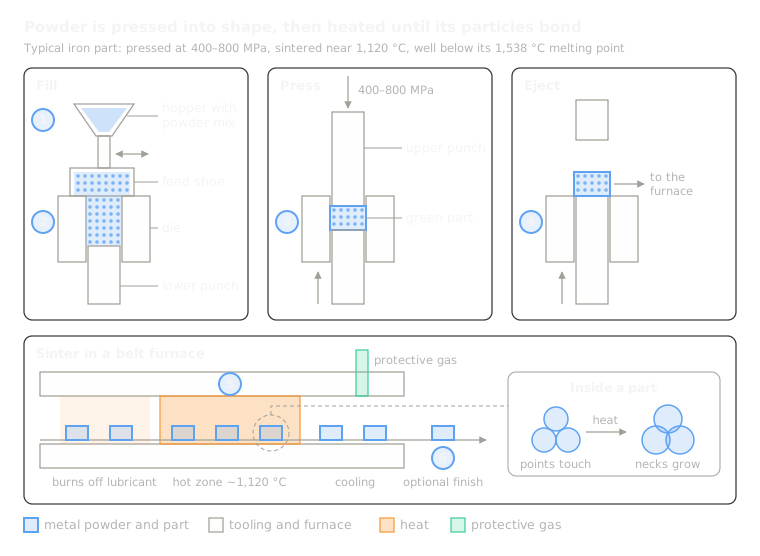 9.1Powder metallurgy (press and sinter)Press powder in a die, then sinter in a belt furnaceOpen the lesson
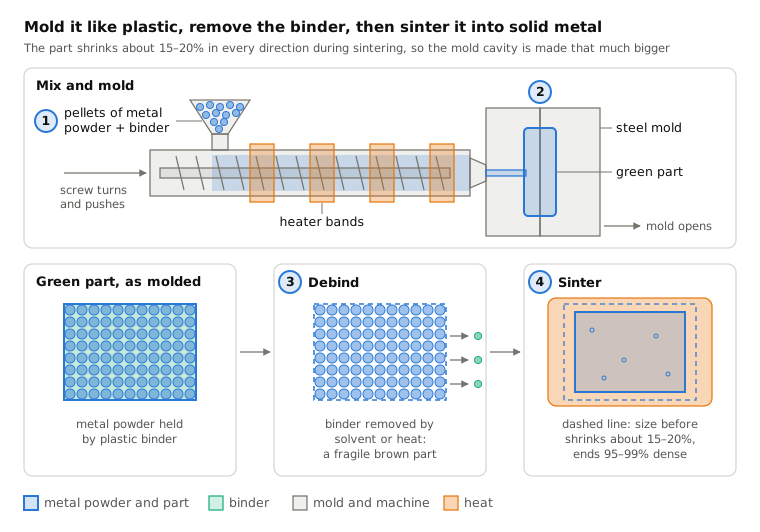
 9.2Metal injection molding (MIM)Mold a powder-and-binder paste, remove the binder, sinterOpen the lesson
 9.3Hot isostatic pressing (HIP)Squeeze with hot argon from all sides to close poresOpen the lesson
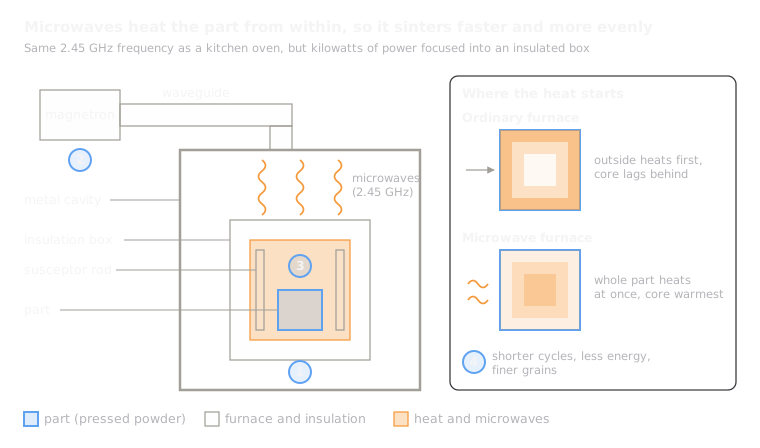 9.5Microwave sinteringMicrowaves heat the part from withinOpen the lesson
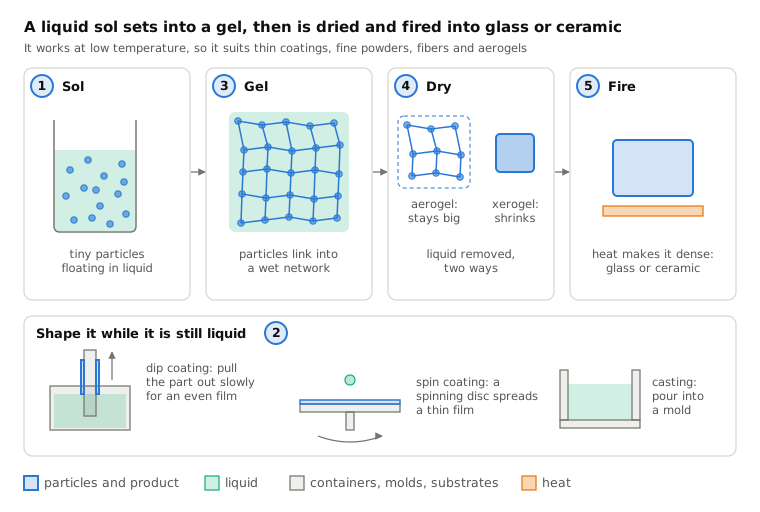
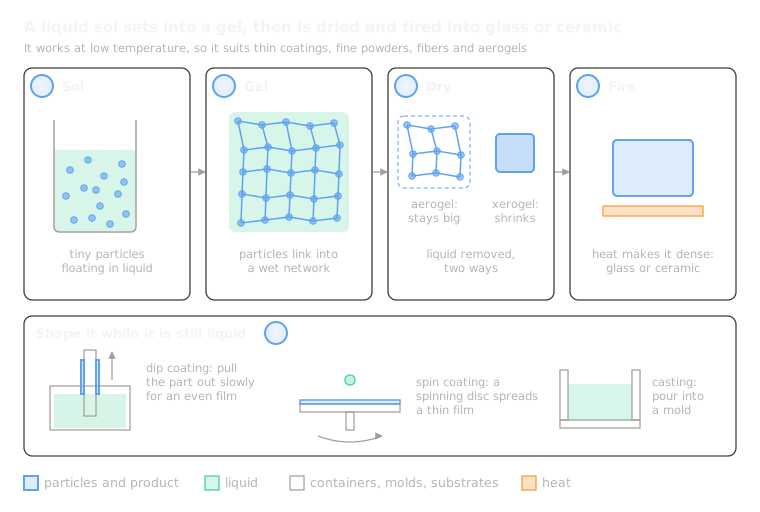 9.6Sol-gel processingA liquid sets into a gel, then is dried and firedOpen the lesson
Try it
Put AI to work in your CAD.
Model parts, generate drawings and automate the repetitive work inside your CAD software.