

Hot isostatic pressing (HIP)
Squeeze with hot argon from all sides to close pores
Hot isostatic pressing (HIP) puts finished or nearly finished parts in a pressure vessel and squeezes them with hot argon gas. The pressure pushes equally from every direction (“isostatic”), so hidden pores collapse and weld shut while the shape stays the same. Jet-engine turbine blades and 3D-printed titanium implants are routinely treated this way.
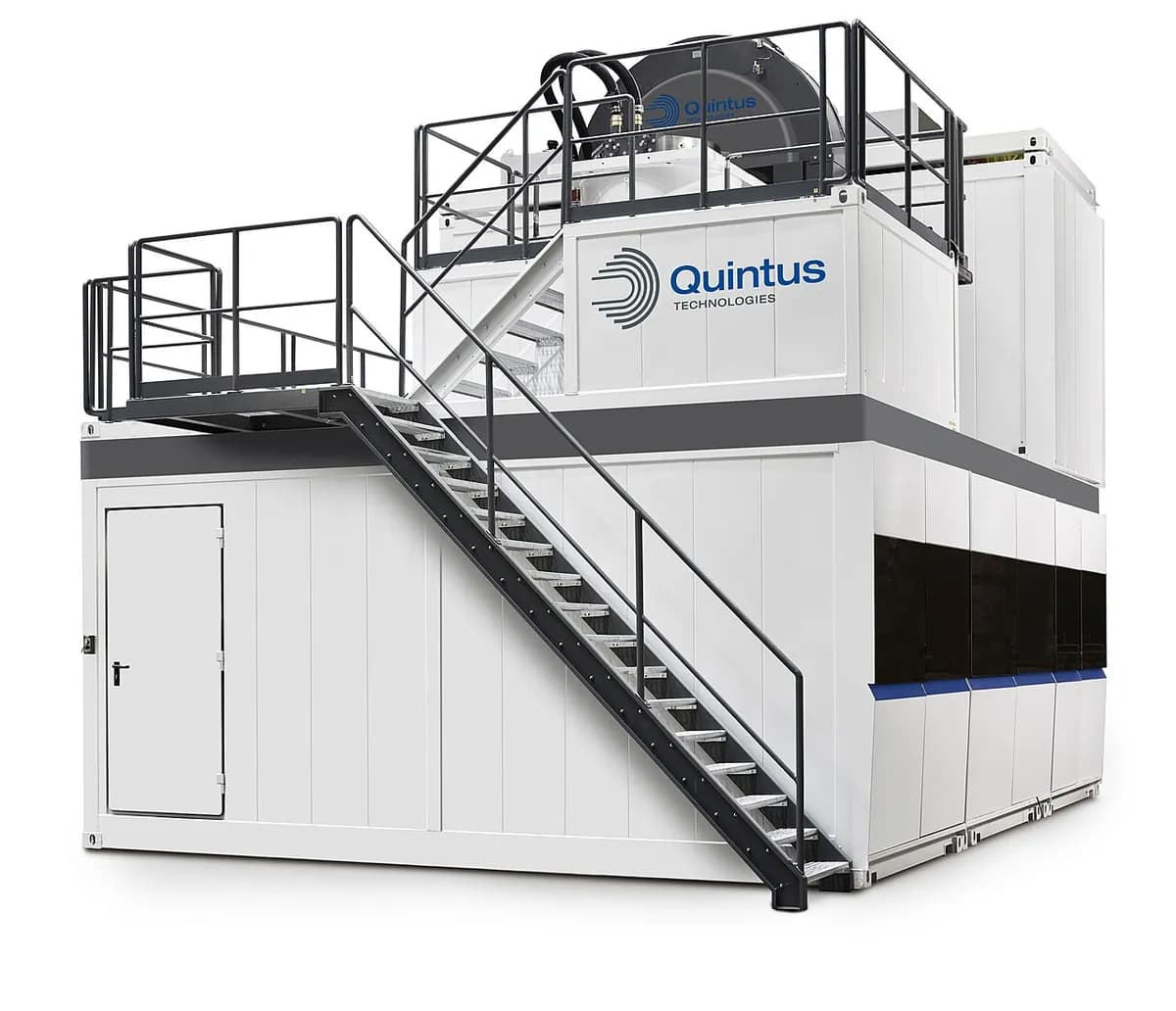
How it works
Load and seal. Parts go in on a fixture, and the vessel is closed with thick steel plugs; in big units a heavy frame holds the plugs in place. The load can be castings, 3D-printed parts, or metal powder sealed in a steel can.
Fill with argon. Air is pumped out, and a compressor pumps in argon, an inert gas that does not react with hot metal.
Heat and pressurize. A furnace inside a heat shield brings the parts to about 900–1,250 °C for steels, titanium and nickel alloys (around 500 °C for aluminum). Heating the trapped gas raises its pressure to typically 100–200 MPa, about 1,000–2,000 times atmospheric pressure.
Hold. For typically 2–4 hours, the hot metal is soft enough to creep (flow very slowly) into its pores. The pore walls touch and bond by diffusion (atoms drifting across), leaving solid metal. Pores open to the surface cannot close, because the gas gets into them.
Cool and unload. The furnace cools, the argon is recovered for reuse, and the parts come out with the same shape at essentially full density. Powder cans are then removed by machining or acid.
Key facts
- Materials
- Castings and 3D-printed parts in titanium, nickel alloys, steels and aluminum; metal powders in sealed cans; technical ceramics
- Typical parts
- Turbine blades, medical implants, valve bodies, tool-steel blocks, printed metal parts
- Part size
- From small implants to parts of several tonnes; the biggest vessels hold loads around 2 m across
- Precision
- Shape is kept; parts shrink only by their pore volume, usually a tiny fraction of a percent for castings
- Surface finish
- Left as it was: HIP does not touch the surface
- Batch size it suits
- Any: one part or a full furnace load, often run by specialist HIP service companies
- Tooling and machine cost
- No part-specific tooling; machines cost from hundreds of thousands of dollars (lab units) to many millions (production units)
- Speed
- One cycle typically takes 6–12 hours including heating and cooling; less in units with rapid cooling
Strengths and limits
Strengths
- Removes internal pores, reaching essentially 100% density
- Large gains in fatigue life (resistance to repeated loads) and reliability
- No part-specific tooling: any shape works if it fits the vessel
- Can turn powder into a solid part, or bond two metals together
Limits
- Cannot close pores that connect to the surface
- Long, costly cycles, usually an extra step after casting or printing
- Very expensive machines, so most companies use a service provider
- Powder cans add cost and must be machined or dissolved away
Where it's used
- AerospaceCast turbine blades and vanes, structural engine castings
- MedicalHip and knee implants in cast or 3D-printed titanium and cobalt-chrome
- Additive manufacturingStandard post-treatment for printed titanium and nickel-alloy parts
- Oil, gas and energyValve bodies, pump parts and manifolds made from powder by HIP
- ToolingPowder tool steels and high-speed steels with a fine, even structure
How to recognize it
- HIP leaves no visible mark: the part looks exactly like the casting or print it was.
- The proof is inside: a cut and polished section, or an X-ray, shows no pores.
- Large parts made from powder by HIP show machined surfaces all over, because the steel can was cut away; drawings and certificates often say “HIPed”.
Compare with
Watch it
Everyday Metallurgy · Why heat plus equal pressure closes internal pores
Quintus Technologies · The vessel, furnace and argon cycle, from a machine maker
Hiperbaric · An animation of one full heat, pressure and cooling cycle
TWI Ltd · How powder sealed in a can becomes a solid, near-final part
See real photos
- Wikipedia: Hot isostatic pressing — history, typical pressures, temperatures and uses; few photos
- Wikimedia Commons photo search
Remember
- HIP squeezes parts with hot argon from all sides at once, so the shape is kept.
- It closes internal pores, giving essentially full density and much longer fatigue life.
- It is a long, costly batch step, used where a part must not fail.
More in Powders and ceramics
All 100 processes
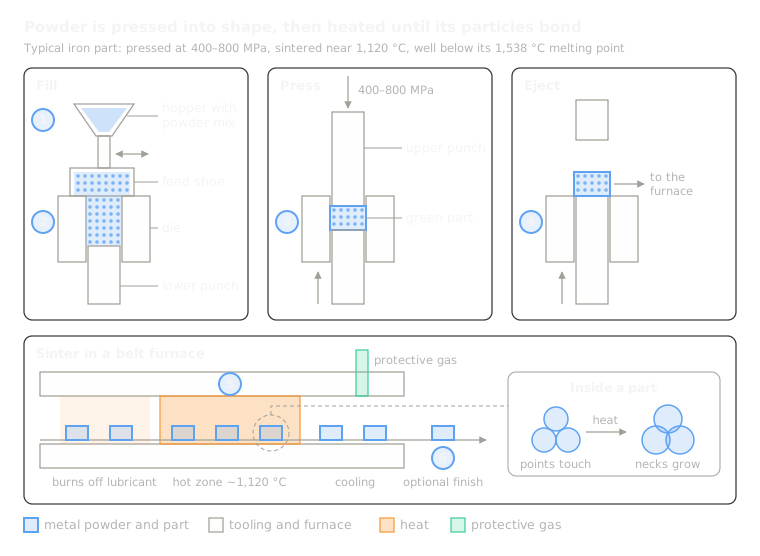 9.1Powder metallurgy (press and sinter)Press powder in a die, then sinter in a belt furnaceOpen the lesson
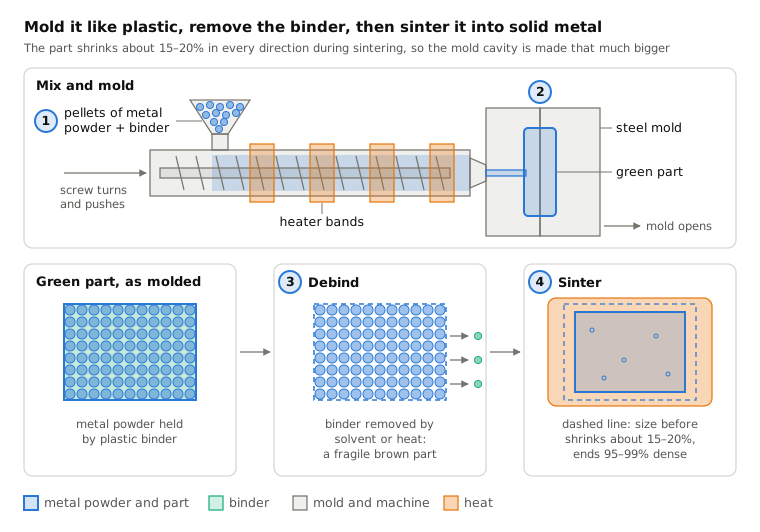
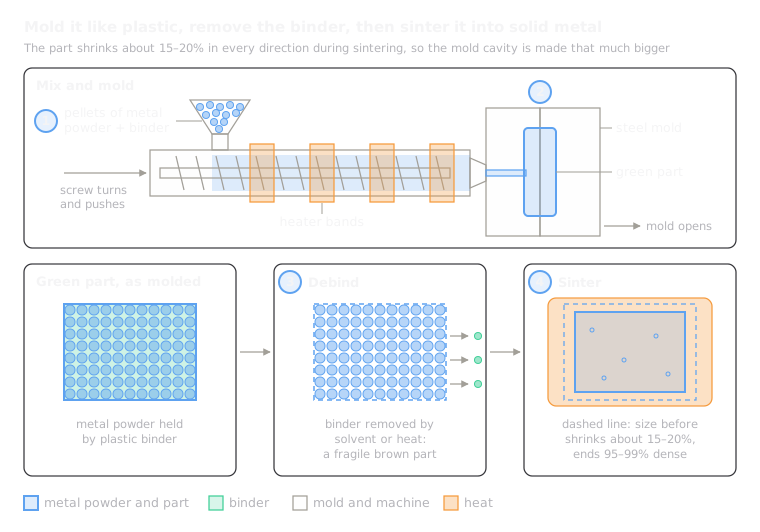 9.2Metal injection molding (MIM)Mold a powder-and-binder paste, remove the binder, sinterOpen the lesson
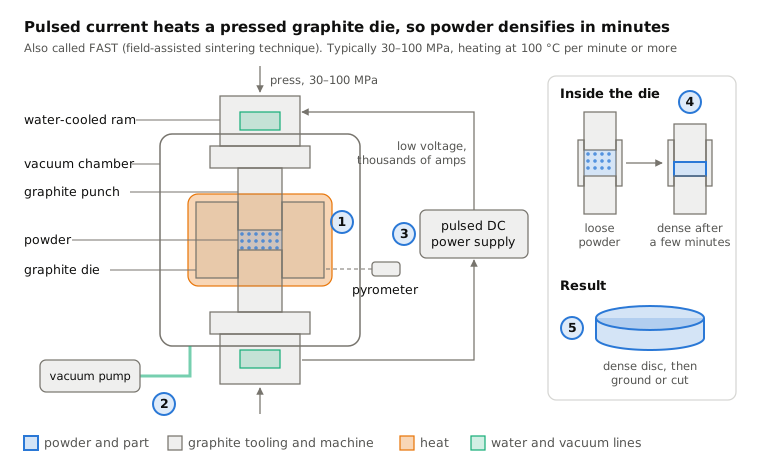
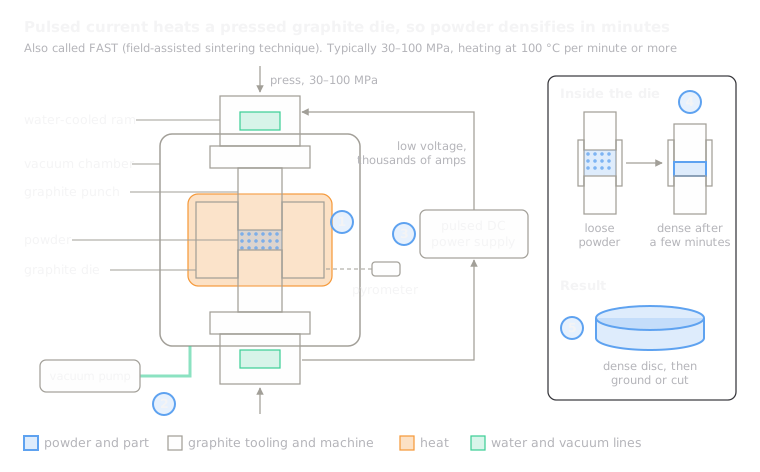 9.4Spark plasma sintering (SPS)Pulsed current heats a pressed graphite die in minutesOpen the lesson
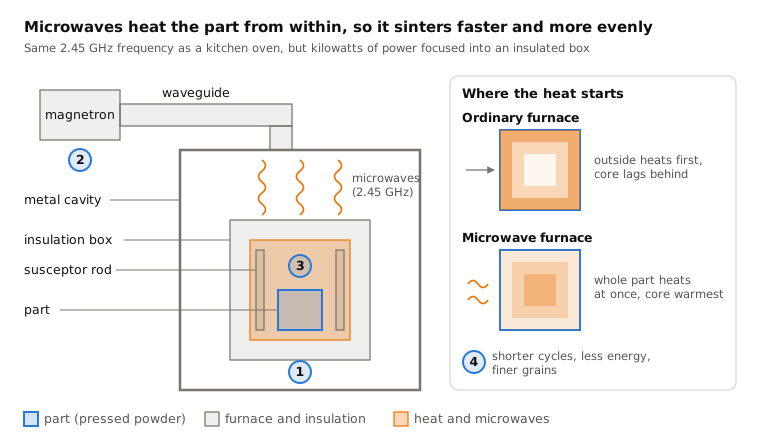
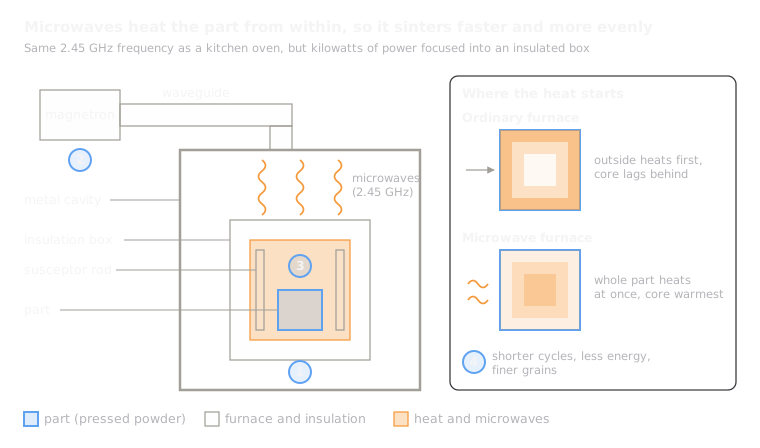 9.5Microwave sinteringMicrowaves heat the part from withinOpen the lesson
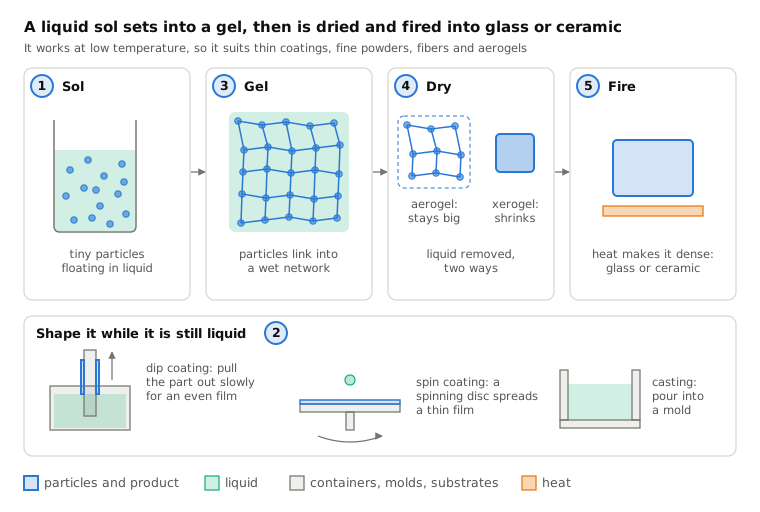
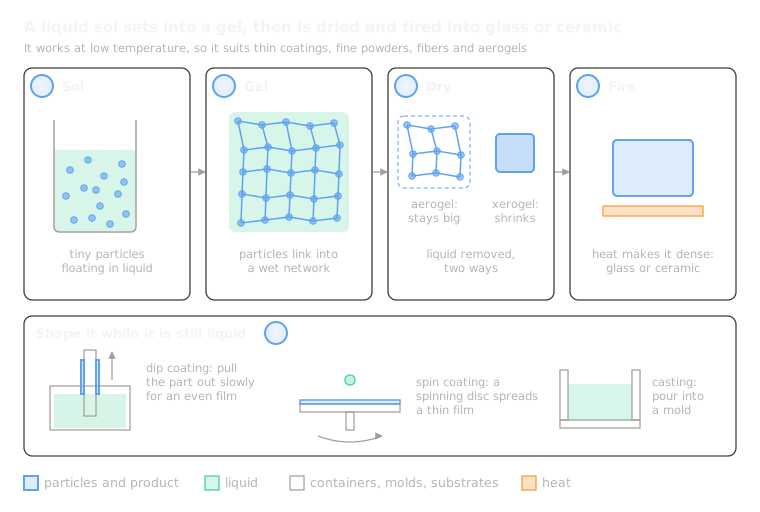 9.6Sol-gel processingA liquid sets into a gel, then is dried and firedOpen the lesson
Try it
Put AI to work in your CAD.
Model parts, generate drawings and automate the repetitive work inside your CAD software.