

Electroforming
Plating grown thick on a model, then lifted off
Electroforming grows a metal part atom by atom on a model, then takes the model away. It is electroplating (Electroplating) left running until the metal can stand on its own. Shaver foils and vinyl record stampers are made this way, because it copies detail finer than a micron (a thousandth of a millimeter).

How it works
Make the mandrel. The mandrel (the master shape the metal grows on) is machined, molded, 3D printed or etched. Its surface is the negative of the one you want.
Make its surface conductive. Plastic, wax or glass mandrels get a very thin conductive coat, such as silver paint or graphite. Metal mandrels get a release layer instead, so the copy can let go later.
Immerse and connect. The mandrel goes into an electrolyte (a bath of dissolved metal salts), facing an anode (the positive electrode, a nickel or copper plate). A DC power supply makes the mandrel the cathode (the negative electrode).
Grow the metal. The current pulls metal ions (electrically charged atoms) onto the mandrel, where they turn into solid metal. The anode slowly dissolves and refills the bath. The layer typically thickens by tens of microns per hour, so a part takes hours to days.
Separate the copy. The shell is peeled or lifted off, or the mandrel is melted or dissolved away. The copy is trimmed and finished; a reusable mandrel goes back in for the next one.
Key facts
- Materials
- Mostly nickel and copper, also gold, silver and iron; mandrels of metal, glass, silicon, plastic or wax
- Typical parts
- Thin shells, foils, fine meshes, seamless hollow parts, finely textured molds
- Part size
- From micro-parts under 1 mm to shells tens of centimeters across; walls from a few microns to several millimeters
- Precision
- Copies mandrel detail below 1 µm (a thousandth of a millimeter); wall thickness is less even, thicker on edges and corners
- Surface finish
- Inner side as smooth as the mandrel, mirror-like on a polished one; outer side matte and less defined
- Batch size it suits
- One-offs to medium series; one mandrel can make many copies
- Tooling and machine cost
- Low to moderate: hundreds of dollars for a hobby tank, typically tens of thousands and up for an industrial line; the long time in the bath is the main cost
- Speed
- Slow: typically tens of microns per hour, so a 1 mm wall takes about a day or more
Strengths and limits
Strengths
- Copies extremely fine detail, even optical-quality surfaces
- Makes thin, light, seamless shells and meshes
- Pure metal with a fine, strong grain
- One mandrel can make many identical copies
Limits
- Slow: thick parts take hours to days
- The copy must come off the mandrel, which limits shapes
- Outer surface less precise; metal builds up on edges and corners
- Needs careful bath chemistry, some of it hazardous
Where it's used
- Music and mediaVinyl record stampers, CD and DVD stampers
- Consumer productsElectric shaver foils, fine filters and sieves
- Printing and electronicsInkjet nozzle plates, rotary screen-printing screens, micro-molds
- Space and opticsX-ray telescope mirror shells, reflectors, waveguides
- AerospaceThin-wall nozzles, cooling jackets, bellows
- Jewelry and artLight hollow gold and silver pieces, metal-coated leaves
How to recognize it
- A thin metal part that copies a texture with startling sharpness, like the tiny holes of a shaver foil.
- A light, hollow piece with no seam, whose inside mirrors the shape of a model.
- Edges and corners slightly thicker or rounder than flat areas, from extra metal build-up.
- A leaf or shell turned into metal with every vein and ridge still visible.
Compare with
Watch it
Winovus · How nickel grows on a mandrel, then is separated
Well Made Music · How a record master becomes nickel stampers
Guild's Garage · A small workshop setup: conductive paint, bath, power supply
Electroforming Artist · A real leaf painted, plated and turned into copper
See real photos
- Wikipedia: Electroforming — principle, mandrels and uses; mostly text, few photos
- Wikimedia Commons photo search
Remember
- Electroforming is electroplating a model until the metal stands alone, then removing the model.
- It copies detail finer than a micron, but grows only tens of microns per hour.
- Shaver foils, record stampers and X-ray mirror shells are electroformed.
More in Coatings and surface finishing
All 100 processes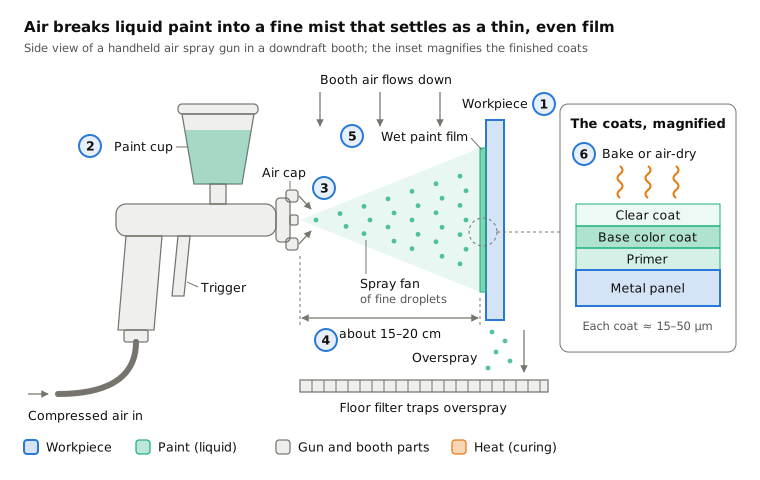
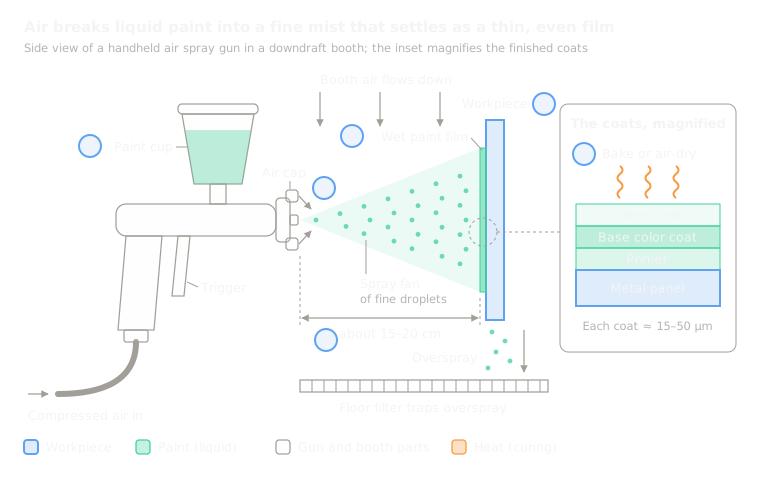 11.1Spray paintingLiquid paint atomized into a fine mist that dries or curesOpen the lesson
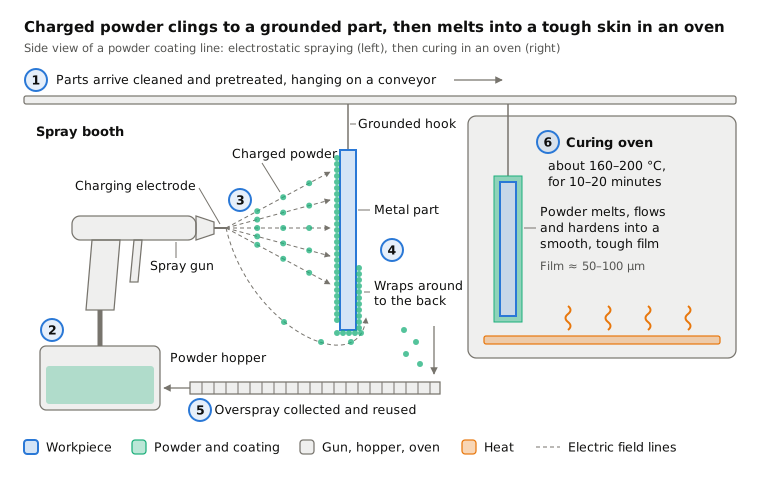
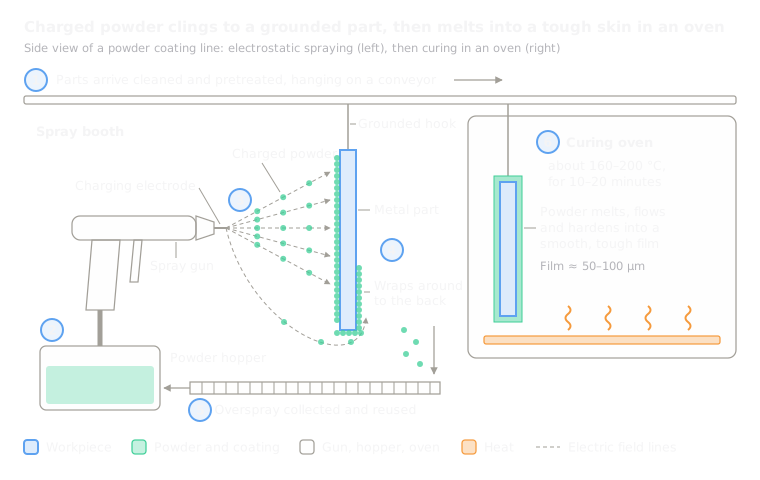 11.2Powder coatingCharged dry powder clings to the part, then melts in an ovenOpen the lesson
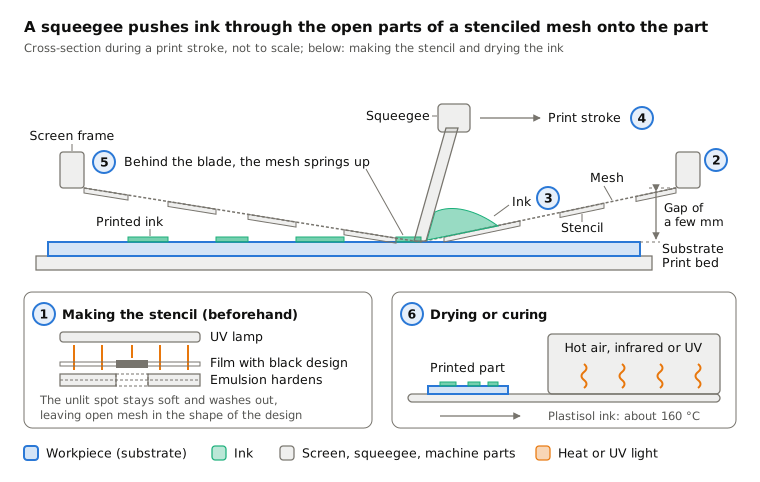
 11.3Screen printingInk pushed through a mesh stencilOpen the lesson
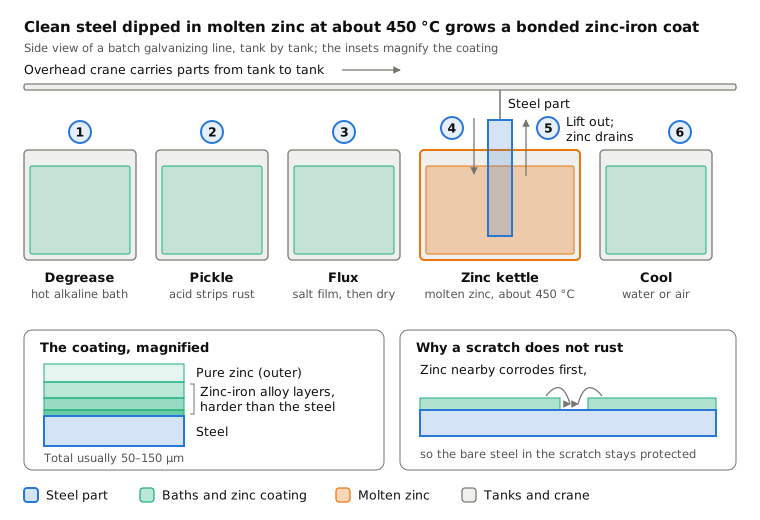
 11.4Hot-dip galvanizingSteel dipped in molten zinc forms a bonded zinc layerOpen the lesson
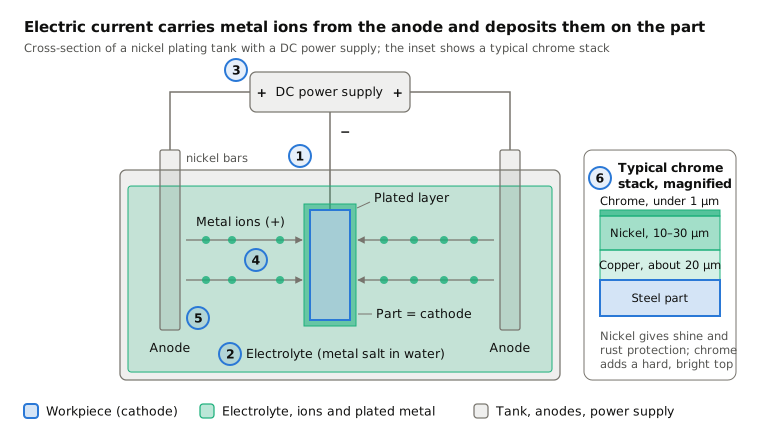
 11.5Electroplating (chrome, nickel, zinc)Electric current deposits metal from a bathOpen the lesson
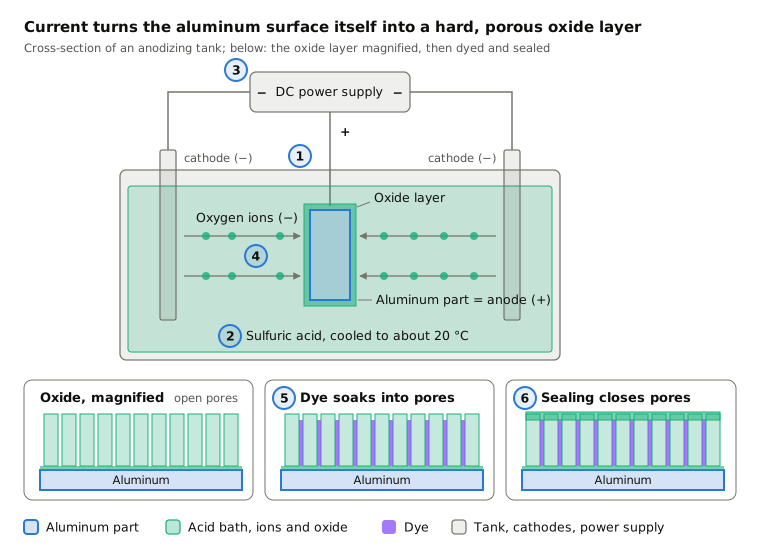
 11.6AnodizingCurrent grows a hard oxide out of aluminum itselfOpen the lesson
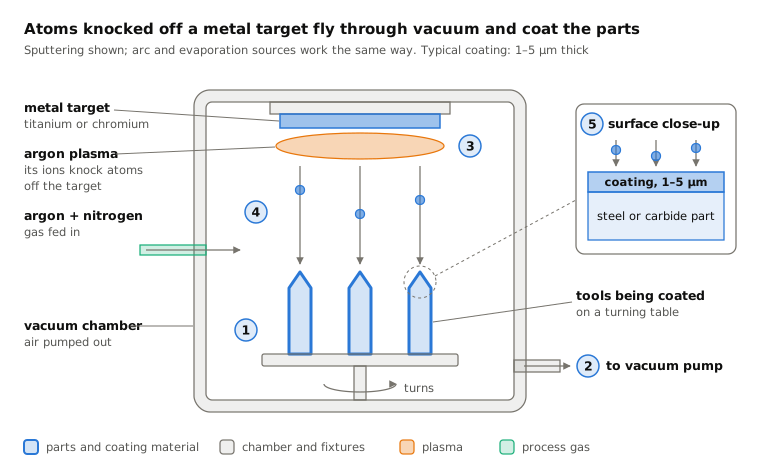
 11.8PVD coating (thin films in vacuum)Atoms knocked off a target coat parts in vacuumOpen the lesson
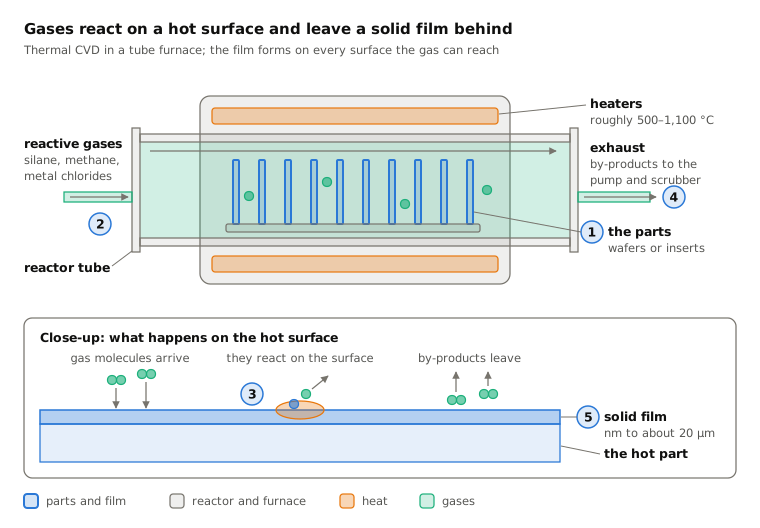
 11.9CVD coatingGases react on a hot surface and leave a filmOpen the lesson
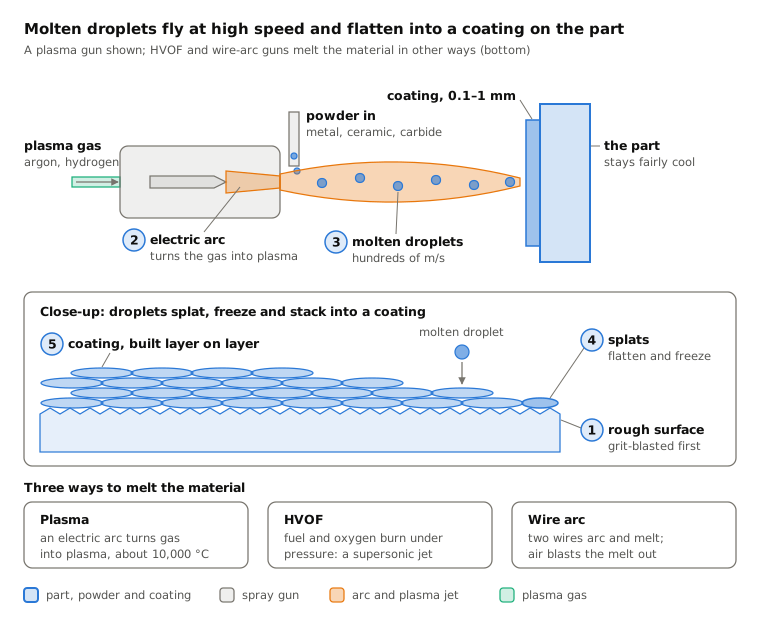
 11.10Thermal spraying (plasma, HVOF, arc)Melted droplets fired at a part stack into a layerOpen the lesson
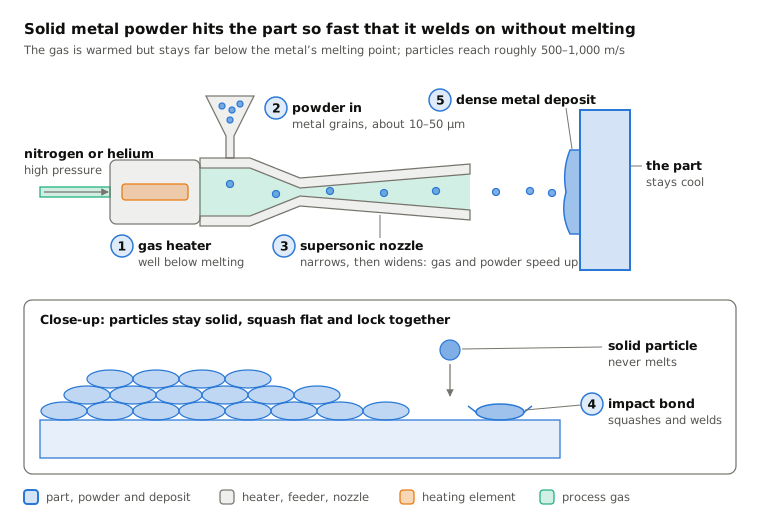
 11.11Cold spraySolid metal grains weld on by sheer speedOpen the lesson
Try it
Put AI to work in your CAD.
Model parts, generate drawings and automate the repetitive work inside your CAD software.