

Electrospinning
Pulls a polymer jet into nanofibers with high voltage
Electrospinning uses a high voltage to pull a polymer solution into fibers hundreds of times thinner than a hair. The fibers pile up as a light, airy web called a nanofiber mat. Such mats boost air filters and face masks, and serve as scaffolds for growing tissue.
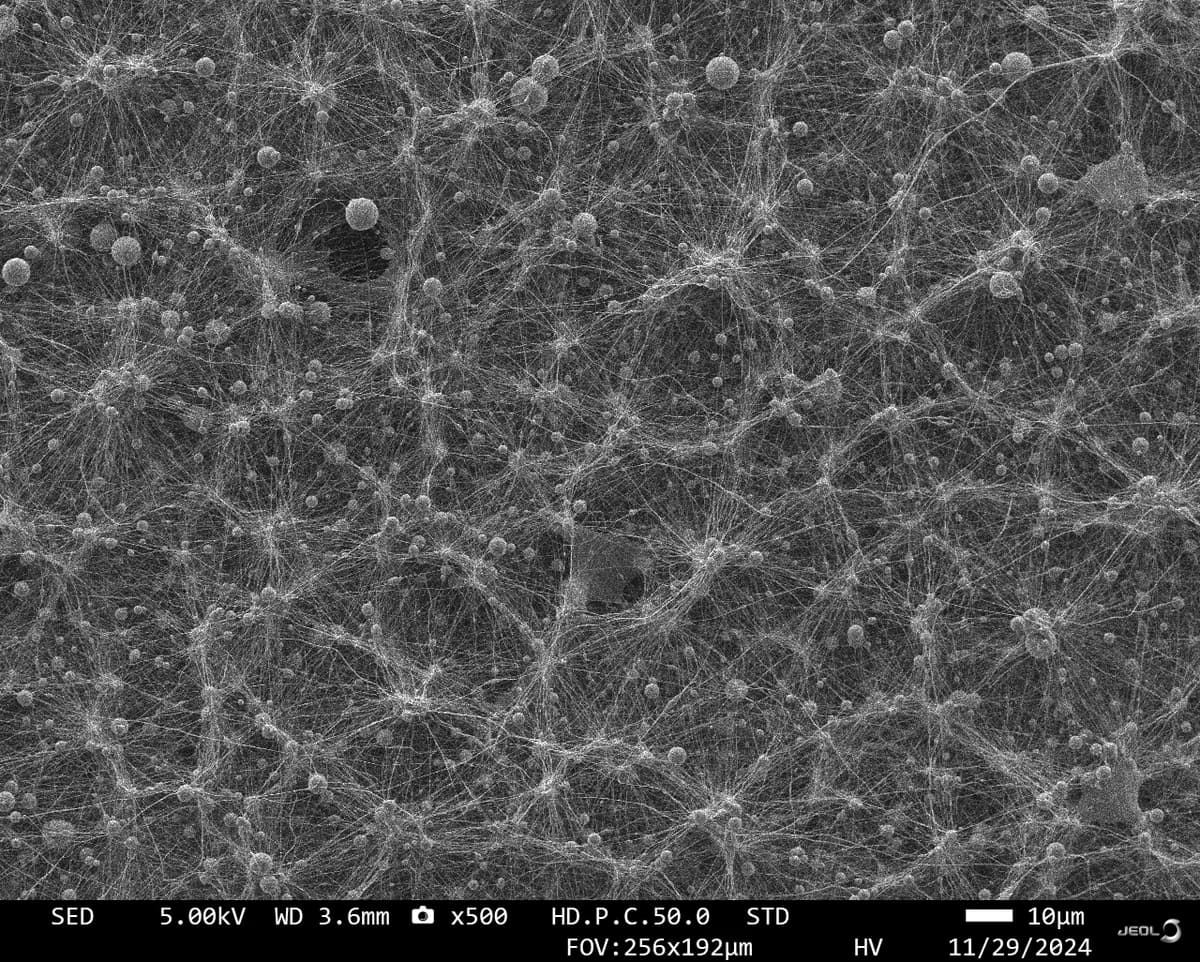
How it works
Prepare the solution. A polymer is dissolved in a solvent, or melted, to the right viscosity (how thick and slow-flowing a liquid is).
Feed a droplet. A syringe pump pushes the solution slowly to the tip of a metal needle, where a droplet hangs.
Apply high voltage. A supply of typically 5 to 50 kilovolts charges the droplet. Electric forces overcome surface tension and pull the drop into a point called a Taylor cone.
Jet and whip. A fine jet shoots from the cone tip, then spirals and whips wildly. It stretches thousands of times while the solvent evaporates.
Collect the fibers. Dry fibers land on a grounded collector: a flat plate for a random web, a fast-spinning drum for aligned fibers, or a moving fabric in a factory. The mat is then peeled off, laminated onto a support or sterilized for medical use.
Key facts
- Materials
- Polymer solutions or melts: nylon, polyester (PET), PVDF, PAN, biodegradable PCL, PVA, collagen, cellulose acetate; also ceramic precursors
- Typical parts
- Nonwoven (felt-like, not woven) fiber mats, filter layers on fabrics, tubes, aligned yarns
- Part size
- Fibers from tens of nanometers to a few microns thick; mats from lab samples to industrial rolls meters wide
- Precision
- No dimensional tolerance as such: the recipe and settings control fiber diameter and its spread
- Surface finish
- Soft, felt-like web with a huge surface area and fine pores that trap sub-micron particles
- Batch size it suits
- Lab grams to roll-to-roll production lines meters wide
- Tooling and machine cost
- Lab set-up from a few thousand dollars; industrial lines much more
- Speed
- A single needle makes well under a gram of fiber per hour; needleless factory lines coat fabric continuously
Strengths and limits
Strengths
- Ultra-fine fibers with a huge surface area
- Simple, low-cost lab set-up
- Huge choice of polymers, blends and additives (drugs, particles)
- Mimics the fiber network around body cells, which helps cells grow
Limits
- Low output from single needles
- Many recipes use toxic or flammable solvents
- Fiber size drifts with humidity, voltage and distance
- Weak mats usually need a support layer; high-voltage safety rules apply
Where it's used
- FiltrationNanofiber layers in building ventilation, engine air and face-mask filters
- MedicalWound dressings, tissue-engineering scaffolds, vascular grafts, drug-release patches
- EnergyBattery separators, fuel-cell membranes
- TextilesBreathable waterproof membranes, protective clothing
- CosmeticsNanofiber face masks and patches
- ResearchSensors, catalysts, ceramic nanofibers
How to recognize it
- Single fibers are invisible to the eye; only the web shows, as a whisper-thin white or translucent film.
- Look at some high-efficiency air, vacuum or engine filters: a delicate coating on a coarser fabric that seems too light to work.
- Under an electron microscope the web looks like tangled spaghetti, with strands of nearly the same thickness.
- Medical versions end up on wounds or inside the body, as dressings and scaffolds that may slowly dissolve.
Compare with
Watch it
Hosein Rostamani · A simple lab walkthrough from solution to fiber mat
Inovenso Ltd. Electrospinning Company · Close-up of the Taylor cone and jet at one nozzle
ELMARCO · Industrial needleless jets rising from a rotating drum
Foshan MBRT Nanofiberlabs Co.,Ltd · An overview of nanofiber products and uses
See real photos
- Wikipedia: Electrospinning — electron micrograph of nanofibers, set-up diagrams and a parameter table
- Wikimedia Commons photo search
Remember
- Electric force does the stretching: drop, cone, whipping jet, dry fiber.
- Fibers are tens of nanometers to a few microns thick, and the web has a huge surface area.
- Single needles are slow; factories use needleless lines to coat filter fabrics.
More in Micro- and nanofabrication
All 100 processes
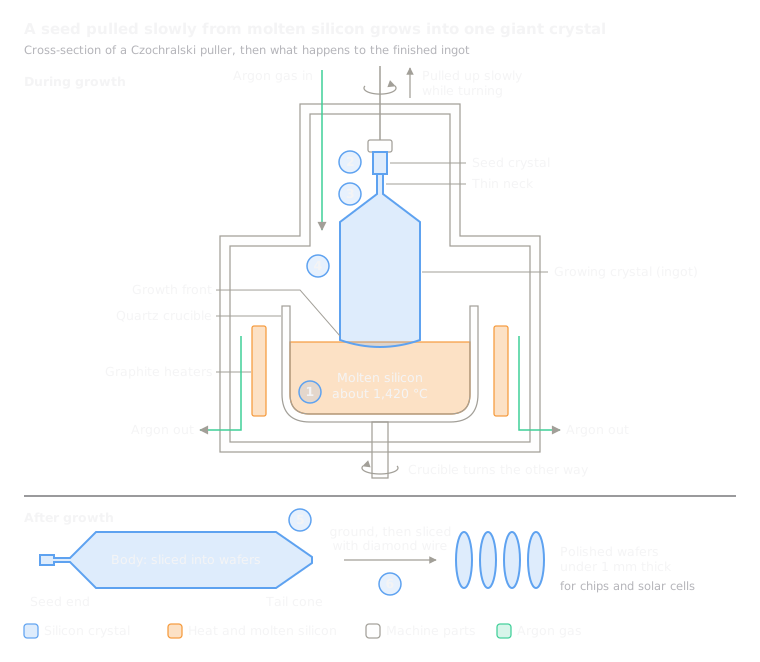 13.1Czochralski crystal growth (silicon wafers)Pulls a giant single crystal of silicon slowly out of a meltOpen the lesson
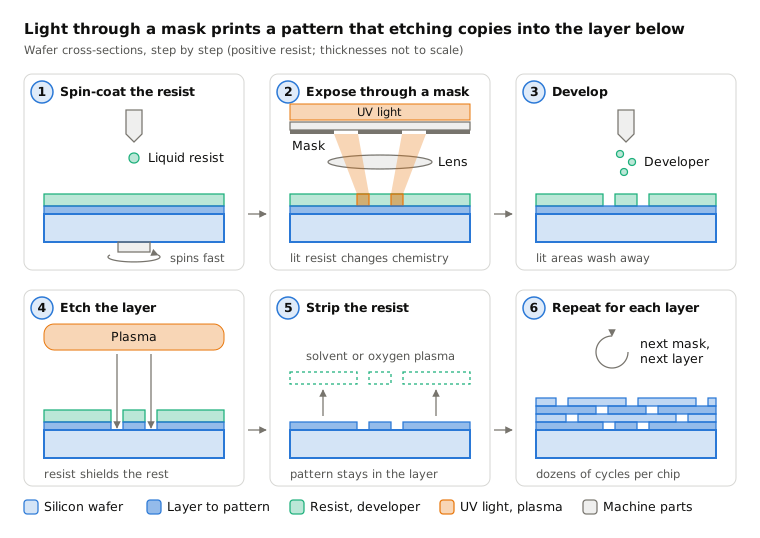
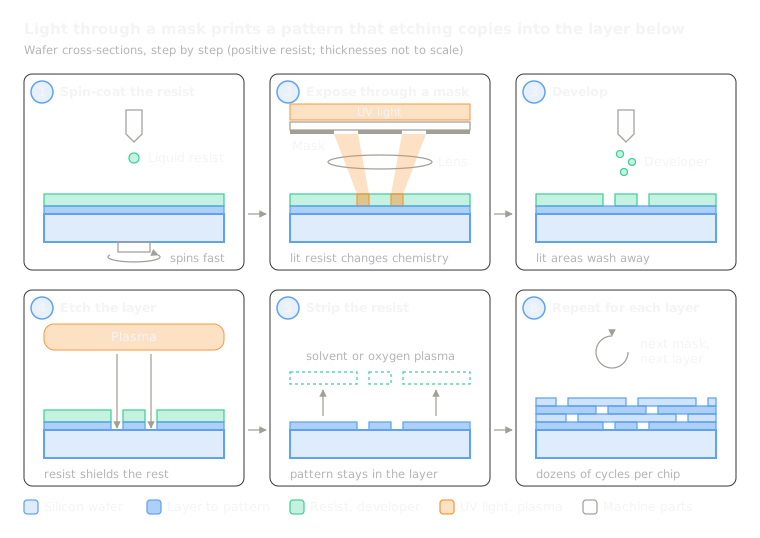 13.2PhotolithographyProjects a pattern with light onto a light-sensitive coating, then etches itOpen the lesson
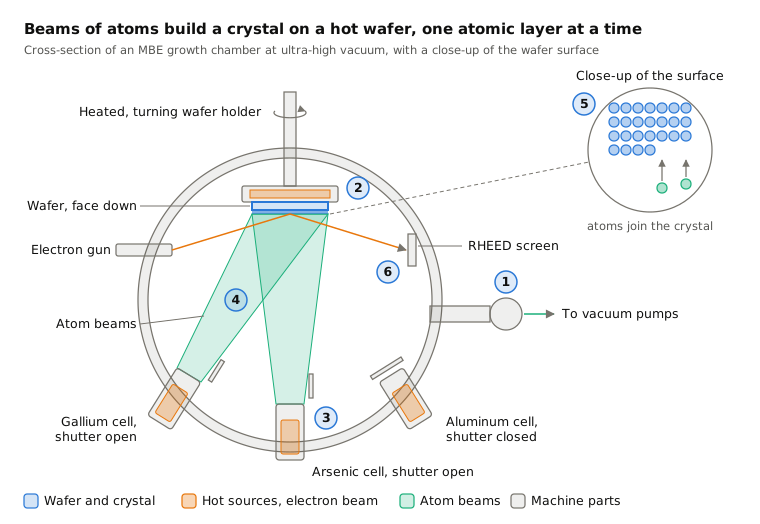
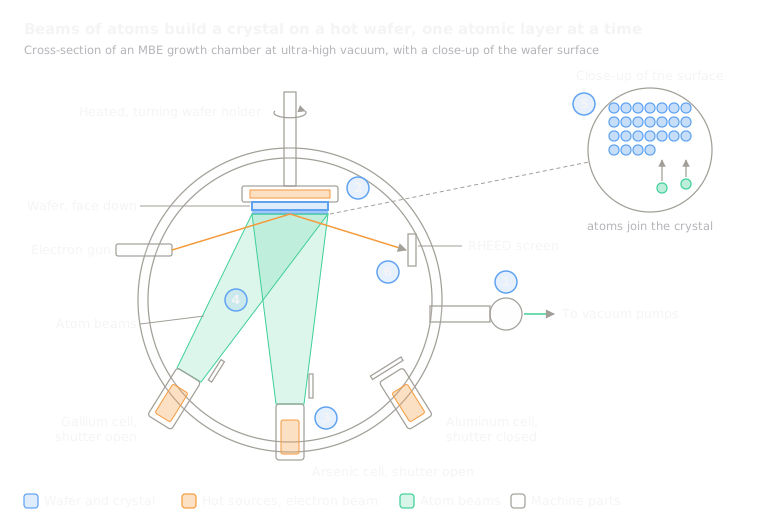 13.3Molecular beam epitaxy (MBE)Grows a crystal one atomic layer at a time from beams in ultra-high vacuumOpen the lesson
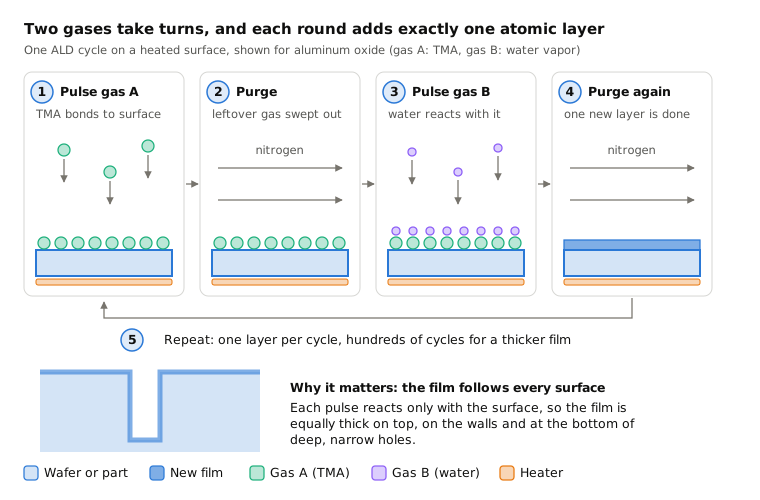
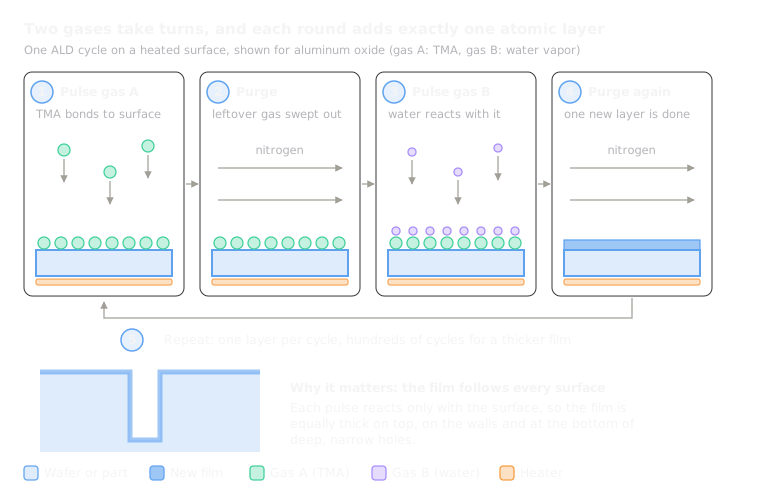 13.4Atomic layer deposition (ALD)Coats a surface one atomic layer per cycle with alternating gasesOpen the lesson
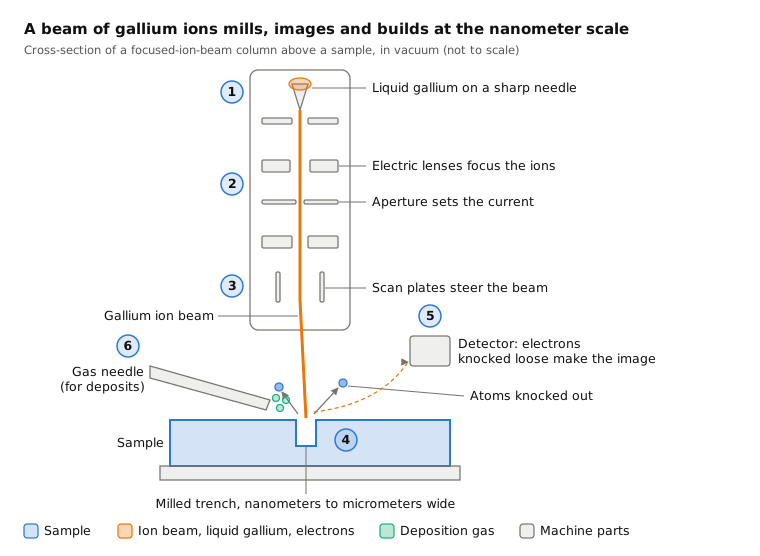
 13.5Focused ion beam (FIB)Mills or adds material with a beam of ions under a microscopeOpen the lesson
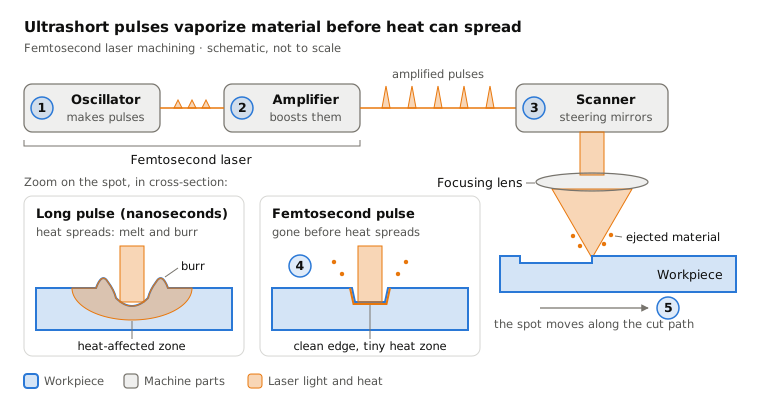
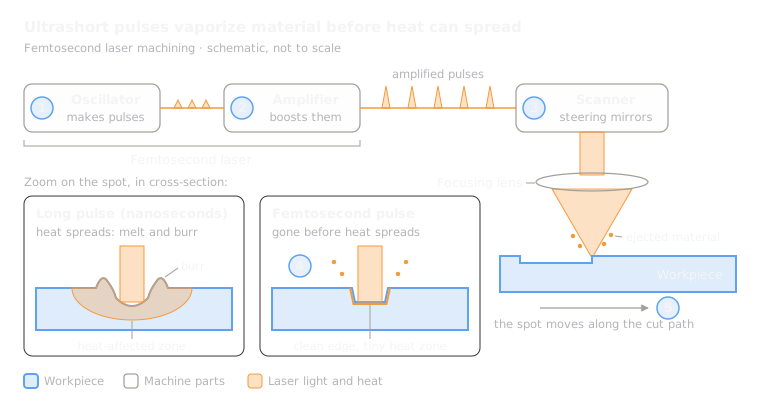 13.6Femtosecond laser machiningRemoves material with ultrashort laser pulses, without meltingOpen the lesson
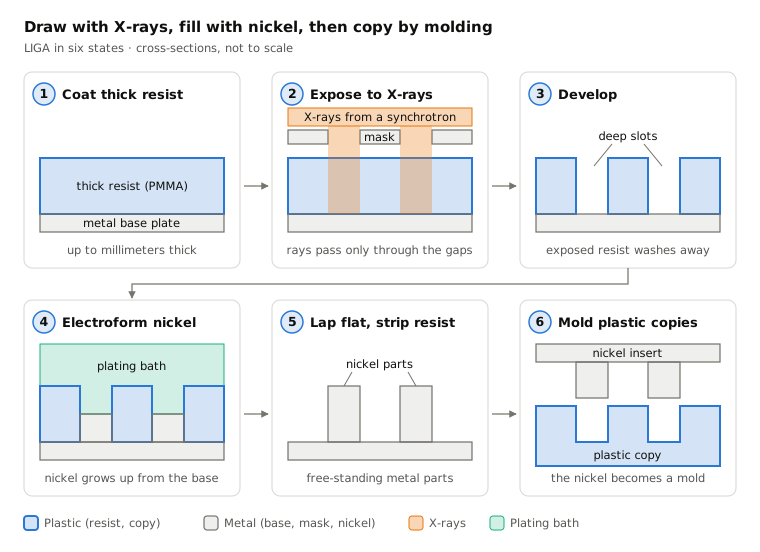
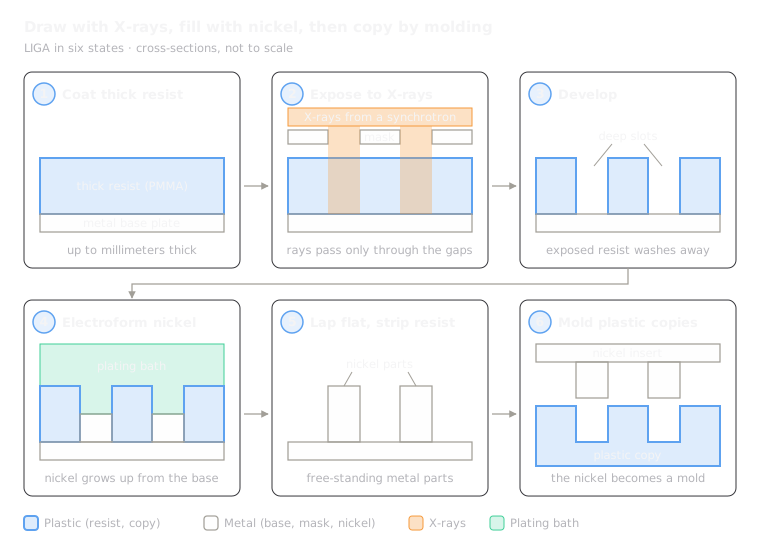 13.7LIGADraws deep slots with X-rays or UV, fills them with nickel, then molds copiesOpen the lesson
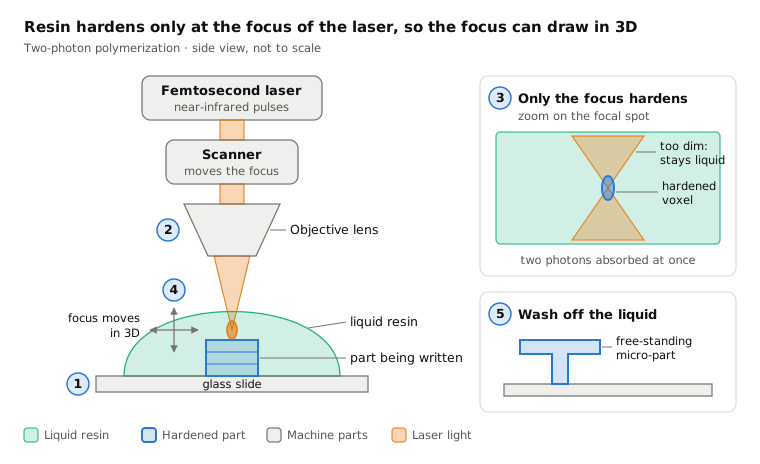
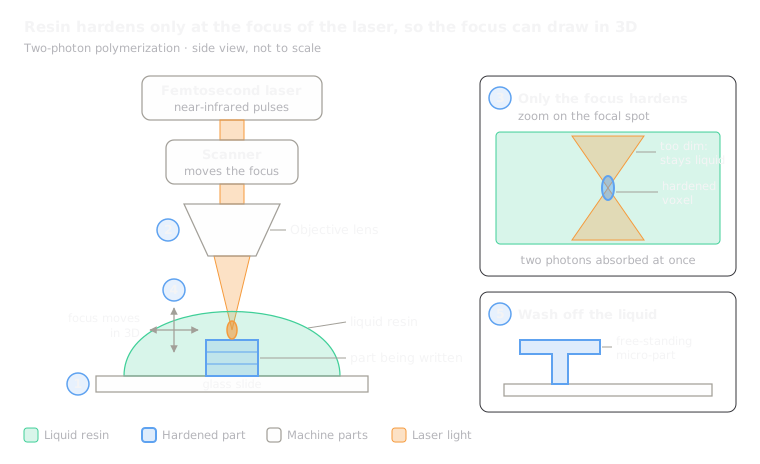 13.8Two-photon polymerizationHardens resin only at a laser focus to print 3D micro-partsOpen the lesson
Try it
Put AI to work in your CAD.
Model parts, generate drawings and automate the repetitive work inside your CAD software.